I Kingma State · Chapter VI
Sold for demolition
1864
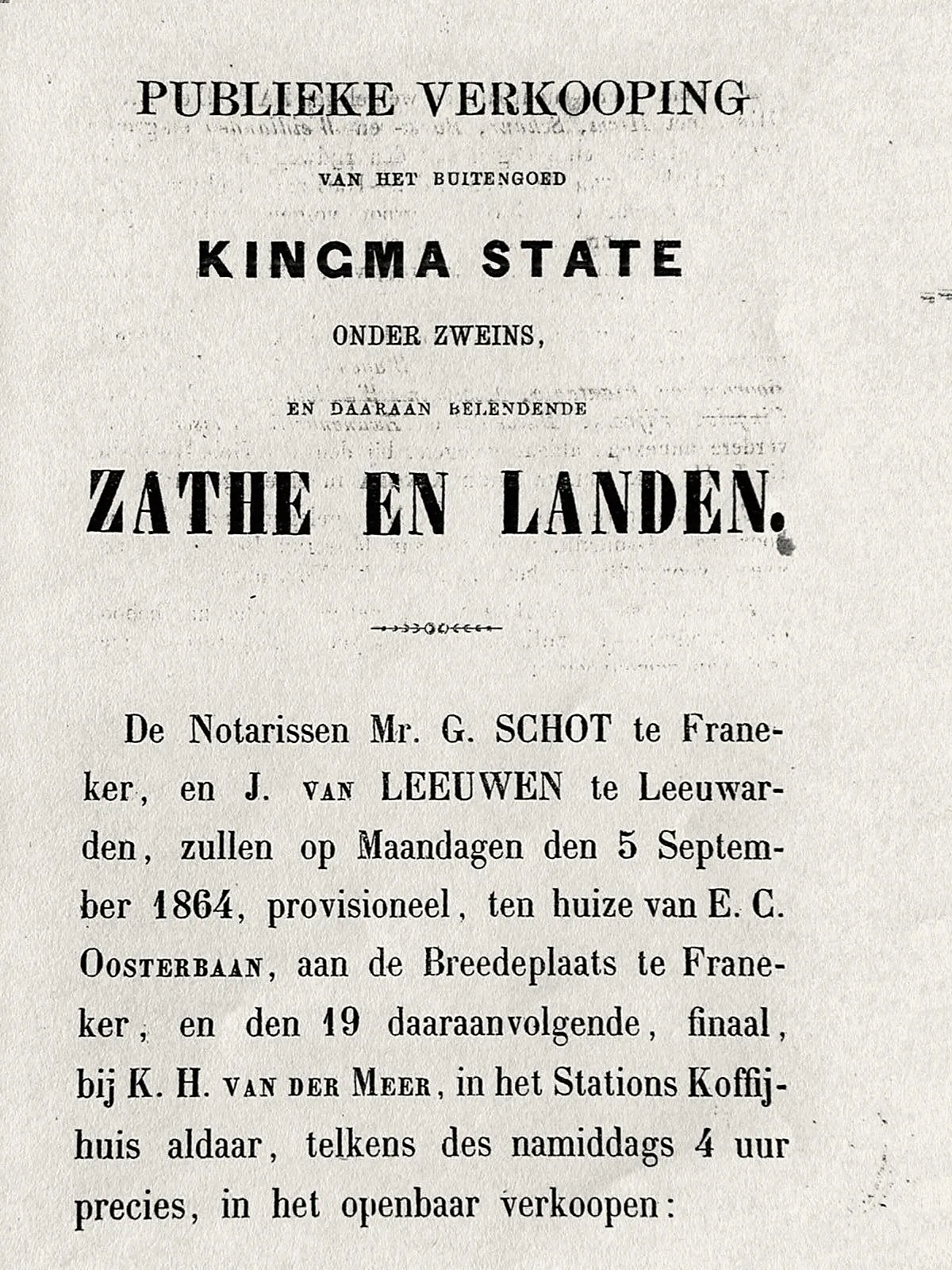
On 5 and 19 September 1864 the public sale took place of “Het buitengoed KINGMA STATE, met deszelfs roijaal Woonhuis, Stalling, Wagenhuis en Woningen, Boomen en Plantagie, Moestuin, Wandeldreven, Lanen en Cingels, Vijvers, Duiventil en Zwanendrift, Visscherij en verdere annexen, aldaar gelegen, bij den HWGeb. Heer Jhr. U. J. H. van Beijma thoe Kingma in eigen gebruik” (the Kingma State estate, with its stately house, stables, coach house and dwellings, trees and plantings, vegetable garden, walks, lanes and tree belts, ponds, dovecote and swan rights, fishing rights and further appurtenances, located there and used by the owner himself, the Honourable Jhr. U. J. H. van Beijma thoe Kingma). The ‘Zathe’ (farm) Vaartzigt and several meadows also belonged to the state.
The advertisement announcing the sale of the Kingma State estate gives the names of the notaries G. Schot and J. van Leeuwen and the dates of the provisional and the final auction.
At the provisional auction, bids are made on the goods for sale. At the final auction the goods are awarded to the highest bidder, who then declares that he accepts them.
The provisional notice to the registry office of 31 August 1864 states that the sales take place at the request of the owner Jhr. Ulbo Jetze Heerma van Beijma thoe Kingma, mayor of Franekeradeel, living in Franeker. It also states that the Kingma State estate is “bij afbraak te verkoopen” (to be sold for demolition).
On Monday 5 September 1864 at three in the afternoon, the buildings on the Kingma State estate at Zweins are provisionally put up for sale for demolition. This is the provisional auction of the buildings on the estate.
All kinds of conditions are attached to the sale of the buildings. The following are interesting: “Het wapen boven de deur behoudt de verkooper aan zich en wordt alzoo niet mede verkocht” (the seller keeps the coat of arms above the door, so it is not included in the sale)
and “De kooper zal kunnen beginnen af te breken met de gehele huizing op den eersten october deses jaars en met de stalling en arbeiderswoning op den twaalfden november mede van dit jaar, terwijl alles moet zijn weggevoerd op den vijfden maart van het volgende jaar” (the buyer may begin demolishing the whole house on the first of October of this year and the stables and labourer’s cottage on the twelfth of November of this year, while everything must have been removed by the fifth of March of next year).
The highest bid comes from Hette Brouwer, a carpenter living in Lekkum: 2,586 guilders.
The witnesses are Jackele Feddes Weidema, innkeeper, living in Tzummarum, and Hendrik Jaarsma, shoemaker, living in Franeker.
The seller signs the deed with “Heerma van Beijma thoe Kingma”. Hette Brouwer is now the provisional buyer of the buildings.
At four o’clock that afternoon the remaining twenty-three so-called ‘percelen’ (lots) are auctioned provisionally. They include several pieces of pasture and arable land, most of them right next to the state, and also a house with barn, stable and hornleger (farmyard) close to the bridge of Kingmatille. But also the ground on which the state stands, the garden, the terp, the driveway with its koepel (garden pavilion, the ‘tea house’) and the access canal.
Fourteen days later, on 19 September at three in the afternoon, the second, final auction is held in the station coffee house of innkeeper Van der Meer in Franeker, where the buildings of the state can be bid on again. The property is then awarded to the highest bidder, who has to declare that he accepts it.
Hermanus Kuilenberg, contractor, and Gerhard Henri Hillebrand, cabinetmaker, both living in Leeuwarden, have meanwhile raised the bid to 2,686 guilders, exactly 100 guilders more than Hette Brouwer bid on 5 September. In 2002 De Kinkhoorn converted that sum with the price index of De Nederlandsche Bank to some 42,600 guilders at 2001 prices, about 19,000 euros (De Kinkhoorn 6). No higher bid is made, so the two men may call themselves the owners of the state, to be demolished.
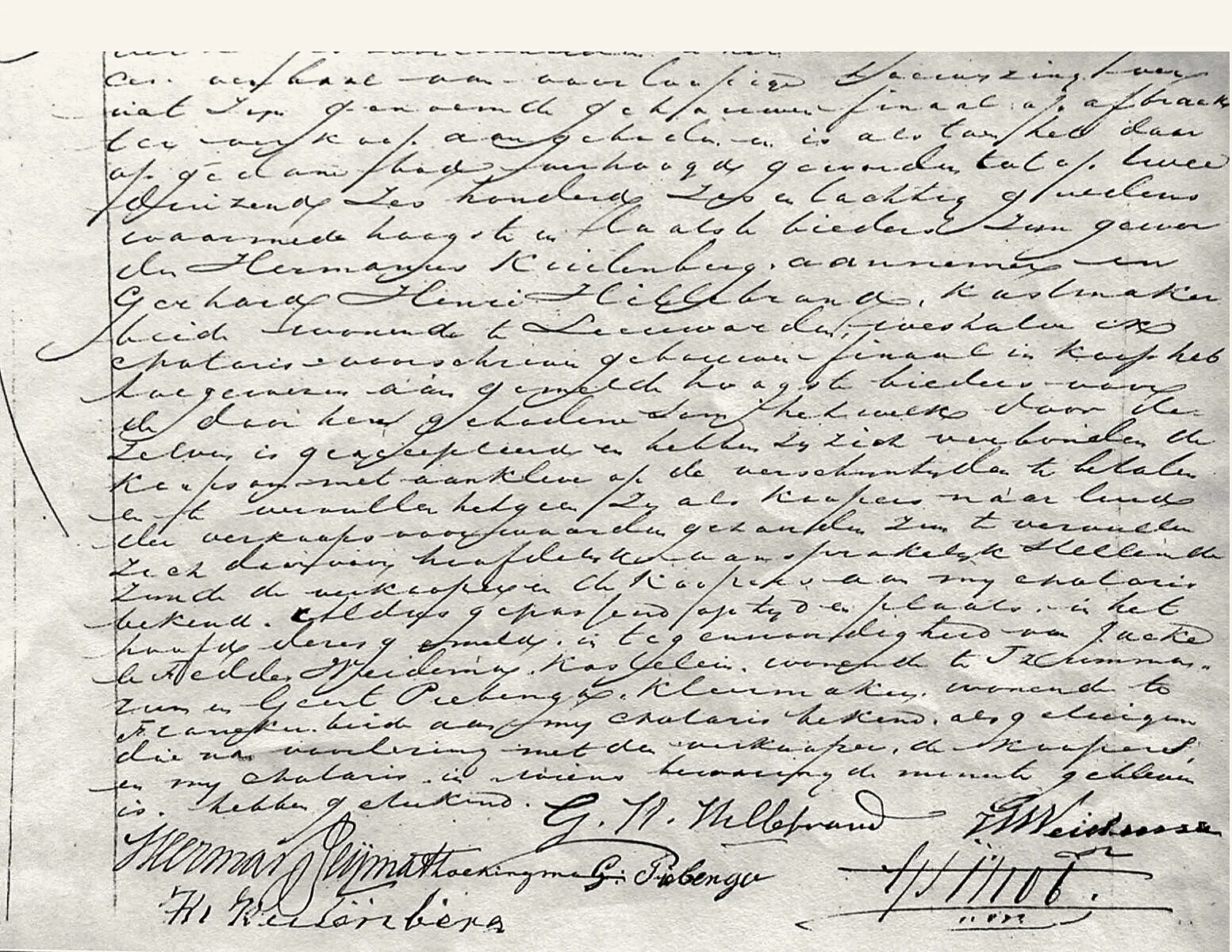
The advertisement for the final auction also gave the bid on the grounds of the state: 4,856 guilders. The buyer of the grounds could then take over the buildings for the demolition bid plus ten per cent: “De kooper van de Gronden van Kingma-State heeft daarna het regt dezelve met eene verhooging van 10 % van de op afbraak gebodene sommen te benaderen” (the buyer of the grounds of Kingma State then has the right to claim them for the sums bid for demolition plus 10%) (Joost Kingma, Ruiter voor de Republiek, 2022, chapter 7).
At four o’clock the same afternoon the second auction of the remaining lots begins.