
I Kingma State · Chapter II
Growth of the landholding
1611–1700
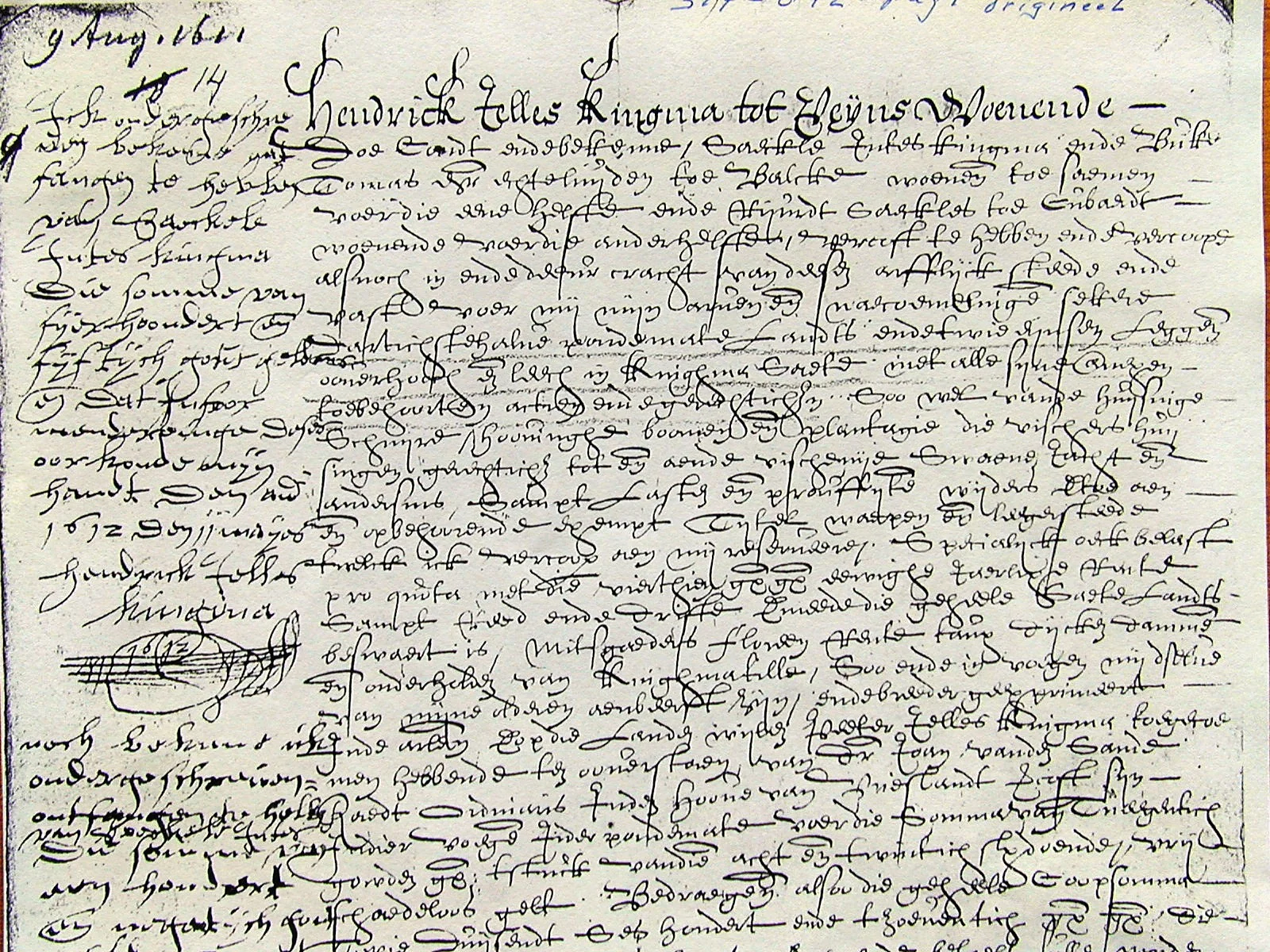
The Kingma State archive holds many deeds of sale of Jelle Pieters Kingum, the grandson of the first Jelle, and of Hendrik and Saeckle Kingma. They were very active in buying land: Jelle Pieters Kingum appears in deeds of 1571, 1579 and 1580; Hendrik Jelles Kingma bought land in Peins in 1612, 1620 (3x), 1621, 1622 and 1624; and Saeckle Intes was active in 1630, 1633, 1635, 1637 and 1642.
With these purchases they increased the size, and with it the status, of the estate, which from then on was called a ‘state’. When that name came into use is not known exactly; the inventory of the family archive already speaks of ‘Kingumastate’ for a purchase of 1579.
In 1611 Saeckle Intes Kingma bought the state from his uncle Hendrick, together with another uncle (for more family history and the family tree, see the Genealogy section).
In the deed of 9 August 1611, Hendrik Jelles declares that he has sold Kingma State, one half to Saeckle Intes Kingma (c. 1584-1652) and his wife Bucke Thomas dr. (1593-1626), who at that time lived in Balk, and the other half to Ruurd Saeckles from Kubaard. Hendrik Jelles and Ruurd Saeckles were uncles of Saeckle Intes.
What was sold was “Dartichsthalve pondemate Landts” (29½ pondemaat of land, almost 11 hectares) in Kingma Sate, with everything that belonged to it: “de huysinge, schuyre, hoovinge, boomen en plantagie” (the house, the barn, the gardens, the trees and the plantings), the fishermen's houses with the right to fishing and swan hunting, and the charges and the income that belonged to it. Excluded were the title, the coat of arms and the burial place: “exempt Tytel, waepen ende legerstede, twelck ick vercooper aen mij reservere” (except the title, the coat of arms and the burial place, which I, the seller, keep for myself). The charges did go with the sale: the property remained “specialyck oock belast” (specifically also burdened) with its share of an annual rent of forty gold guilders on the whole sate, with dikes and dams and with “onderholden van Kingmatille” (the upkeep of Kingmatille), as the seller had inherited these charges “van mijne olderen” (from his parents). The upkeep of the bridge thus passed to the buyers together with the state. The purchase price was 3670 gold guilders, to be paid in three instalments. Ruurd Saeckles (died 1613) probably acted as the financier. An earlier deed of sale, of November 1610, concerns 130 pondemaat of land in Kingma State, almost 48 hectares.
In his will of 1625, Hendrik Jelles had appointed Saeckle Intes as guardian (curator) of his son and heir Rienck. Rienck, who studied in Franeker and Leiden, died in 1635. His inheritance went to nine heirs, who each sold their share to Saeckle in 1635 and 1636. In this way Saeckle became the owner of all the possessions of Hendrik Jelles and his son. Most probably these also included the coat of arms and the title of Kingma State, which Hendrik Jelles had kept out of the sale of 1611.
Ignatius van Kingma, Saeckle’s son, also enlarged the landholding of Kingma State: between 1683 and 1692 he bought farms in Zweins, Peins and Herbaijum.