IV De Kinkhoorn
De Kinkhoorn 12 — October 2005
Volume 6, number 2
This issue as pdf (Dutch) · Read the Dutch original · the printed original
Foreword
On a modest scale we held the second international Kingmadag on Saturday 2 July. As is well known, interest from the Netherlands was too small to set it up on a larger scale. Nevertheless it was a successful and enjoyable day. A report follows in this issue.
Once again I have delved into the puzzle of the Kingma State on the Wadden coast. I have not really got to the bottom of it. The most likely explanation still seems to be a scribal error from Keijma to Kingma.
One problem is that you are dealing with documents that are 300 to 400 years old, and they are not always equally clear and systematic.
However, a new perspective has emerged, and you will be able to read more about this in a future issue.
Drawing on Terluin's lecture, Tjeerd Kingma discusses the meaning of the crest in the Kingma coat of arms and goes on to describe the turbulent life of the Reverend Hero Pieters Kingma.
This time we have a well-filled portfolio of tidbits in the Wetenswaard section, and furthermore a book about Kingmas by F. Thoomes-Kingma is about to be published.
Before the feasting, the Kronkels first give a well-meant warning about fake genealogies known to us (but perhaps not yet to you).
As always, we wish you much reading pleasure.
Kees Kingma
Chairman
Report of the Kingmadag 2005
The Kingmadag 2005 – the first lustrum. By your reporter on the spot: Jeroen Kingma
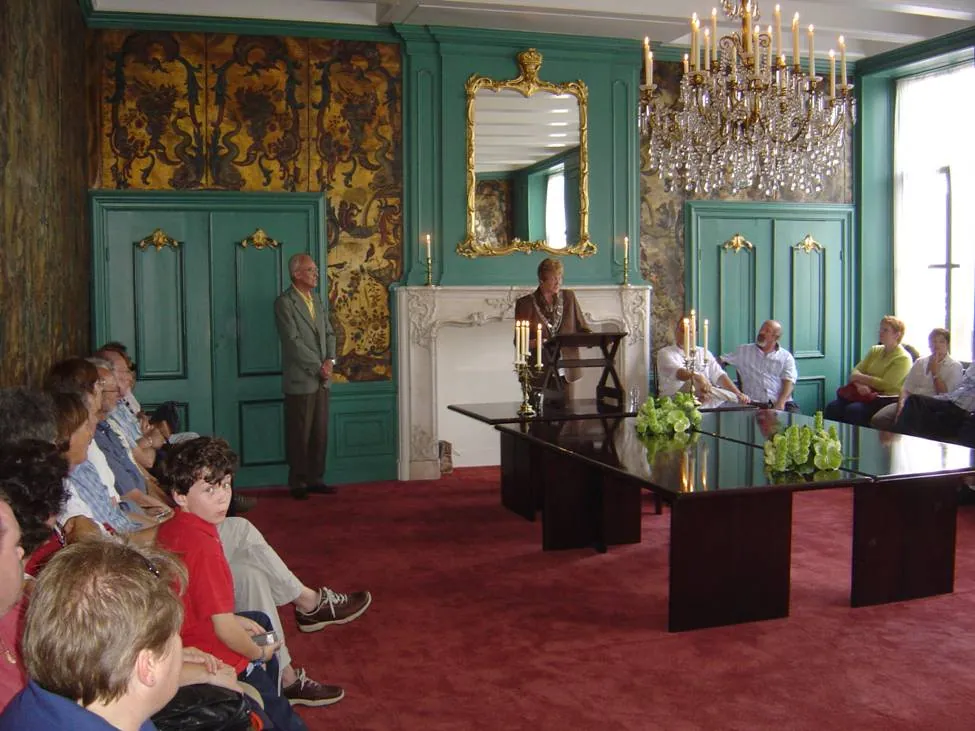
Most of you will no doubt still remember that we organised the first Kingmadag in June 2000. More than 400 Kingmas and family members with a different surname thoroughly enjoyed a wonderful, culturally and historically rich, and above all convivial day. That left us wanting more. Last year we were approached from various sides with the question of whether we intended to do this again in this first lustrum year.
We took up the challenge and got to work. After writing to a thousand Dutch and three hundred and fifty foreign Kingmas, we received registrations for just over one hundred and fifty participants, of whom just over twenty-five from abroad. Far fewer than we had hoped given the previous success, and above all too few to organise a good programme at an affordable price. We then took the difficult decision to organise the day only for our foreign family members, since a reasonable number of them had already booked the trip.
The result was a very enjoyable day with a colourful mix of Kingmas from every corner of the world. Besides various varieties of English, German, Spanish and of course accent-rich Dutch were the languages spoken by participants from Australia, the United States, Canada, Chile, Switzerland, Germany and the Netherlands. In the end, a Dutch Kingma family that had a foreign Kingma as a guest also added to the day. They had planned their family weekend in Franeker so that it could be combined with the Kingmadag.
The day began with a reception in the particularly fine old town hall of Franeker, which is now only used for ceremonial occasions. After the coffee our chairman welcomed everyone, and in particular Mrs Haveman, the mayor of Franeker, who opened the day with a very enjoyable speech. She had gone through the archives once again and drew on the long history of Franeker and the role of the Kingmas in it. The bridge incident involving Johan Maurits and Ignatius van Kingma was not left unmentioned (see Kinkhoorn 1).
As thanks for the warm welcome by the city of Franeker, our chairman presented the mayor with a beautiful Makkum tile featuring an image of Kingma State. After this the group set off for the village hall in Zweins.
There three groups were formed, each setting off towards their first stop on the tour. Since almost none of the participants had visited Zweins before, a tour similar to that of 2000 had been chosen.
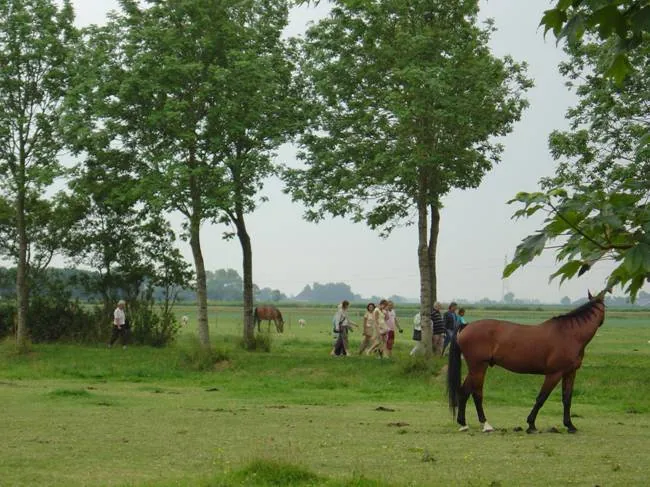
This again produced amusing sights of Kingmas strolling from the Church via the grounds of the state (a Frisian manor house with associated land) to Kingmatille and back. The horses present were not entirely unaffected by the sudden surge of interest in little Zweins either, as the accompanying photo shows.
In the Church of Zweins, Joost Kingma provided insight into the connection of the Kingmas with the church in Zweins and the Kingmas buried there. Naturally this covered the damaged gravestones from which all family coats of arms have been removed, as well as the stone bearing the Kingma coat of arms which was later placed in the floor during the restoration, but which probably did not originate from the church.
In Kingmatille, Kees Kingma showed everyone the old teahouse of Kingma State. The development of Kingmatille was also discussed at length - from a small village with the bridge over the old trekvaart (tow canal), from which it partly derives its name, to the present small ribbon village along the Harinxmakanaal.
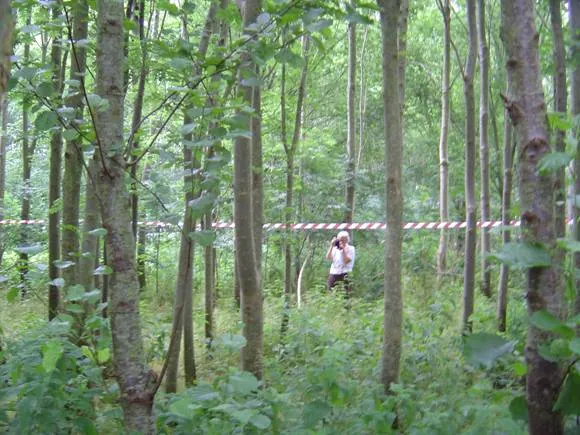
Of course a tour of the state grounds could not be missing either. The undersigned had the pleasure of conducting this in English, Dutch, and - somewhat unplanned - in German as well. The goats that used to keep the grass short have not done so since this year. This was noticeable, especially for those who had missed the good advice to bring sturdy walking shoes. Without exception, Kingmas proved to be persevering, and all of them got to see the highlight of this part of the tour: the outline of the state, marked out with tape, based on the archaeological investigation carried out in 2004.
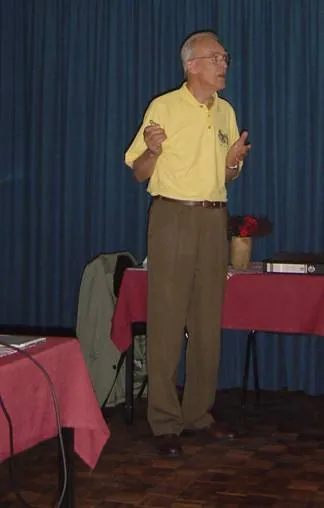
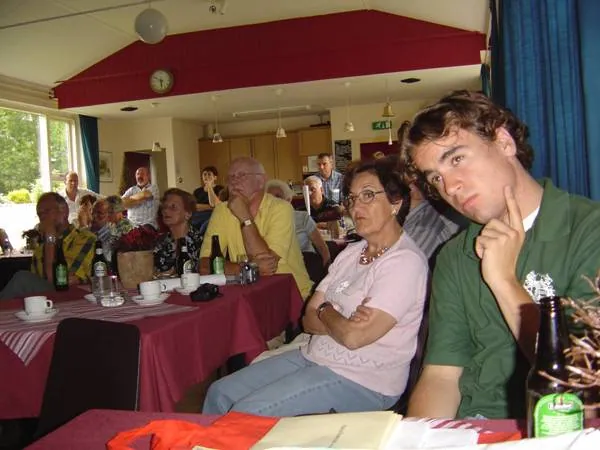
After a refreshing break in the village hall, Kees Kingma gave an extensive presentation on the history of the State, the development of the Kingma coat of arms, our surname, and various other interesting facts. All of this was followed by a captivated audience.
After this, the paths of the Dutch and foreign guests parted. The former group continued their family weekend. We closed the day in fitting style with drinks and a Dutch buffet with our foreign guests in the oldest student pub in the Netherlands. All in all, another very pleasant and successful day. Who knows, maybe there will be another chance in five years…
The meaning of the swan in the crest of the Kingma coat of arms
Continuation of the lecture on heraldry by Mr J.C. Terluin on 20 November 2004 in Zweins
The crest on the coat of arms of the Kingmas is adorned with an emerging swan's neck wearing a collar. The swan symbol relates to swan hunting, where the collar indicates the right of the lord of the state (a Frisian manor house with associated land) to keep swans.
In the Middle Ages everyone was entitled to hunt swans. The Burgundians turned swan hunting into a privilege. Those who had traditionally practised swan hunting held claims to it.
Because the lords and freeholders usually could not produce written proof of their swan-hunting rights, and swan hunting also gave rise to many disputes, councillor Everardus Nicolai was instructed in 1529 to record the claims of the inhabitants of Harlingen, Franeker and the Vijf Delen.
This resulted in a so-called swan book, which contained a list of the districts where swan hunting existed and the marks used by the owners of the swans on the beak and webbed feet.
During the Republic the stadtholder acquired the right to hunt swans, but even then the old swan hunts remained in place.
Because swans were desirable objects (among other things, quill pens made from their feathers, and swan down), swan-hunting rights were frequently infringed. A few farms, for example the former state Hoxwier near Mantgum, still hold the right to hunt swans today.
The emerging swan on the crest forms a fine decoration on the coat of arms of the Kingmas.

The Kingma State on the Wadden coast (2)
Continuation of the article of the same name in Kinkhoorn 11.
In the “Streekarchivariaat N.O. Friesland” [Regional Archives of N.E. Friesland] in Dokkum, one document was found bearing the name “Kingma” as the name of the estate (land and buildings), namely the stemkohier (a register of voting rights attached to landed property) of Nes from 1684-'85.
The register van aanbreng (a 1511 land and tax survey) in Tresoar might possibly provide an explanation, but it proved impossible to establish a link between the taxpayer and the land in question. Nor did the name Kingma or Keijma appear under Nes.
The stemkohier of 1640 listed Keijma as the name of the estate at plot 3 under Nes, with secretary Cornelis Vermees as owner.
Plot 3 in the stemkohier corresponds to plot 62 on the pre-cadastral map and in the floreenkohier (an old Frisian land and tax register) of 1700, where the owner listed is the grietman (the head of a Frisian grietenij, roughly comparable to a district magistrate) Jhr. Ernst van Aylva (the v in this name is pronounced as u).
Plot 62 is an elongated strip of land lying along the Wadden dike, between this dike and plot 88, on which, among other things, the name Kingma is recorded on the map of Eekhof.
Now, the map of Schotanus still shows a house a little to the east of Kingma. This house could have stood on plot 3 or 62, and could therefore have been Keijma. Kr. Boelens also makes this suggestion in his booklet about Nes1. Later maps no longer show this house, but when a vote-bearing house disappears, the voting right normally passes to the owner of the land - in 1700 that is the aforementioned grietman.
In the stemkohier of 1698, plot 3 or 62 is likewise designated as Keijma, with the grietman Jhr. Ernst van Aylva as owner and Jan Douwes (the elder) as user. This Jan Douwes is listed in the floreenkohier of Nes from 1700 as the owner of plot 88, on which stands the house indicated as Kingma on various maps. It is conceivable that Jan Douwes later acquired ownership of the adjoining plot 62, which he had initially rented, and with it the voting right of Keima, which would then have moved to the house on plot 88. This is, however, not very likely. In 1708 plot 62 was still owned by Van Aylva.

It remains strange that the name Kingma occurs only in the stemkohier of 1684-'85. Before and after it, in the stemkohieren of 1640 and 1698 respectively, the name Keijma is recorded.
This makes it likely that we are dealing with a scribal error.
This is also supported by what Boelens says in his booklet about Nes: “Keyma , dit is een zeldzame naam. Ik geloof niet dat die elders voorkomt. Mensen die die naam dragen heb ik niet kunnen vinden.”
The name Kingma, however, was well known. If the long ij or y in Keijma or Keyma was pronounced the Frisian way, as an “i”, the mistake becomes even more understandable.
Perhaps, you never know, the true solution will one day come to light. That will then have to come from someone else.
Kees Kingma
1 NES in doarp yn’e Dongeradielen. Biskreaun fan Kr. Boelens; 1949-'50.
Rev. Hero Pieters Kingma
Pieter Jelles Kingma lived as a freeholder at Kingma State in Zweins from 1560-1610 and was a member of the Gedeputeerde Staten (Provincial Executive) of Friesland (1601, 1604). His son Hero Petri Kingma was born in 1596 in Zweins, according to the “Friese Synode Verslagen van 1621-1650” [Frisian Synod Reports 1621-1650]. He married Jancke Adema at the age of 27, and married for the second time to Minck Minckes.
Hero was a student at the Academy in Franeker in 1617, minister in Itens (1624-1627), Oosterwierum (1627-1641) and in Sneek from 1641 until his death on 31 July 1667.
He appears quite often in the reports of the Synod. For instance, in 1623 the congregation of Itens issued two calls, namely to Hero Petri Kingma and to Matthaeus Petri, son of Rev. Petrus Vomelius. The dispute that arose was won by Hero with the support of the Gedeputeerde Staten. The Synod accepted this outcome.
A similar situation arose in 1636. The deputies of the Frisian Synod became involved with the two calls issued by the congregation of Oosterend to Sibrandus Atsma and Hero Petri Kingma. After a session of three days, they chose Sibrandus Atsma, who received the most votes - unlike in the classis of Sneek.
On 7 June 1642 Rev. Hero Petri Kingma opened the meeting of the Synod and was then chosen as preases; on 11 June he closed the meeting.
In the Leeuwarder Courant of 19 February 1977, a somewhat piquant and painful facet of this minister's life comes to light:
“There were all kinds of them, the ministers' wives. In the seventeenth century we meet Minck Minceks, the second wife of Rev. Hero Petri Kingma. In his time he was one of the leading ministers, who served in Sneek, among other places, from 1641 until his death. He was greatly honoured, presided over Synods, and drew a full Martinikerk in Sneek. But whoever came there, his wife Minck did not. This second Martha had, it was established in 1666, by then not set foot in church for nine years. She used Sunday as a working day. Out of respect for “father” Hero, the church council was very lenient, but strictly speaking his wife should have been denied the Lord's Supper. Hero Kingma was deeply ashamed and said that he could not force her even with a stick. Perhaps it was from sheer misery that he died the following year.”
This history did not stop Hero's two sons from also choosing the profession of minister.
Tjeerd Kingma
Source: Teade Kingma
Wetenswaard
Restoration of the little church in Boer to start in 2006
In Kinkhoorn 7 (April 2003) we had an article about the little church in Boer, a small village in Franekeradeel, located about 3 km northeast of Franeker along the road from Dongjum to Ried.
What makes the little church interesting to us is the pulpit. It was donated to the little church in the 17th century by the well-known Colonel Ignatius van Kingma. On the front panel a coat of arms can be seen. Below it the donor's name is inscribed: “I.V.KINGMA” (see photo).
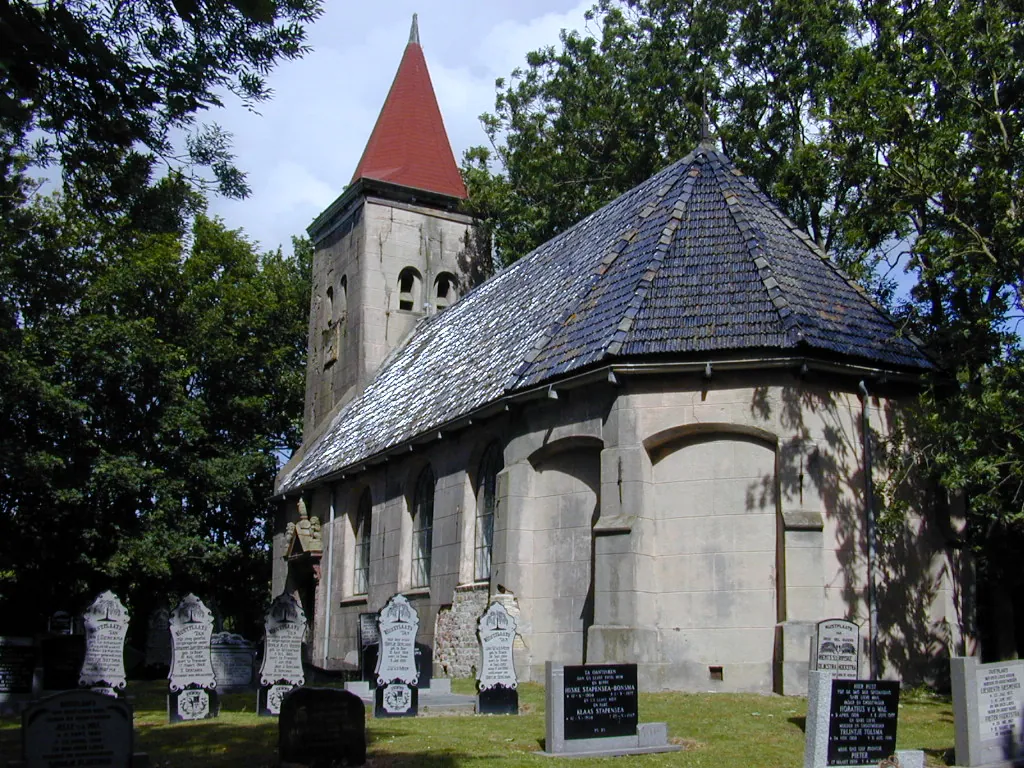
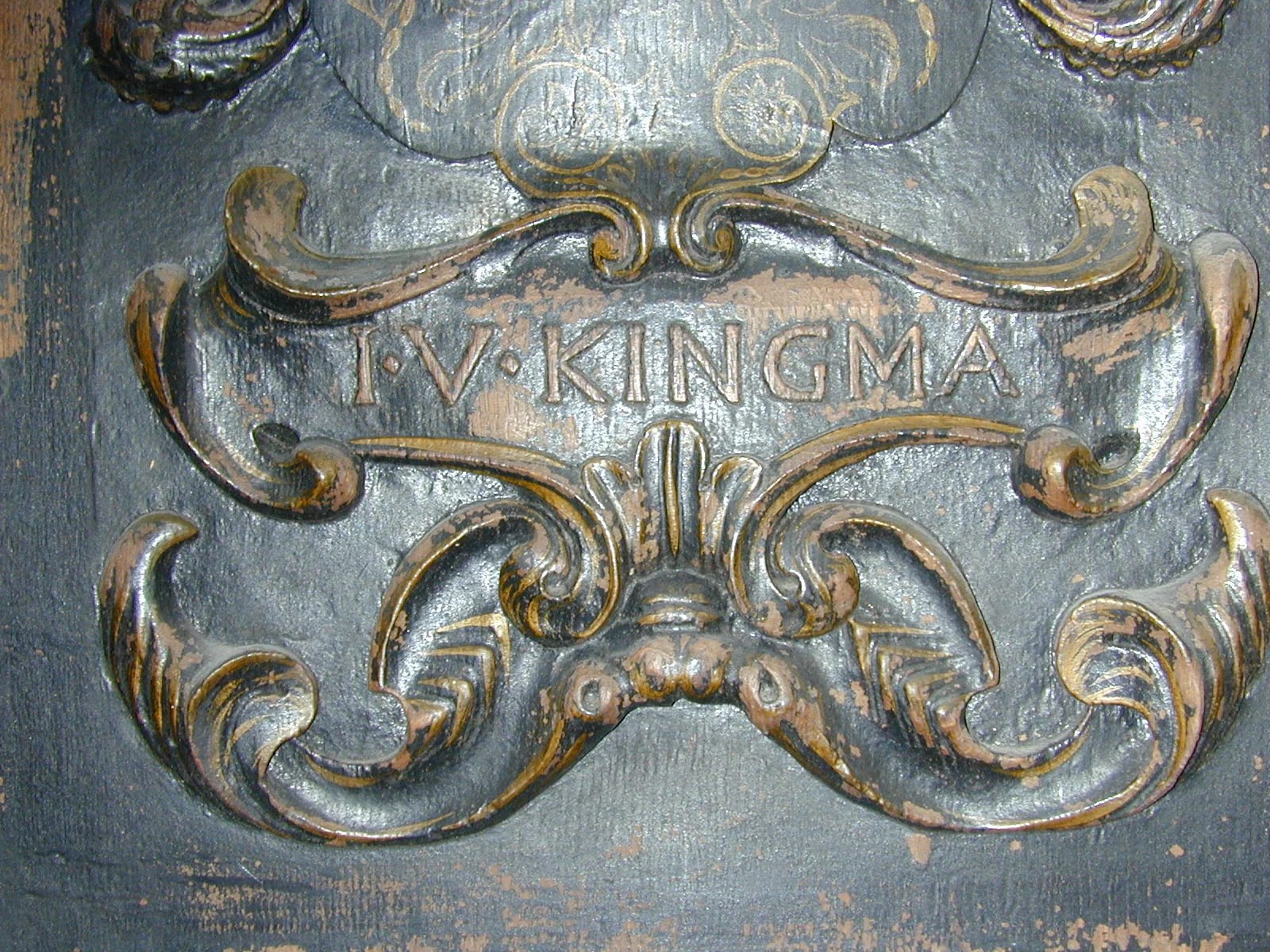
We noted at the time that the little church was in a state of disrepair and that the restoration, planned for 20 years already, was urgently needed.
We recently received word from the Stichting Alde Fryske Tsjerken, which owns the little church, that the national restoration grant has been awarded and that work is planned to start in 2006. The interior of the church, including the organ and pulpit, will also be included in the restoration.
However, the national grant does not cover the full amount needed. This is why the Stichting Alde Fryske Tsjerken is asking its donors to contribute an extra amount to make the restoration possible. As the Stichting Kingma State, we have decided to respond to this, given the relationship we as Kingmas have with the church.
We would like to encourage our donors to also transfer an amount to account number 29.81.00.703 at the Frieslandbank, payable to Stichting Alde Fryske Tsjerken, with reference “Donation, restoration church Boer”.
The little church, beautifully situated in the terpelân of Northwest Friesland, is more than worth your contribution.
German Kingmas in the spotlight
Our website has recently been supplemented with a German translation of the first 9 issues of De Kinkhoorn, made by Ralf Kingma from Friesenheim (Schwarzwald, Germany). Where possible, he has supplemented the text with his own images and photos. Painstaking work with an impressive result.
In addition to the regular issues, he has produced a Sonderausgabe of De Kinkhoorn. This extensive publication reports on the results of his Ahnenforschung from 2002 onward in Friesland, in search of the ancestors of the German Kingmas. His grandfather Jan Bontjes Kingma was born in Lions (Leons, between Winsum and Jorwert, the smallest village in Friesland with 22 inhabitants, one hamlet and one church) and emigrated to Germany in 1898 at the age of 16 together with his brother Bontje Bontjes. He left the Netherlands because of the high unemployment in the countryside and became a farmer in Neckargerach (near Heidelberg). Jan Bontje died there in 1969 at the age of 87.
You can find the Sonderausgabe, which also offers a family tree of the German Kingmas, and the German versions of De Kinkhoorn on our website: www.kingmastate.nl .
Will the rebuilding of Kingma State remain a castle in the air?
The Stichting Herstel Kingma State, founded a few years ago to realize the rebuilding of Kingma State in some form, has suffered a significant setback. And because we want to keep you, our warm supporters, informed not only of the good but, when necessary, also of the bad in our findings, here is a brief report on the state of affairs.
Since our founding, our articles of association have stated that we will also investigate the possibilities of restoring or rebuilding Kingma State. To that end we have established many contacts, including regular contact with the municipal government of Franekeradeel and the provincial government. In addition, we have made contact with various private and public organizations that might possibly play a role as partners in the redevelopment. At our donor meetings we have regularly reported on these contacts and discussions. We have also, with financial support from our donors and the affiliated Kingmastichting, had Arcadis carry out an archaeological survey at the site of the former state to see whether we could find remains of the buildings and moats. Which indeed, albeit modestly, turned out to be the case.
In the spring we again held a round of consultations with the municipality, Staatsbosbeheer as owner of the state grounds, and with two housing corporations.
One of the corporations turned out to be interested in further investigating with us the possibility of using the site for (senior) housing.
After several years of searching for a suitable development partner, we were hopeful. However, after extensive analysis, this corporation informed us that, given the current economic climate, it saw insufficient prospects for developing housing at the site.
Since we had already, at an earlier stage, assessed other possible uses of the site that could lead to rebuilding as (provisionally) unfeasible, we have come to the conclusion that rebuilding is not among the realistic possibilities within the foreseeable future.
The Stichting Herstel is now considering how to proceed.
We will keep you informed.
The Kingmaschool in Amersfoort (continued)
In De Kinkhoorn 9 (April 2004) I wrote an article about the Kingmascholen in Amersfoort and Amsterdam, founded by teacher Fokke Yntes Kingma.
Recently another article came to my attention that also pays attention to this teacher and his innovative teaching methods.
I do not want to withhold from you a number of passages from “Onderwijs in Amersfoort 1850 – 1920” by dr. M.L.J. Meijer.
In its report on 1839, the local school committee gave Kingma's bewaarschool (an infant school for young children) a very positive assessment: ”Lieten tot nu toe Bewaarscholen alhier veel te wenschen overig, zoo verheugt de Kommissie zich thans met lof melding te kunnen maken van zoodanige school door den onderwijzer F.Y. Kingma onlangs alhier opgerigt (…) De doelmatige inrigting dezer school en de ijver des onderwijzers, door zijne Echtgenoot ondersteund, geven de gegronde hoop dat deze inrigting al meer en meer aan haar doel beantwoorden en de verlangens der ouders uit den fatsoenlijken stand bevredigen zal.”
“Fatsoenlijken stand” — that is something we would not write so easily nowadays.
Fokke Yntes Kingma enjoyed national renown for the reading and singing methods he developed.
School inspector Wijnbeek visited Kingma's school to observe firsthand how this method worked in practice.
He made no secret of his admiration and indicated that it would be of great importance for female teachers at bewaarscholen (infant schools) to spend some time at Kingma's school during their training.
Fokke Yntes Kingma was a dedicated teacher and a great pedagogue, who was close to his pupils and cared for them warmly. His merit is that he (…) at a time when individual instruction was giving way to the classroom system, took the personal creativity of the child as his starting point. “Het onderwijs moet niet alleen naar de jaren der betrekkingen, maar ook naar de gesteldheid der leerlingen worden geregeld”, aldus Kingma.
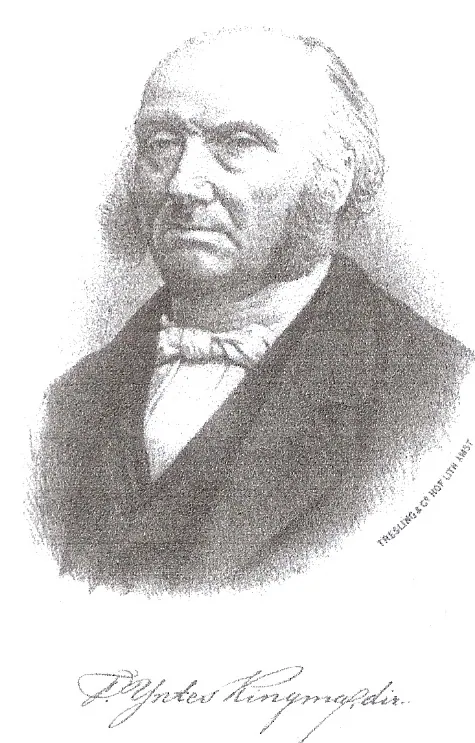
Although upon his appointment he had committed to admitting only children up to the age of six to his school, this proved impossible to maintain in practice.
In particular, many residents from the ‘den beschaafden burgerstand’ preferred to send their children to Kingma. A list of pupils' names shows that in 1847, just under half of the 71 children at Kingma's school were 6 years old or older.
Complaints from other schools, which faced increasing competition from Kingma, led to Kingma being ordered on 29 July of that year to remove children over the age of six from his school. His income fell as a result to such an extent that he and his large family were forced to leave Amersfoort. Via Leeuwarden, where he was again a private tutor for a few years, and Utrecht, he went to Amsterdam, where he founded a school for 'speech-impaired' and 'backward' children. Both this school and the Amersfoort school still exist under the name Kingmaschool.
Joost Kingma
Miscellaneous
My Ancestors Kingma
Coming soon: “Mijn voorouders Kingma” [My ancestors Kingma], by F. Thoomes-Kingma. Two centuries of Oostdongeradeel (1650-1850) A century in Tietjerksteradeel (1850–1950). 64 pp. The booklet will be sent upon transfer of € 9.50 (incl. postage) to giro account 118143, in the name of F. Thoomes-Kingma, Culemborg.
Don't fall for it!
In the autumn issue of the quarterly magazine of the C.B.G., the Centraal Bureau voor Genealogie [Central Bureau for Genealogy] in The Hague, there was an article warning about the activities of the “Stichting Genealogie Nederland”.
This “Stichting” [foundation] sends out letters offering, for € 49,95, a publication entitled “De Kroniek van het oude geslacht ..............” [The Chronicle of the old family ..............]. You can fill in your family name here.
Shortly afterwards I too received one of these letters in my mailbox with a “wonderful” offer. Even with a 35% discount if I ordered the publication before 21 October 2005. The letter was signed by Willem Lambertus J.J. Pince van der Aa, chairman of the aforementioned Stichting.
It all closely resembles the letters distributed between 1993 and 2001 by a Rotterdam bookseller. Although this man was already sentenced by the Hague Court of Appeal in 1997 to a fine of 25,000 guilders, and was convicted again in Belgium in 2004, he keeps trying to sell absolutely worthless genealogies and family coats of arms. Also in Germany and England. So don't fall for it, despite all the guarantees and quality certificates that are promised.
Kees Kingma
Kingma Kronkels: Feasting

Joost Kingma
Genealogy always keeps us very busy, I wrote last time in these Kronkels. That naturally remains the case, and that means that this time we are making it the main course of the autumn gathering. For the broad outline, anyway. For the small side dishes I still have to rely on whatever I hear or am sent by this person or that.
A good friend of mine treated me the other day to the joyful news that we are related. He looked very pleased about it. Now our daughters play together so often that we had already said they seemed almost like sisters. Well, now that was also a proven genealogical fact. A certain Metske Siebes van der Leest (1767-1835), an ancestor of my friend, remarried - after an earlier marriage to Rinske Geerts - on 5 June 1811 to a Kingma girl, namely Trijntje Jacobs Kingma, born on 8 June 1774 in Wanswerd as the daughter of Jacob Jans Kingma. A bit of an old charmer, that Van der Leest.
Another treat is the fact that we now know for certain that our colonel Ignatius van Kingma (1621-1700) not only maintained written contact with the Frisian stadtholder Willem Frederik van Nassau (1613-1664), but also met him regularly in person. And that indeed to share a meal together.
Willem Frederik kept a diary between 1643 and 1654 1 and on Saturday 10 July 1649 he writes in it: ‘Exercities gedaan. Wezen wandelen op het huis te Swichum, dat aangenaam en fraai is, met veel oude schilderijen en wapens in de ruiten. Ik at met Erentruyter, Focke Jacobs, Hemmema en Kingema….’ The footnote shows that this refers to Ignatius van Kingma, a soldier in the States' army. Incidentally, he mentions dinners with officers very regularly, so Ignatius will certainly have joined in more often to enjoy a good meal. A real feast.
1 To be read in De Friese Geschiedenis in meer dan 100 verhalen [Frisian History in More Than 100 Stories], compiled by Kerst J. Huisman. The relevant text passages received from Herre Kingma.
Colophon
‘De Kinkhoorn’ is a periodical publication of the Stichting Kingma State.
The periodical is sent to donors of the foundation.
You can become a donor by transferring an annual amount of at least 12 euros to account number 55.00.97.538 at ABN AMRO bank in Arnhem, in the name of the Treasurer of Stichting Kingma State.
Print run: 150 copies.
Published at least twice a year.
Stichting Kingma State
Secretariat:
Sterrenboslaan 20, 3972 GD Driebergen
tel: 0343 521212
fax: 0343 517689
e-mail: info@joostkingma.nl
website: www.kingmastate.nl
Board
Chairman: C.S.J. Kingma, Emmen
Secretary: J.H. Kingma, Driebergen
Treasurer: J.M. Kingma, Arnhem
Board member: Tj. Kingma, Zwolle
Design and production
Drukkerij Bakker Baarn
This publication is registered with the Koninklijke Bibliotheek [Royal Library] under ISSN: 1569-8645
When reproducing the content of articles from De Kinkhoorn, in whole or in part, please cite the source.