
IV De Kinkhoorn
De Kinkhoorn 15 — April 2007
Volume 8, number 1
This issue as pdf (Dutch) · Read the Dutch original · the printed original
Foreword
This Kinkhoorn contains the final part in the series on the 1696 will of Ignatius. Along with it, an article on the supplementary will of 1698. With this the complete will has been covered.
In the meantime, however, thanks to the kind cooperation of a staff member at Tresoar, I have come into possession of photos of the “not accessible for consultation” will of Ignatius from 1683. This precursor to the 1696 will consists of only three pages, which I have since transcribed. It now appears that this will is not complete and only covers the first three pages. Whether the remaining pages have been lost or perhaps ended up misfiled in the wrong folder, I naturally do not know. I will inquire about that again and return to it in a future Kinkhoorn.
Old maps have always fascinated me. There are now a great many old maps on which Kingma State is marked. That of course says something about the importance of such a house. Because you actually expect a map to show mainly place names and the names of buildings of general importance. So if a distinguished family house is mentioned, its importance must rise above the family level, or it must otherwise be striking.
If the year of publication of a map on which, for example, a state (a Frisian manor house with land) is indicated is known, that means at any rate that the house existed in that year, or at least until shortly before it.
That is why I have started inventorying old maps on which Kingma State is mentioned. I will report on that in the time to come. You will find a striking beginning in this Kinkhoorn.
Kees Kingma
Chairman
Will of Ignatius van Kingma from 1696 (3)
Will of “De Heer Old Brigadier Ignatius van Kingma” te Sweins, 1696 – continued from Kinkhoorn 13 and 14
Kees Kingma
We continue on page 11. After the listing of Ignatius's possessions, it now turns to bequests.
Omdat er in Peins geen huisarmen zijn en de kerk alhier in grote armoed is vervallen legateert Ignatius aan de kerk tot aflossing van hare schulden een somma van driehondert rijxdaelders door zijn erfgenamen binnen twee jaar na zijn dood te betalen.
Dan legateert hij aan zijn oude dienstmaegd Maike Cornelis tot Franeker woonagtig voor haer getrouwe diensten twintig goudguldens 1 jaerlijks so lang sij leeft en in Frieslandt woonagtig blijft. This legacy had to be paid annually out of the proceeds of Rinnerda State in Sweins, at the time worked by Jan Yettes.
Zo ook legateert hij aen zijn gewesen Caemerdienaer Gerlof Fransen, tegenwoordig schooldienaer en organist te Minnertsga de somma van twee hondert carolusguldens.
Daarna legateert hij aen Antie Keimpes Ruiterschild, mijn tegenwoordige dienstmaegd, indien sij Antie bij mijn overlijden bij mij woont een somma van agthondert carolusguldens welke legaat mijn erfgenamen gehouden sullen wezen tegen vier procento op interesse te houden, so lang mijn legatarise Antie Keimpes Ruitenschild 't zelve int geheel of voor een gedeelte sal willen laten staen. With this he does in effect require Antie to remain his maidservant until his death. But she receives still more, such as: de cas (kast) in de daegs caner staende en twee dozijn servetten met twee tafellakens bij de legataria uit deselve cas te kiezen en sullen mijn erfgenamen tevreden wesen met 't overleveren van 't linnen bij gemelte Antie van mij testator in dagelijkse huishouding ontvangen sonder den zelven om naedere oplossinge of inventaris dies te molesteren 2. Item 3 legatere ik aen deselve mijn dienstmaegd 't bed met zijn toebehoren mede in geseide daegs camer sijnde.
Verder legateert hij aan Jan Fransen zijn koetsier en Tabe Ruirds zijn tuinman elk een hondert carolusguldens boven haer te goede sijnde loon, so se beide oft wie van beiden bij mijn versterven bij mij woont oft wonen om voor een weinig tijt daer van te subsisteren 4 tot sij een andere dienst hebben becomen 5.
Then follows: voorts begeere ik dat aen ieder mijner domestiquen 6 of dienstboden elx een eerlijk roukleed werde gegeven.
Next it is the turn of a former servant of his late father: na mijn conditien bespreke ik aen Doeke Sijtses tot Peins zijnde aleer knegt geweest bij mijn testators wijl vader saliger, de Heer Zaeckle van Kingma, jaerlijks tien ducatons tot sijn onderhoudt.
Then follows the legacy to: Hero Kingma 7, tegenwoordig S.S. theologie student tot Franeker een somma van vierhondert silveren ducatons 8 op twee termijnen als 't eerste de tweehondert ducatons bij mijn versterven en 't tweede of de andere tweehondert ducatons een jaar na mijn doodt.
Then follows — rather awkwardly worded — the instruction to the heirs that they must meet the financial obligations arising from the estate, if need be paying out of their own pocket. But that they must do so without any vastigheden (immovable property) from the estate being beklemdt 9 or veralineerd 10 or sold. For these must at all times be preserved for the upkeep of Kingma State and its possessors.
Then Ignatius also settles, concerning his grave, an old grievance with van der Waeijen, professor of theology in Franeker. This was because of a conflict, and even lawsuits, with this man, who used Ignatius's lands to take the shortest route into Franeker. Van der Waeijen first lived on a state that bore his name and lay halfway between Kingma State and Heerma State, and later, according to this will, on Heerma State. Nog begeere ik testator dat mijn landen lopende van de Heereweg nae Sweijns en vice versa niet sullen mogen werden afgeslath 11 voor en aleer Heerma State nu professor van der Waeijen toebehorende, sal sijn vercogt, maer alles te laeten blijven in sodanigen staet als bij mijn afsterven zall werden bevonden, bij paene 12 van twee hondert silveren ducatons aen't Nieuw Weeshuijs te Leuwarden te verbeuren. Aen welcke gedagte Nieuw Weeshuijs legatere een hondert insgelijks silveren ducatons.
Then follows the close of the will, which begins with: Voorders begeere 't geene ick testator met mijn eigen hand geschreeven off onderteeckend en aengebooren 13 Pitsier 14 sal hebben bevestigd sal sijn van sodanigen kragt als off 't in dit mijn testament ware begrepen. Then follows the official closing, in which the new owners, with the blessing of God Almighty, may take possession of the assets in order to better maintain the state and themselves, whereby those who oppose the will shall, as a punishment, be deprived of everything allotted to them.
Then the names are given of the honourable men who acted as witnesses and who co-signed the will, alles in een context sonder van maelkanderen te scheiden voor en aleer alles volbragt was, aldus gedaen ten huysse van mij testator tot Sweijns.
(signed)15 I. van Kingma, 14-12-1696; Rommert Jans; Bauke Jacobs; Gerben Jansen; A. Radinga, 1696; Pytter Runnes; Jan Franses; P. Tzummeri, 1696.

1 goudgulden — presumably this refers to the coin also known as “acht en tweintig”, worth 1 gulden 40, i.e. 28 stuivers.
2 moleste(e)ren, lastig zijn, moeijelyk vallen, (Practisyns Woordenboekje).
3 item, desgelyks, insgelyks, zoo ook, (P.W.)
4 subsiste(e(ren, bijstaan, helpen, (P.W.)
5 This last part looks like a form of unemployment bridging.
6 domestiquen, huisgenoten, (P.W.).
7 Hero (Johannes) Kingma, born around 1672; his great-grandfather Pieter Jelles Kingma was a brother of Inte Jelles Kingma, the grandfather of Ignatius. A rather distant relative, then. One may well wonder what moved Ignatius to leave a legacy to Hero. Was it the fact that he was studying to become a minister, or was Ignatius Hero's godfather? In the latter case the abbreviation S.S. could stand for susceptores, godparents, witnesses at baptism (Latin, as used in genealogical research). But the placement of the abbreviation and the plural form are, in that case, rather odd.
8 silver ducatons, also called silver riders because of the image of a horseman, minted in Friesland from 1659 to 1668. Worth about a quarter more than the silver ducat, which is comparable to the later rijksdaalder.
9 beklemdt is related to the beklemrecht. This is a permanent and hereditary right to use land belonging to someone else, on which the user's house is built, (van Dale).
10 veralieneren, van aliëneren, vervreemden, afstand van rechten doen, (van Dale).
11 afgeslath, waarschijnlijk van afslechten, oneffenheden aan de oppervlakte wegnemen, het land, de grond afslechten, de hoogten wegnemen, (van Dale).
12 paenen (pene, peine), deze woorden betekenen straf, boete, breuke, (P.W.).
13 aengeboren, door en met de geboorte verkregen, b.v. rechten, (van Dale).
14 pitsier, pitsier, pynszer, (lak)zegel., (Paleografisch Album).
15 See accompanying photo.
Will of Ignatius van Kingma from 1698
Kees Kingma
This will, a page and a half long, is a supplement to, and on some points an amendment of, the will of 14 Dec. 1696.
Ignatius begins by declaring that: wat hij in zijn solemneele 1 testament van den 14de decembris 1696 heeft gesteld en met zijn eigen handt mochte hebben onderteeckenten en met zijn aengebooren 2 pitzier 3 bevesticht van kracht blijft inzoverre het door dit aanvullende testament niet wort gederogeert 4, augmenteert 5 ofte verandert.
Then he recalls that he had bequeathed to the church of Peins the sum of three hundred rijxdaelders. Dat verandert hij in vierhondert caroliguldens en daarbij legateert hij vervolgens aen de dyaconye 6 van gedachte dorp driehondertviftig gelijcke guldens. If we assume that one rijksdaalder is 2.50 caroliguldens 7, then the original legacy to the church of Peins of 300 x 2.50 = 750 guilders has been changed into 400 guilders for the church and 350 guilders for the diaconate, together again 750 guilders.
The will continues: als mede in dien in ons kerk van Sweins dyakens mochten werden gestemt soo legatere ic aen den selve dyaconye hondert rijxdaelders van 50 stuivers per stuck. Apparently the church of Peins does now have poor parishioners and, with that, a diaconate, and he takes into account that the same could happen in Zweins.
Ignatius also changes the following. The eight hundred caroliguldens that he bequeathed in 1696 to Antie Keimpes Ruijterschilt, his maidservant, he changes in 1698 into a legacy of four hundred caroliguldens van 20 stuivers het stuck sonder iedts meer op conditie in mijn solemneel testament gedagt als sij Antie nog bij mijn overlijden bij mij woont. Here he halves the legacy without further explanation. What the addition “sonder iedts meer” is meant to convey is not clear. One would hope, for Antie's sake, that this was not meant to imply that the goods bequeathed to her from the House were also no longer bequeathed to her.
The will then concludes with: Begeere ic onder geschreven dat deese booven staende posten ofte veranderingen sullen werden promtelijck nagefolgt als of deselve in mijn solemneele gedachte testament waren beslote, aldus gedaen op mijn Huys tot Sweins den 12de Novembris 1698 in kennisse mijns ondergeschreven handt en aengeboren pitsier,
After this, only Ignatius signs, with the usual flourishes to his signature, date and wax seal.
A few more general remarks about the wills
All three wills are written in a different hand. The last, short will from 1698 could have been written by Ignatius himself. There are also no witnesses or a notary who co-signed it. But no confirmation of this can be obtained as long as we do not know for certain what his handwriting looked like. Comparison with letters sent by Ignatius provides no confirmation either, because those letters also all show different handwriting.
The wills of 1696 and 1698 were both, after the death of Ignatius in November 1700, provided with signed annotations in the margin of the first page. Respectively in 1701 with regard to the registration in the secreet recesboeck 8 and the fideicommissaere registratieboeck, beide berustende in de graphie des Hoffs van Frieslandt, and in 1702 in the hypotheecqboeck 9 of Franekeradeel.
1 solemneel, plechtig, openlijk, naar behoren, (Practicyns Woordenboekje).
2 aengebooren, door en met de geboorte verkregen, b.v. rechten, (van Dale).
3 pitzier, pitsier, pynszer, (lak)zegel., (Paleografisch Album).
4 gederogeert, derogeren, afwijken, buiten werking stellen, (van Dale).
5 augmenteert, vermeerderen, (P.W.).
6 dyaconye, diaconie, armbestuur van een hervormde gemeente, (van Dale).
7 This corresponds with the list regarding “Ald jild” in the handwritten booklet of Theunis Jans Heeg (1852-1929) in Tresoar, call number: Hs 366 IV. In this case it concerns Hollandse Rijksdaalders.
8 secreet recesboeck, blijkbaar geheim boek waarin ondermeer belasting- en stemrechtgegevens werden bijgehouden, (Fockema Andreae Woordenlijst).
9 hypotheecqboeck, hierin zijn div. schuldbekentenissen overgeschreven. maar ook koopakten, soms testamenten, enz. (Gids voor Genealogisch onderz. in Friesland).
Possessions of Ignatius van Kingma around 1700
A well-known joke is that there are only two certainties in life: death and taxes. Although at first glance not very appealing subjects, both have proven very useful for historical research, since in many cases they lead to records being kept in registers. In the case of taxation this was the so-called floreenkohier (an old Frisian land-tax register).
In Friesland, the floreenkohieren contain, per sathe or farm, information about owners, users, area, rental value, neighbouring properties and field names. The floreenkohieren were revised every 10 years and thus form a good source for researching the development of our ancestors' land ownership.
To make things easier for researchers, the Province of Friesland has set up the so-called HISGIS. This is a historical geographical information system accessible via the internet (www.hisgis.nl). It contains a reconstruction of land ownership as of 1700, plotted on the cadastral map of 1832. So the map image is from 1832, not from 1700.
Just like the cadastre, the floreenkohieren thus form a tax record. The record is organised per farm and the lands belonging to it. Important for the reconstruction is that this unit (farm plus land) remained the same over time. New owners and users, as a result of sale, inheritance or leasing, were registered under the same geographical unit. It is also important that in 1848 the cadastral plot numbers are given for every unit. Colouring in those numbers on the cadastral map of 1832 therefore also shows the extent of the original lands of around 1700.
The accompanying little map is based on the information from HISGIS and shows the possessions of Ignatius van Kingma in Zweins in 1700. The red pieces are land in the possession of Ignatius van Kingma for which he owed tax. The yellow piece is the former state (Frisian manor house with land) grounds, on which the moat is clearly recognisable in blue. You can see that a not insignificant part of Zweins was in his possession. When, in a conversation with, among others, the provincial archaeologist of Friesland, I linked this to the idea that Ignatius was therefore an important man for Zweins, some question marks were raised about that. Not that his importance was doubted, but the basis for it in terms of land ownership was. There are, namely, a number of terpen (artificial dwelling mounds) in Zweins of which Ignatius owned only 1. Since ownership of a terp was usually reserved for wealthier (and influential) families, there must have been several families of importance in Zweins. This also fits the picture that there were once 4 states in Zweins and its immediate surroundings.


At the peak of his prosperity, Ignatius owned about 212 1 pondemaat of land in Zweins. This is an old Frisian unit of area. Converted, he had about seventy-eight present-day hectares of land in Zweins. Outside Zweins, mainly in Peins and Dronrijp, he owned another 268 1 pondemaat of land, bringing the total to 560 1 pondemaat, or 206 2 hectares. A not inconsiderable amount for that time, but certainly not the largest landowner in Friesland either. By comparison, the Popta family owned 724 1 pondemaat at the same time, almost one and a half times as much. The other Kingmas together owned 255 pondemaat at that same time. This shows that Ignatius was, at that time, by far the largest landowner among the Kingmas then living.
Also nice to mention is that, while finding out how many pondematen went into a hectare, I also came across a few other wonderful old Frisian units of area. To close off this piece, a few examples: mud, einsen, haid, koegangen, and, in my view the finest: the koningsweide, of which Ignatius had 115,200.
Jeroen Kingma
1 The figures are based on data found in HISGIS for the year 1700.
2 The conversion is based on information from Wikipedia.
Zweins and Kingma State on old maps
One of the oldest maps on which Kingma State is to be found is the map of Friesland (Frisia Occidentalis) in the “Atlas Maior” by Joan Blaeu. This cartographic masterpiece was published by Blaeu in Amsterdam in 1662 and 1665. This world atlas, published in Latin, contained 594 maps in 11 volumes and was the largest and most expensive publication of the 17th century.
Tresoar owns a copy of this atlas, neatly stored in a bookcase specially made for it, bearing the coat of arms of Prince Willem Friso, who once donated the atlas to the University of Franeker.
It is indeed remarkable that Kingma State appears in this world atlas.
It was the Groningen cartographer Barthold Wicheringe who, in 1616, was the first to put distinguished houses on a map.


Kees Kingma
P.H. Wijk, Groninga Dominium
2 From the six-volume reprint of the “Atlas Maior”, the volume “De Lage Landen”.
Faded glory: the decline of Frisian states in the 19th century
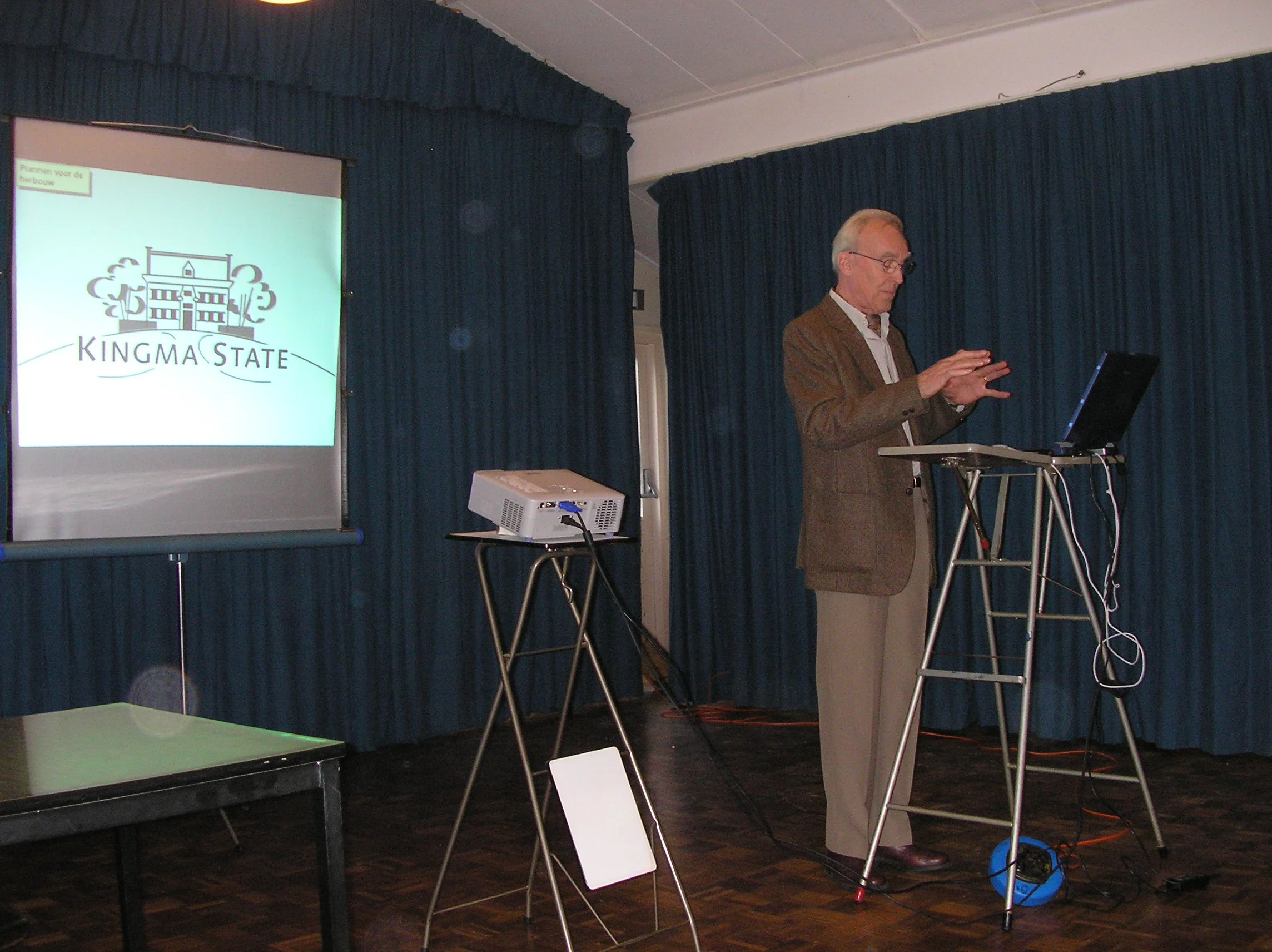
Under this title, Professor Yme Kuiper, professor at the University of Groningen and former chairman of the Fries Genootschap, gave a lecture during the donors' gathering on Saturday 4 November in the village hall of Zweins. An exceptionally engaging account, in which he discussed the relationship between the history of the Frisian nobility and the disappearance of many of the old states (Frisian manor houses with land).
The size of the Frisian nobility, still fairly numerous at the start of the 19th century, gradually declined over the course of this century. Besides the disappearance of the stadtholder and his entourage at the end of the 18th century, the rise of socialism also played a part in this. These were turbulent and poor times in the countryside, and the nobility, who often held a position as grietman (roughly comparable to a district magistrate) of the municipalities, preferred to leave. Many moved to the sandy grounds, such as the inner dune fringe between The Hague and Haarlem, the Utrechtse Heuvelrug and Twente. In 1851, 34 of the 100 highest assessed for land tax in the Netherlands came from Friesland. With 7 percent of the Dutch population, the province thus had the highest number of large landowners of all the regions of the country. By the end of the 19th century this number had dropped sharply.
What effect did that have on the states in which the nobility was generally housed.
Of the roughly one hundred states the province counted in 1840, about forty were inhabited by noble families.
By 1900 there were still around thirty states, of which about ten housed nobility. This means that the nobility, but also other families, sold and had demolished many of the houses.
Nowadays a few dozen states still remain. 1
In noble families it was uncommon to sell or bequeath the house to a (random) person from outside the family. The family house was often the birthplace of many generations, who also derived their name from it. Such a goed (estate) was therefore not simply handed over to a stranger. Preferably, and sometimes even laid down in a will, it was inherited within the family along the male line of the testator. On top of that, building materials were expensive and a house fetched a good price when demolished. That is how many splendid states disappeared, including Kingma State in 1864, and we now have to make do with a handful of remaining states (and here and there a new one!).
Joost Kingma
1 How many states still exist today can, among other things, be deduced from the booklet “Staten, stinzen en Stadshuizen in en rond Leeuwarden” by Rita Mulder-Radetzky, published by the Stichting Staten en Stinzen. It already names 13. Three of those are town houses, but those are actually states too. Further from Leeuwarden there are various others, e.g. Epema in IJsbrechtum, Fogelsangh in Veenklooster, Rinia in Oudemirdum, Oranjewoud and Oranjestein in Oranjewoud, Harta State in Hogebeintum, and at least nine more. The first brochure of the above-mentioned Stichting states that in the 17th century there were more than 400, of which only a few dozen remain today.
Kingma Kronkels: Blue
Joost Kingma
Blue is an important colour in the Kingma coat of arms. Both the field in which the arrow is depicted, and part of the crest, are blue. That brings me to blue news.
There is a suspicion that the use of the kinkhoorn (conch shell) in the coat of arms is connected to the name Kingma (originally Kinghum). Kink means “twist” or “bend”; a kinkhoorn is the name for a twisted, spiral-shaped little shell.
Another possible explanation for the name Kingma is that it is derived from the bend that the road makes at the site of the old Kinghum. In a recent discussion with the province about the rebuilding of Kingma State, however, this was called into doubt by the provincial archaeologist present. I understood that he considers this explanation less likely, because features of the surrounding landscape are not often the explanation for a Frisian name dating from the Middle Ages. Since for now it does seem rather obvious that the toponym Kinghum is a contraction of kink (bend) and hum (house), and the old Kingmas were referred to as (van) Kinghum, I will for the time being leave it at a possible origin of the name. One of our family twists, perhaps?
Fortunately, others too sometimes have a twist in their thinking. Take the following, for instance.
On 13 January we informed the village community of Zweins and Kingmatille about our vision for the rebuilding of the state (Frisian manor house with land). In doing so we used the term “recreational shared use” for a footpath and cycle path that we would like to build on the grounds, for local recreational users out for a stroll. A few of those present turned out to have understood that “recreational shared use” as the start of, of all things, a campsite. For us, that is quite literally the very last thing we would think of as a purpose for Kingma State.
A twist of thought, then.
To prevent further misunderstandings, we immediately struck that term from our vocabulary. And to confirm our proper intentions, after the deed was passed before the notary, we presented Folkert de Jong — who gave us the opportunity to buy back the ancestral land — with a blue (!) street sign reading ‘Folkertpad’. A path like a new bend around the former Kinghum, winding around a blue moat.
Other blue news, to be read in the latest Kingma Kroniek 1, is that the descendants of Hylke Jans, known as the ‘Makkum branch’, have since last year been included in the Nederlands Patriciaat (N.P.), also referred to as the Blauwe Boekje (Blue Booklet). This publishes the genealogies of well-known, non-noble Dutch families. There is also the so-called Rode Boekje (Red Booklet) with noble families. Such a publication gives a solid boost to the recording of a piece of the Kingma past.
But I must advise you against immediately travelling to the Centraal Bureau voor Genealogie to ask whether the same could be arranged for your branch of the family, because such a family genealogy has to meet a large number of conditions, and besides, it may already be too late. There are reports, namely, that the N.P. is ceasing to admit new genealogies of patrician families.
A road with too many bends, it seems to me. And little blue prospect.
1 Kingma Kroniek 31, March 2007, a publication of the Vereniging Familie Kingma
Donation request 2007
To the donors of Stichting Kingma State
Subject: Donation 2007
Date: April 2007
Dear donor,
Once again a year has passed and Stichting Kingma State has entered its 7th year of existence. To our pleasure we see that our shared family history, and in particular the history of Kingma State in Zweins, continues to enjoy great and lasting interest. During our fifth gathering in October of last year, at our usual location in Zweins, we had a wonderful speaker in Mr. Yme Kuiper, on the decline of Frisian states in the 19th century. For those who were unable to attend, a review has been included in the enclosed Kinkhoorn. The autumn gathering for 2007 has already been scheduled for Saturday, 10 November. Please mark it in your diary now. You will be informed further about the programme in due course.
As you know, the foundation was established to make it easier to carry out the research this requires and, now that the land has been acquired, to bring ever closer the realization of the dream of rebuilding the state. De Kinkhoorn is our periodic publication, through which we keep interested parties such as yourself informed of our activities. As you will understand, publishing this magazine and gathering information involves costs. Thanks to your donations, in the years of our existence we have been able to bring some thirteen issues of the Kinkhoorn into the world.
We hope that you will once again wish to make a contribution this year. For the first time in the 7 years of our existence, the continually rising costs have forced us to implement a small increase in the contribution we ask of you. To cover our costs, a contribution of 22.50 Euro (previously 20.00 Euro) per year is needed. To give as many interested parties as possible the chance to stay informed of our work, we have set a minimum contribution of 15.00 Euro (previously 12.00 Euro). As a donor you will receive the Kinkhoorn and invitations to the activities we will be organizing this year.
We hope we can count on you again this year.
Thank you in advance for your financial and moral support!
Kind regards,
Stichting Kingma State
Kees Kingma
Chairman
There are two ways to pay your contribution:
- You can transfer the amount to ABN AMRO account 55.00.97.538, in Arnhem, in the name of Stichting Kingma State, stating "Donation 2007" as the reference.
- It is also possible to have your contribution debited annually from your account by direct debit. If you wish to make use of this, you are requested to fill in the enclosed form and send it in. If you have already done so in one of the previous years, the amount you indicated, including the increase mentioned in the enclosed letter, will be debited automatically from your account at the start of June 2007. In that case you need do nothing.
Colophon
‘De Kinkhoorn’ is a periodical publication of the Stichting Kingma State.
The periodical is sent to donors of the foundation.
You can become a donor by transferring an amount of at least 15 Euro annually to account number 55.00.97.538 at the ABN AMRO bank in Arnhem, in the name of Treasurer Stichting Kingma State.
Print run: 150 copies.
Published at least twice a year.
Stichting Kingma State
Secretariat:
Sterrenboslaan 20, 3972 GD Driebergen
tel: 0343 521212
fax: 0343 517689
e-mail: info@joostkingma.nl
website: www.kingmastate.nl
Board
Chairman: C.S.J. Kingma, Emmen
Secretary: J.H. Kingma, Driebergen
Treasurer: J.M. Kingma, Arnhem
Board member: Tj. Kingma, Zwolle
Design and production
Drukkerij Bakker Baarn
This publication is registered with the Koninklijke Bibliotheek under ISSN: 1569-8645
In case of full or partial reproduction of the content of articles from De Kinkhoorn, please credit the source.