IV De Kinkhoorn
De Kinkhoorn 3 — March 2001
Volume 2, number 1
This issue as pdf (Dutch) · Read the Dutch original · the German translation by Ralf J. Kingma
Foreword
By now it is already 2001 again and spring is approaching, so it's high time for the next Kinkhoorn. It goes for me as it does for most others: time flies, and I wish there were more time available for all sorts of things, such as, for instance, research into the history of the family and the State. And everyone will readily believe that a great deal of time goes into that. But fortunately there are some nice things to report.
Top of the list is the fact that a photo of the State turns out to exist. That is quite remarkable, because the time of the State's demolition falls in the period of the very early days of photography in the Netherlands. In this Kinkhoorn an article is devoted to this photo, and a copy of the photo is included.
At the Ryksargyf in Leeuwarden, the van Beyma thoe Kingma family (descendants of the last residents of the State) has deposited a large collection of documents which, for the most part, had been kept at Kingma State until its demolition. This collection of documents, which largely relate to people who lived at the State, is kept under the name “Family Archive of Kingma State” and contains well over a thousand inventory items, many of which consist of several pages. So here lies an enormous field of work to which a great deal more time can (must) still be devoted, especially since many documents are written in old script. This old script cannot simply be read but requires careful and expert study to decipher.
You will find an example of this old script in this Kinkhoorn. It concerns here a “Deed of Sale” relating to the purchase of the State by Saeckle Intes in 1611. The accompanying article goes further into this fact — important for the history of the State — and the details of the purchase.
Further rummaging in the Kingma State archive will likely yield much more interesting and significant material, some notable facts of which — concerning the name and the history of habitation — are already revealed in this issue.
Kees Kingma
Chairman
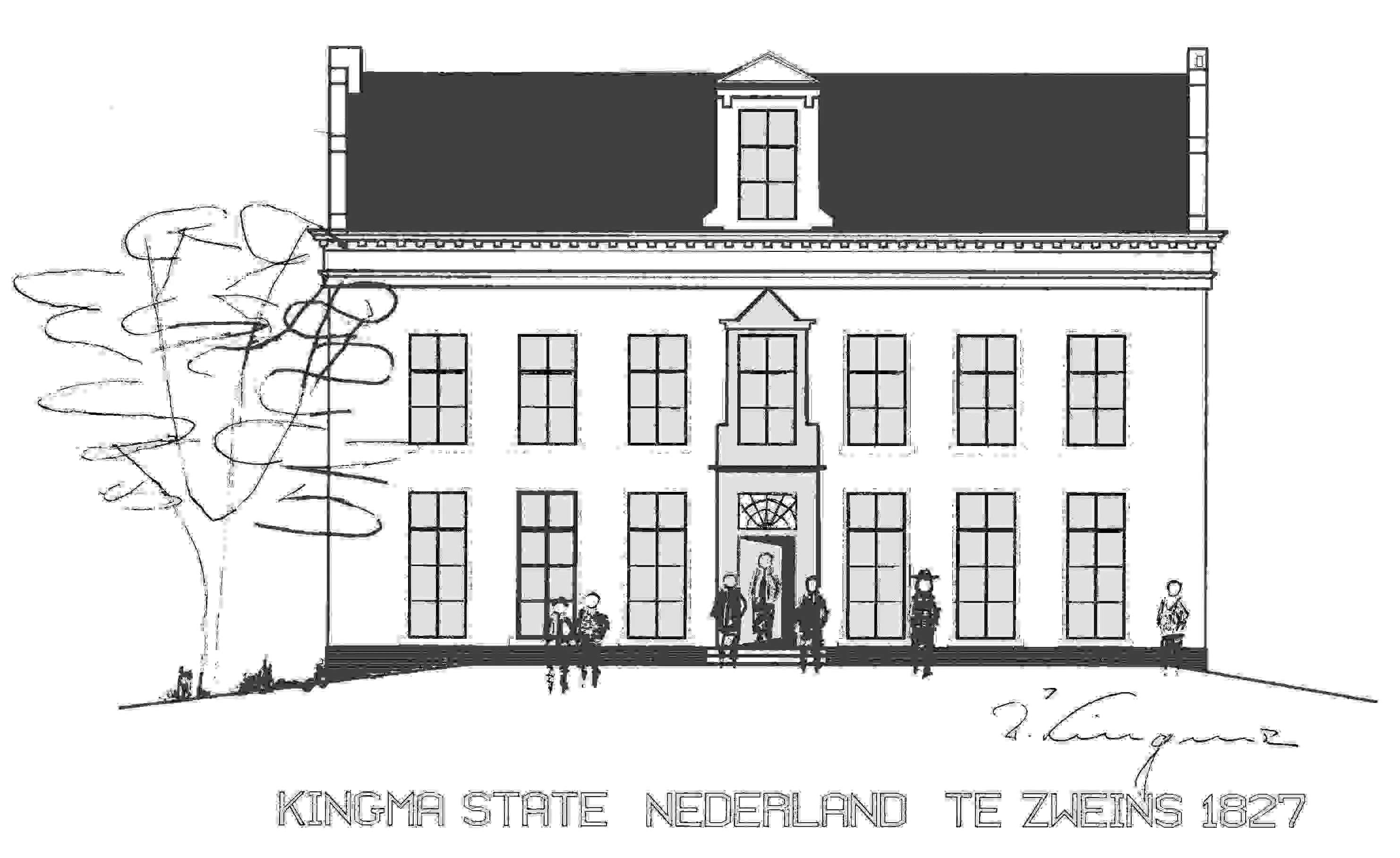
Photo of Kingma State
When invitations were sent out for the Kingmadag on 8 July 2000, an invitation also went to Jhr Mr C.L. van Beijma thoe Kingma, who lives in Overijsel and whose ancestors lived at Kingma State (hence the addition "thoe Kingma" to the name). In a kind letter he wrote to us that he appreciated the invitation but that there was no family relation to the Kingmas, and wished us a successful day besides. In the same letter, however, he also let us know that he was in possession of an original photo of the State.
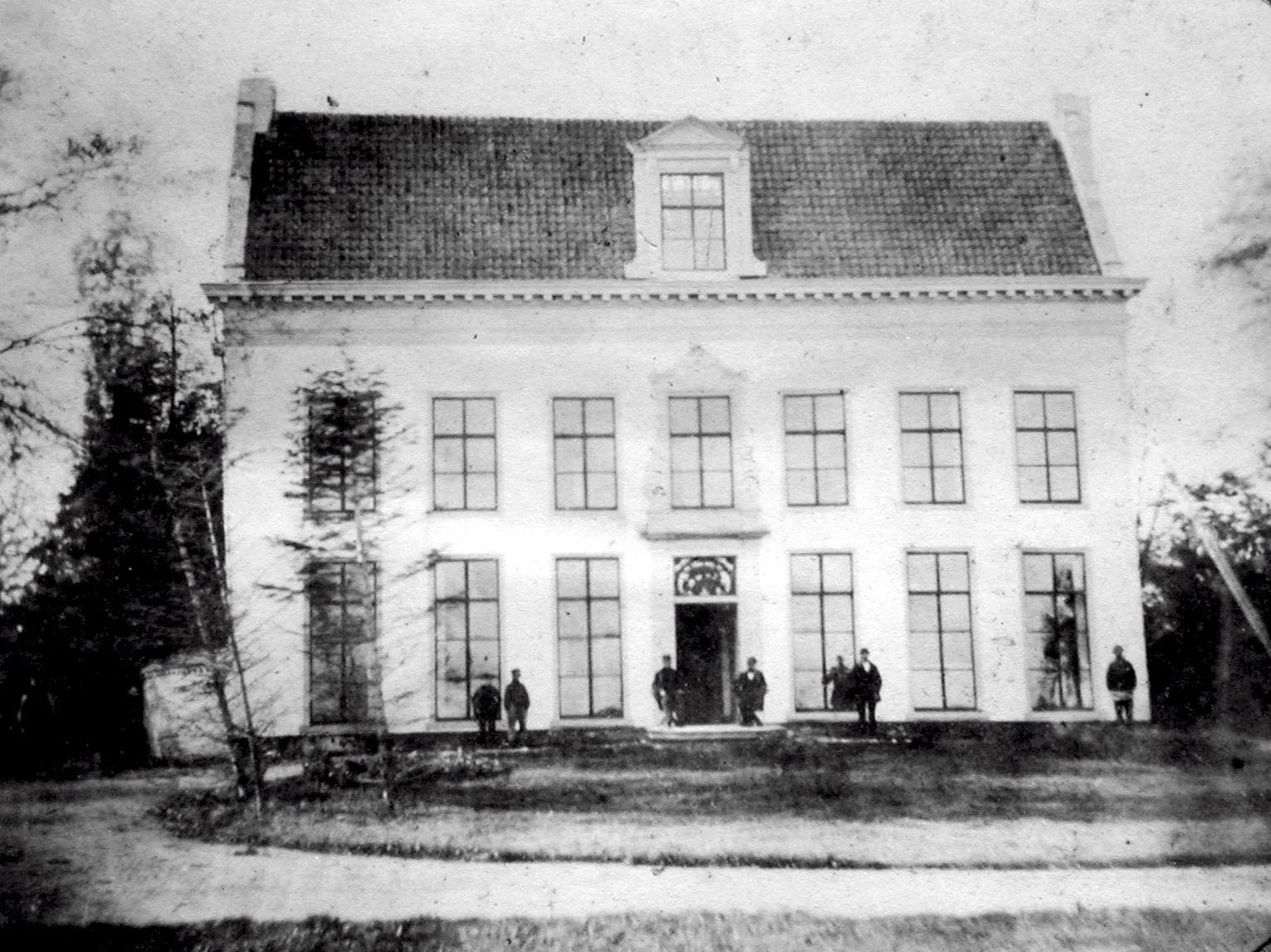
That was of course an intriguing piece of news, but because of the many tasks connected with the Kingmadag in Zweins we could not attend to it right away. In the meantime three board members have paid a visit to Mr van Beijma thoe Kingma and seen the photo. It turned out to be of unexpectedly good quality, considering that the photo was taken some 140 years ago, thus in the early days of photography.
The oldest surviving photograph was made in 1827 by the Frenchman Joseph Nicéphore Niépce with a camera obscura (without a lens), exposure time 8 hours, and on it one can, with difficulty, make out something. 1839 is often called the birth year of photography. The Frenchman Daguerre (1787-1851) and the Englishman Talbot (1800-1877) had by then each developed a usable, though entirely different, process, and the first portable cameras were also developed at that time. Before photography became somewhat more widely adopted, though, and more workable exposure times became possible, several more years would still pass.
Because the State was sold in 1864 and, as far as we know, demolished afterwards, it can therefore certainly be said that the photo must have been taken during the very early days of photography in the Netherlands.
With a digital camera I took, of course with the permission of Mr van Beijma thoe Kingma, photographs of the State photo. A tricky task, since the photo was framed behind glass, which can easily cause disturbing reflections. Naturally you would rather not take such a fragile old photo out of its frame. Fortunately I knew about that situation beforehand, so I could prepare for it. After making some corrections in brightness and contrast with a computer program, the result can be called satisfactory, and is shown in this Kinkhoorn.
The photo was taken from fairly close by, with the photographer positioned slightly left of the centre of the front façade. As a result, it is not visible that the house has two bays, as can be seen in Martin's watercolour, which, incidentally, shows quite a bit of artistic licence. It is clearly visible that the window above the front door has a frame, as does the front door itself. Photographed along with the house are seven people, presumably both residents and staff. One of these seven is standing, barely noticeable, in the doorway. The third figure from the right is probably the reflection of the person with the bowler hat standing at an angle in front of the window.
It is clearly a plastered building. This fact and the building style indicate that it is a 19th-century building. Since we know that it is much older, this means that perhaps the last resident had it rebuilt. Perhaps more can be found about this in the family archive of Kingma State. In any case, the photo gives us an exact picture of what the State looked like in its final phase, thanks to the initiative of one of the last residents to make use of the fledgling art of photography. Although it also cannot be ruled out that the Fries Genootschap had a hand in this. This society, for instance, is known to have also commissioned the Leeuwarden drawing master A. Martin to immortalise *states* that were slated for demolition. In any case, it is particularly nice that we now have this photo at our disposal.
Kees Kingma
Reborn
On 1 March 2001, thus roughly 550 years after the birth of our founding ancestor, once again a
Jelle Kingma
This descendant, in the 15th generation from Jelle Kingum, has as proud parents Rudi and Annet Kingma-Kloppenberg, and as grateful little sisters Kirsten and Iris.
Worthy of his namesake, he weighed a good 5 kilos dressed weight. The tape measure stopped at 54 centimeters (let's just hope he doesn't end up walking around with his head in the clouds, ed.).
Congratulations can be sent to: Wijhezicht 34, 8131 DL in Wijhe (0570-524786).
Deed of sale of the State from 1611
According to a “Deed of Sale” found in the 'Family Archive of Kingma State', Kingma State was sold on 9 August 1611. The accompanying photo of a deed of sale, drawn up by Notary van Tongeren, shows the beginning of it. The first line is still quite legible. After that it continues in the old script customary at the time, which is virtually impossible to decipher without prior study. Fortunately, an also handwritten transcription was enclosed, from a period possibly 50 to 100 years later, which was reasonably legible. From this I have in turn made a transcription in printed letters.
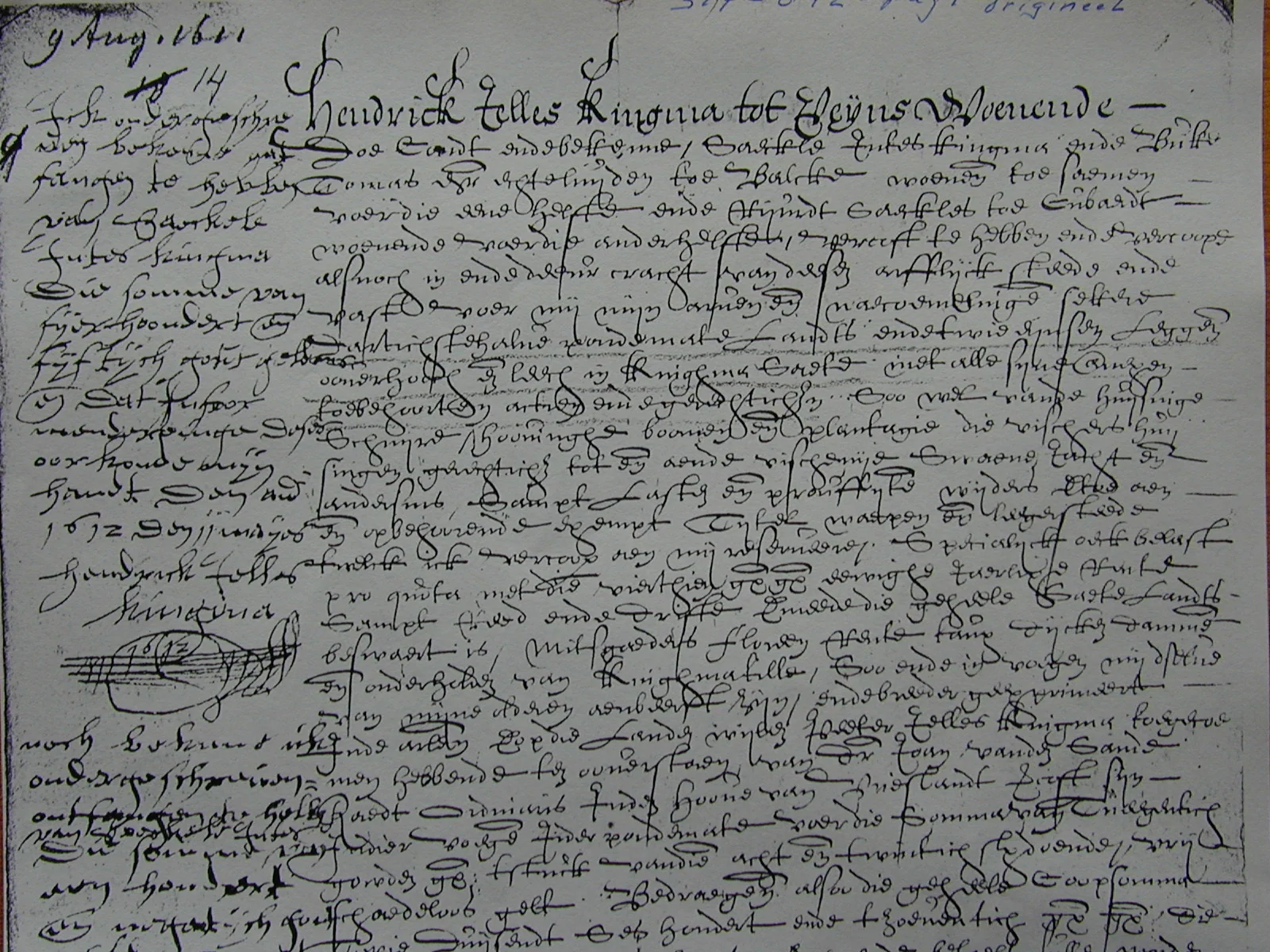
The deed of sale begins as follows:
“Hendrick Jelles Kingma tot Peijns woenende, doe condt ende bekenne, Saeckle Intes Kingma ende Buke Tomas dr (= dochter ) echteluyden toe Balcke woenen toe saemen, voer die eene helfte, ende Ryurdt Saeckles toe Cubaerdt woenende voer die ander helfte, vercoft te hebben ende vercoope alsnoch in ende deeur cracht van deesen arfflijck Steede ende vast voer mijn arven en naecoemelinge.”
Then follows a list of land and structures such as: “huysinge schuyre hoovinge boomen en plantagie”, but also the right “aende vischerije swaene jacht en andersins”. Furthermore, “Tytel en Waepen” are also mentioned.
The purchase price amounts to three thousand six hundred and seventy gold guilders (the currency used before the euro) and must be paid in three installments.
Hendrick Jelles Kingma, son of Jelle Pieters Kingum and great-grandson of Jelle Kingum, the oldest known “Kingma”, thus sells the State, for one half, to a son of his brother Intes Jelles. Why the State was not inherited I do not yet know. It is known that the eldest brother of Hendrick Jelles, Pieter Jelles, who had lived at the State, had already died in 1610, and his wife before 1611. So it may be that Hendrick Jelles inherited the State from his brother. He lived in Peins and possibly had no interest in moving to Zweins. Whether he had children I do not know; the deed does mention heirs.
Saeckle Intes Kingma and his wife Buke Tomasdr thus buy the State for one half and evidently go to live there. They have five children, four of whom apparently die young. They are buried, together with their parents who die later, in one grave in the Church of Zweins. The fifth child, Ignatius (the later Colonel), inherits the State in 1652 and will be the last Kingma to live there.
For the other half, Ryurdt Saeckles buys the State. He signs the deed as Rijoerdt Saclijs. Ryurdt was a brother of Saeckle's mother, Trijntje Saeckles Sanstra. He died in 1618. He probably acted as a lender for the still-young Kingma couple.
In the left margin of the deed, Hendrick Jelles wrote and signed statements regarding the payments made. Here, only Saeckle Intes is named as the payer.
On 14 November 1634 everything — repayments and interest — was settled.
Further study of the deed may well bring more details to light. Moreover, a number of uncertainties in the deed still need to be resolved. These are related to difficulties in reading the old transcription: some letters are written unclearly or are of an unfamiliar form, and difficult old terms are sometimes used.
According to the deed, the State was sold “cum annexis”, i.e. with appurtenances. A number of these have been mentioned above. The Kingmas, however, also owned a good deal of land here and there. Apparently not all of that was sold along with it. How that was handled can certainly be traced, for a large part, in the “Family Archive of Kingma State”.
More on these matters later, after further research.
Kees Kingma
Plans for Rebuilding Kingma State
The rural area of Friesland has, and had, many stately houses and farmsteads, referred to as states (a Frisian manor house with land). On the old salt-marsh ridge that stretches along the former tow-canal east of Franeker, an impressive series of such states developed from the fourteenth century onward, mostly situated on terps (an artificial dwelling mound raised above flood level) in an imposing landscape setting.
One of these houses was Kingma State. After the death of the last resident, Julius Mathijs van Beyma thoe Kingma, the house was demolished in 1864 and the terp was dug away.
Stichting Kingma State has set itself the goal of deepening and sharing historical knowledge of Kingma State and its residents.
In addition, the foundation wants to investigate whether it is possible to rebuild the State.
Recently, encouraged by the tremendous interest at the Kingmadag 2000, the board of the foundation decided to actually get the investigation into a possible rebuilding underway. To that end, talks were held with Staatsbosbeheer, the current owner of the land on which the State stood. In October last, Staatsbosbeheer informed us that it is in principle willing to grant the Stichting a leasehold on the site for the purpose of the rebuilding. Contact has also been made with the Franekeradeel municipality to inform them of our initiative.
We want to start planning in the near term, which should lay the basis for financing and realization. The intention is to rebuild the former State and redesign the surrounding land based on thorough archaeological, architectural-historical and landscape research.
The starting point for the use of the house and garden is to strengthen the landscape quality specific to this area, characterized by openness, tranquility and space. In the layout and design of the State, the domestic character takes priority.
Possible uses for the house include guest rooms, a museum function and/or permanent residence.
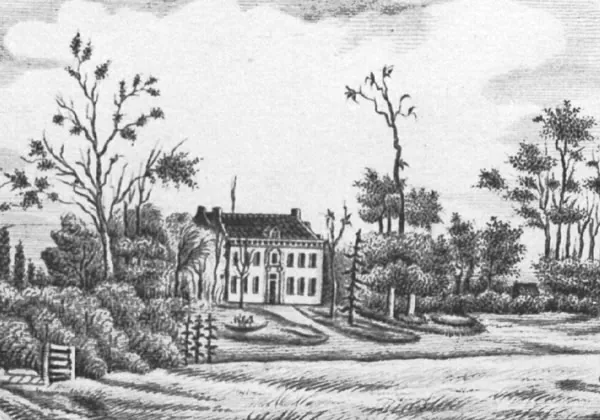
For the time being, the rebuilding will be based on the appearance of the State and the surrounding landscape in the mid-19th century, as shown in the watercolor by A. Martin (see cover), the photo of the house from around 1860 shown elsewhere in this issue, and data from further archaeological and historical research.
Of the large number of states that must have given the North Frisian terp landscape an impressive allure in the 17th century, only a very limited number remain in this area. The rebuilding of Kingma State could possibly provide an impetus for similar initiatives by private organizations in this region.
Wetenswaard
The last residents of the State
Jhr Julius Matthijs van Beijma thoe Kingma was initially regarded as the last resident of the State. He died on 14 September 1847, eleven days before his 66th birthday. His widow, the Dowager Agatha Wilhelmina van Voss, however, continued living at the State until her death on 14 September 1861.
In accordance with the will of Julius Matthijs, drawn up in 1846, she receives the usufruct of his entire estate. In a deed of 20 April 1848, however, it is established by mutual agreement that she will remain living at the State, with the use of all the furniture she needs, but that she waives all further rights she held under the will. In return, her four sons — three of her children having already died by then — will pay her a thousand guilders (the currency used before the euro) annually, in two installments.
Her youngest son, Ulbo Jetze Herema van Beijma thoe Kingma, lives with her at the State. In the sales booklet drawn up by the notaries for the public sale of the State to be held on 5 September 1864, this Jonkheer Ulbo is accordingly named as the user of the State. Why he sold the State is not yet known, but it seems likely that his brothers, after the death of their mother, wanted to receive their share of the inheritance.
The name Kingma
It has previously been assumed that the name Kingum, which must be derived from the dwelling place of our ancestors, changed to Kingma via Kinguma, which means descendant of Kingum. Probably as a corruption. If you say Kinguma quickly, it naturally becomes Kingma. Moreover, spelling at the time — certainly of names — was not well fixed; people wrote the name down as they heard it. This change of name appears to be confirmed by a number of deeds of property transfer from the 16th century. In a deed of sale of 27 November 1571, Claes Pieterzn Kingum sells land to Jelle Pieterzn Kingum. But on 5 May 1579, a plot of land from Kinguma zate (a Frisian farmstead), called “De Betert”, north-west of Kinguma state, is sold to Jelle Pieterzn Kingum. On 5 May 1580 there is mention of land in Kingma zate at Sweins that is sold to Jelle Pieterz. Kinguma.
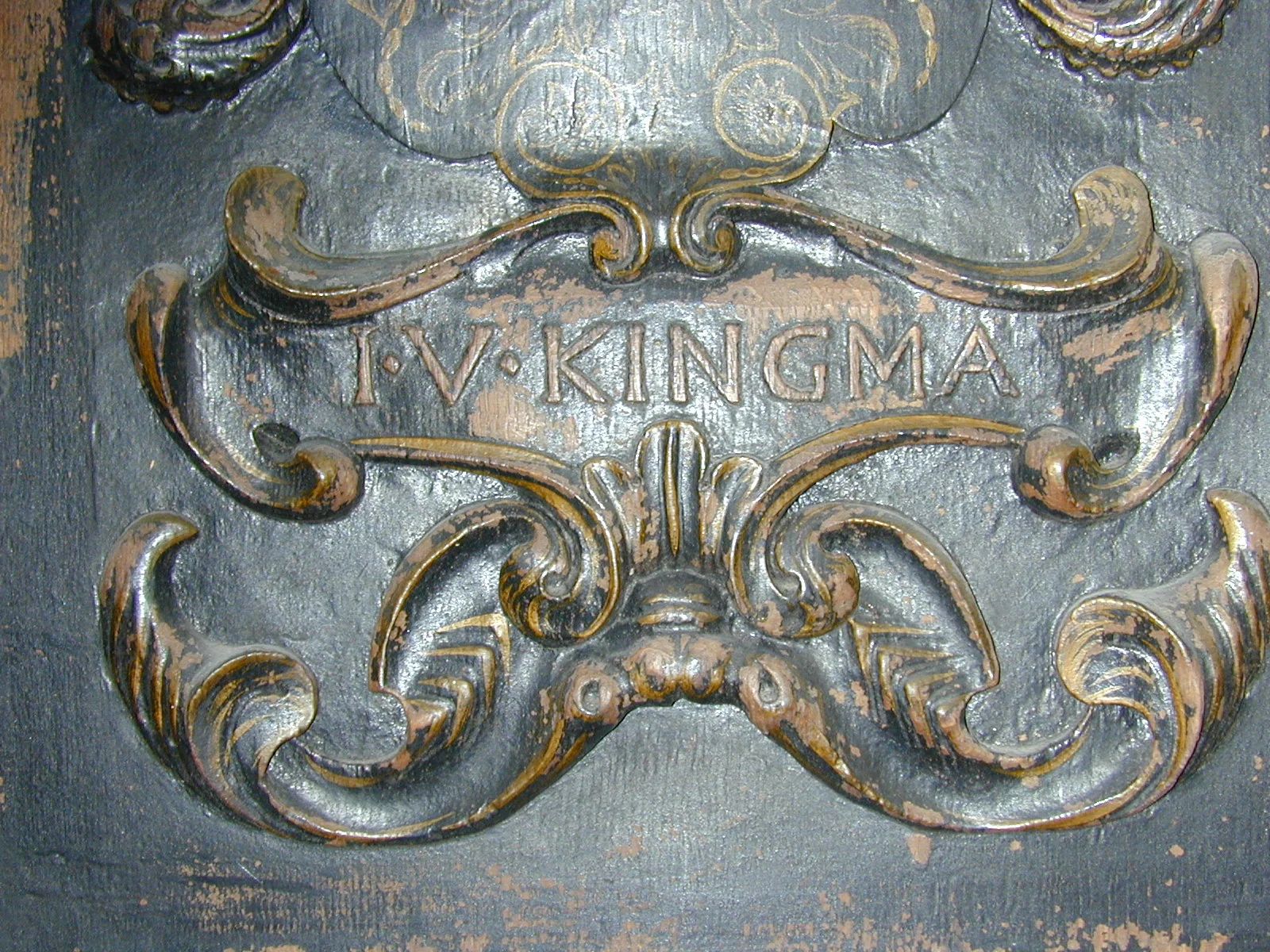
In the deed of sale of the State of 9 August 1611, only the name Kingma is used anymore.
Kingma Kronkels: Much Cold but Also Much Love

Joost Kingma
You often come across nice little items like this.
Especially when you're constantly trying to understand more about the economic boom in Friesland in the 17th century. After all, this formed the basis for the rise of the many states (a Frisian manor house with land) in this region.
Oddly enough, the 17th century coincided with what meteorological circles call 'the Little Ice Age'. We all know the many colorful paintings of ice-skating fun from this period. The Kingmas must have been terribly cold in their State. In 1657, for instance — the year noted on the entrance gate next to the 'tea house' — it was already freezing from 20 October onward. It stayed bitterly cold well into March of the following year.
During this severe winter one could admire ice masses between the East and North Frisian islands. And in Denmark an entire army even marched across the sea ice. The warlike Swedish king Charles X Gustav was fighting the Danes and had already conquered Jutland. To reach Copenhagen he had to cross the Little Belt. The severe frost came to him as a gift from heaven: in February he marched with 12,000 infantry, cavalry and artillery — heavy guns, in other words — across the frozen water, and on 28 February forced the surprised Danes into the Peace of Roskilde.
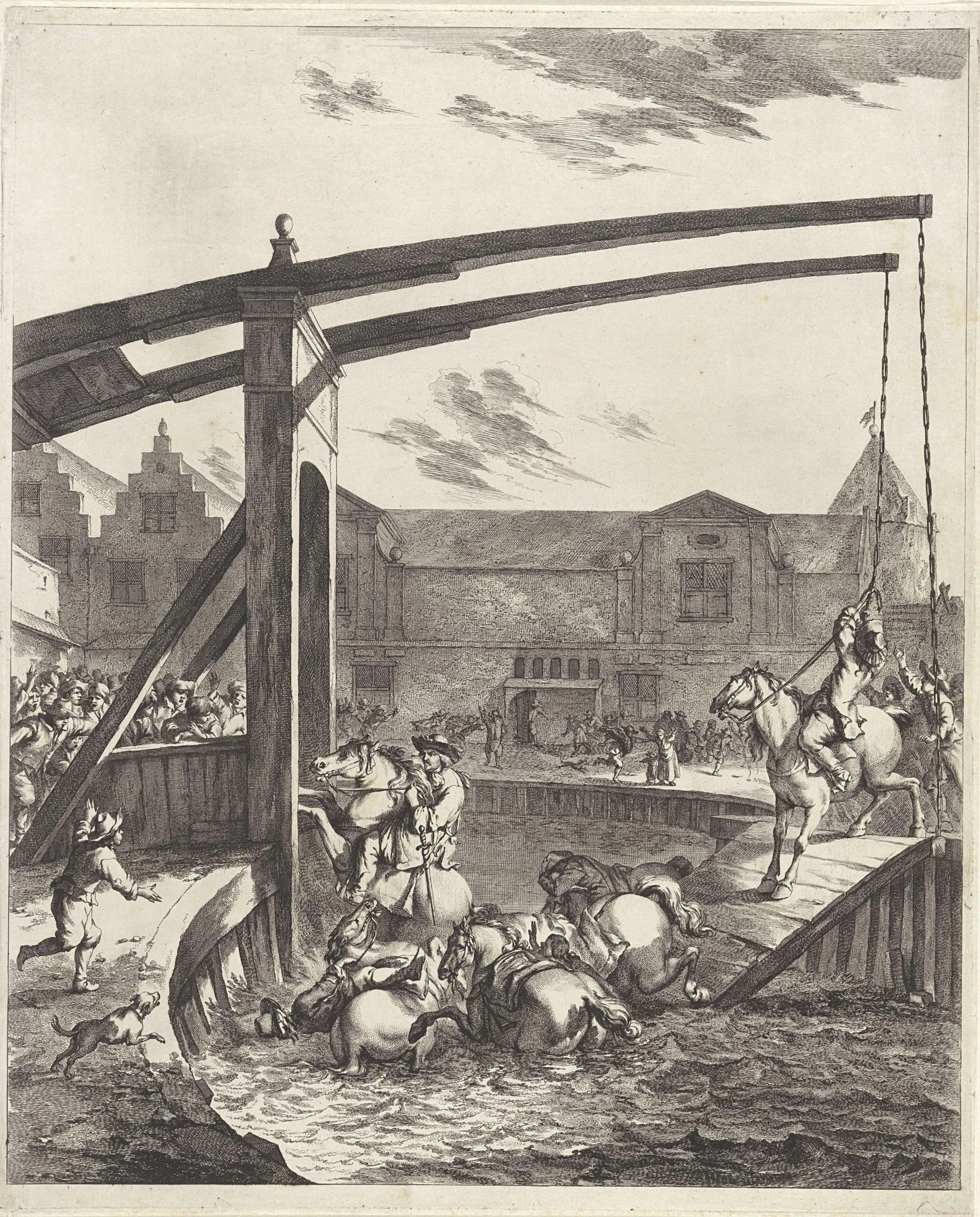
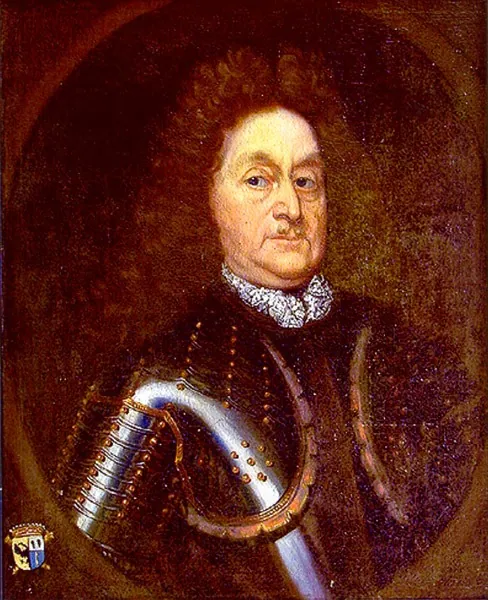
The ice did not always hold the cavalry, despite that Little Ice Age. The resident of our State, Ignatius van Kingma, found that out when he got a soaking in the harsh winter of 1664/65, after falling through the Tolbrug in Franeker with a group of 21 riders (see De Kinkhoorn no. 1). A nice picture of that incident in Franeker was made, by the way, which is reproduced elsewhere in this Kinkhoorn, along with a picture of Ignatius once he had dried off again.
Not far from this bridge, in that same Franeker, a university had been founded on 29 July 1585 by stadtholder Willem Lodewijk — the second in the Republic after Leiden.
And now I come to that newspaper item. In NRC Handelsblad of 15 February last, under the headline 'The Cambridge of Friesland', Michiel Krielaars wonders whether this university tradition could not be restored, since Franeker, 'with its sixteenth-century canals, Renaissance town hall, Gothic church and former Academy Building', lends itself perfectly to housing a top intellectual institute such as a University College.
Well, we're certainly willing, proud as we are of this history. A lovely town indeed, Franeker. I'm growing fonder of it all the time. Especially when, on a beautiful summer day, you recover from a historical exploration of the town at the coffee and tea house 'De Tuinkamer'.
And if you want to know more about love and Frisian stadtholders, then, as someone with an interest in history, I can certainly recommend the book 'Love by Commission', about the court life of Willem Frederik van Nassau, by Luuc Kooijmans. Or, if you are interested purely in love, the book 'With All My Love' by Daphne Rose Kingma.
Daphne, nicknamed 'the love doctor', is a relationship therapist and the author of some six books, gives seminars at the University of California, and is a welcome guest on TV shows. She lives and works in Santa Barbara. Speaking of famous namesakes.
Perhaps it would be a good idea to invite her as the first lecturer at that new top university institute in Franeker?
Colophon
'De Kinkhoorn' is a periodical publication of the Stichting Kingma State.
The periodical is sent to donors of the foundation.
You can become a donor by transferring at least f 25,- annually to account number 55.00.97.538 at ABN AMRO bank in Arnhem, in the name of the Treasurer of Stichting Kingma State.
Print run: 150 copies.
Published two to four times a year.
Stichting Kingma State
Secretariat:
Sterrenboslaan 20, 3972 GD Driebergen
tel: 0343 521212
fax: 0343 517689
e-mail: kingma@worldonline.nl
website: www.kingmastate.nl
Board
Chairman: C.S.J. Kingma, Emmen
Secretary: J.H. Kingma, Driebergen
Treasurer: J.M. Kingma, Arnhem
Board member: W.J. Kingma, Valkenswaard
Design and production
Drukkerij Bakker Baarn