
IV De Kinkhoorn
De Kinkhoorn 4 — September 2001
Volume 2, number 2
This issue as pdf (Dutch) · Read the Dutch original · the German translation by Ralf J. Kingma
Foreword
By the time you receive this Kinkhoorn, summer is already well behind us. Summer isn't exactly the best time for historical research, since house and garden demand attention and fine weather invites you to do things other than rummage around in archives.
Even so, a few more things have come to light. Old exhibition catalogues turned out to be useful here. For instance, a catalogue of the "Historical Exhibition of Friesland," held in 1877 in the Royal Palace in Leeuwarden on the occasion of the 50th anniversary of the Fries Genootschap van Geschied-, Oudheid- en Taalkunde. (The proceeds of this exhibition made possible the purchase of a large house, and with it the establishment of the Fries Museum.) This catalogue lists three items that once belonged to Colonel Ignatius van Kingma, who died in 1700 and was, as is well known, the last Kingma to live at Kingma State. These are: a marshal's baton, a painted portrait of Ignatius, and a sjabrak (a cloth for a horse).
The sjabrak turned out to be in the possession of the Fries Museum. Where the marshal's baton is remains unknown. The portrait turned out to be hanging in Heringa-State, nicknamed the Poptaslot, in Marssum.
Pictures and a description have been included in this Kinkhoorn.
Another catalogue, of an exhibition on Frisian Heraldry, held in 1942 in the Fries Museum, also lists the sjabrak and a signet ring bearing a coat of arms and the initials I. K., possibly also belonging to Ignatius. Unfortunately, however, the coat of arms later turned out not to be the Kingma coat of arms. The catalogue further lists three objects bearing the Kingma coat of arms that came from private ownership, namely a fork and a wax seal belonging to L. Kingma, and a coat of arms carved in wood belonging to H.R. Kingma, both from Bolsward. Since the exhibition was held 60 years ago, it may be difficult to trace the (current) owners. Perhaps a Kinkhoorn reader can give us a tip.
Kees Kingma
Chairman
Ignatius van Kingma
Ignatius went to study in Utrecht. Here he had an illegitimate son, Johan Uitdenbongaert (the surname is that of his mother, Margaretha). Ignatius wanted to marry her but was not given permission by her father. He did not finish his studies and chose a military career.
He married Jaeycke van Vierssen in 1651, daughter of the master of the Frisian mint. She died 33 weeks later, presumably of the notorious childbed fever, for on a monument to her, at the front of the church of Zweins, there is a poem by the minister, one line of which reads “Wort door een hete koorts met ‘s lyfsvrucht weggeruckt”.
After the death of his father, on 12 February 1652, Ignatius became the owner and occupant of the State.
In 1654 he married Ydt van Meynsma, a Catholic widow who had presumably converted to the Reformed faith. She died on 30 November 1671 and was interred in Beers, with her family. Both marriages remained childless.
In 1647 Ignatius was appointed Cornet (ensign, i.e. an aspiring officer, in the cavalry) by the Provincial Executive of Friesland (Gedeputeerde Staten). In 1655 he was Ritmeester (Captain) of a company of harquebusiers, as appears from a will of his wife Ydt from that year. In 1662 followed his appointment as Sergeant-Major of Horse, by the States of Friesland. Apparently the title Sergeant-Major was at that time used for a rank higher than Ritmeester. Later he became Brigadier, and in 1671 Colonel of a regiment of horse in the army of the United Netherlands.
Militarily he lived in a relatively quiet period. Although the Peace of Münster was not concluded until 1648, Friesland, after the last Spanish invasion in 1622, otherwise remained fairly quiet in that respect (see: “Fryslân 500 vijf eeuwen provinciaal bestuur”).
With the exception of the disaster year 1672, when the Republic was attacked on many fronts by an international coalition of England, France and the Bishops of Cologne and Münster.
Bernard van Galen, the Bishop of Münster (“Bommen Berend”), also threatened Friesland. Ignatius will undoubtedly have had dealings with this, in Friesland or elsewhere.
For the rest, he lived in the “Golden Age”.
On 14 December 1696 his will was completed. It begins as follows:
In den Name Godes Amen.
Alzoo niets sekerder sij dan de doodt, en onzekerder dan de uire en tijdt van dien, in overdenking van welks hebbe ik Ignatius van Kingma old Brigadier en Collonel over een regiment Ruiteren residerende tot Sweins, met voorbedagte rijpe rade, volkomen verstandt, redenen en memorij, uit mijn eigen vrije gemoedt, en wille gemaeckt, dees mijn Testament, uiterste en laatste wille, welke ik begeere kragt te sullen hebben als een Testament solemneel, minus solemneel, codicil, fideicommis, gifte ter saeke des doodt, of andere bheste wille invoegen dselve best na regten, usantie van deze lande, sal kunnen bestaen;
And so it continues for fourteen, of course handwritten, pages in folio format. The most important thing is that he left all his possessions to the son of his sister Catharina, Zaccheus van Gemmenich, whom he made fideicommissaris.
The so-called fideicommis, also known as “erfstelling over de hand”, is a testamentary provision whereby one person is granted all possessions as usufructuary. This person has the obligation to keep the property intact and to pass it on again, in its entirety, to a custodian from the next generation. It originates in Roman law and was especially common in the time of the Republic. It was used above all by noble families to keep the ancestral estates within the family (and the influence that went with that!). With the introduction of the Civil Code in 1838, the establishment of a fideicommis was prohibited.
An addendum to the will is dated 12 November 1698. In it, among other things, the church of Peins and his servant girl Antijs are given a sum of money. This document is sealed with a wax seal, a photograph of which is included in this issue of De Kinkhoorn.
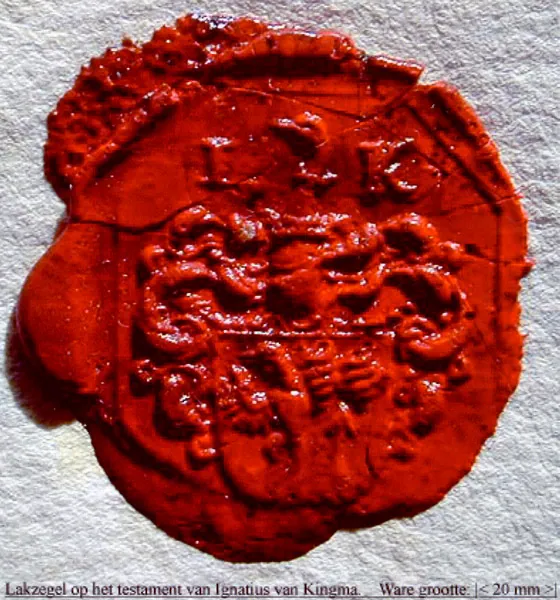
This seal shows the Kingma coat of arms with helmet and emerging swan. The swan is flanked by the letters I and K.
Ignatius died on 26 November 1700 and was buried, next to his first wife, in the church of Zweins. The gravestone shows the coats of arms of Ignatius and of his wife. Unfortunately, the upper half of both coats of arms has been hacked away. This is the result of a decree from 1796, the French period. Coats of arms symbolized social rank, and that was no longer permitted in the age of “Egalité”. Something was probably placed on Ignatius's gravestone at the time that covered the lower half of the arms, which is why that part was spared. On the other gravestones the coats of arms have been hacked away entirely.
Johan Uitdenbongaert still went to court against Zaccheus van Gemmenich over the inheritance. The documents, partly from 1701 and partly from 1703, comprise 15 folio pages and state, among other things, that Johan is “Coopman in sijden stoffen tot Utrecht”. He is accused of wrongfully using the name “van Kingma”. It is further stated that “een speelkind ‘t welk nooit onder eens vaders magt is geweest, niet van des vaders familie kan geagt worden” and “dat soodanig persoon niet de oorsprong, geslagt en conditie van syn vader maar van syn moeder volgt”. From these lines alone it is already clear that Johan has no success and can whistle for the inheritance.
Kees Kingma
The portrait of Ignatius
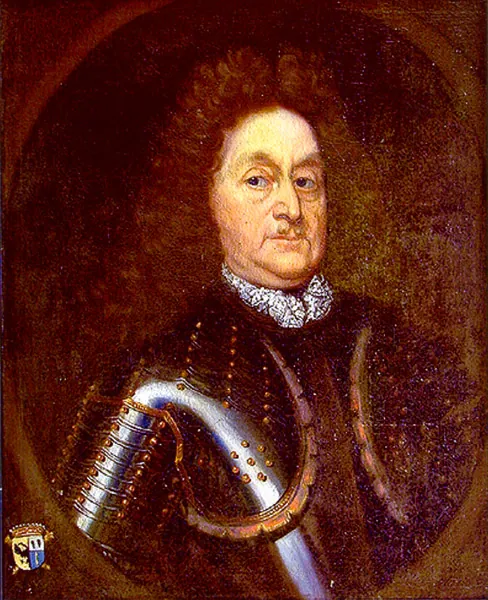
The painted portrait of Ignatius van Kingma hangs in Heringa-State in Marssum (± 4 km west of Leeuwarden). This state (a Frisian manor house with land), whose year of construction is unknown, was inhabited in the 16th and 17th centuries by members of the Heringa and Eysinga families. The last resident, Anna Eysinga, died in 1676. In 1687 the state was bought by dr. Henricus Popta; he was a lawyer at the Court of Friesland and used the state as a summer residence. That is why Heringa-State is commonly known as Popta-Slot. Henricus Popta, who had become a wealthy man by living frugally, also founded a Women's Almshouse next to the Slot (he knew from his own background what poverty was). Popta stipulated that, after his death, the Slot should no longer be inhabited. Slot and Almshouse are placed under the Stichting "Dr. H. Popta – Gasthuis", which is managed by a number of trustees. The trustees have imposed a strict ban on photography. That is why, on behalf of the Stichting Kingma State, I requested written permission to photograph the portrait of Ignatius. That permission was granted, and you can see the result in this Kinkhoorn.
The painting was probably once donated to the Fries Genootschap. In 1908 it was loaned, along with other paintings, to the Stichting Popta Gasthuis, and in 1929 it was purchased by that foundation. There was no special relationship between Ignatius and the residents of Heringa-State.
Ignatius is depicted in what was probably his official uniform as colonel, for by his appearance he was already over 50 and therefore held that rank. He had a good head of hair, probably his own, since the era of wigs had not yet begun. The peculiar look in his eyes, seen in many portraits from that period, is the result of shaved-off eyelashes. This was customary at the time to achieve a sterner appearance. At the bottom left the Kingma coat of arms can be seen. The portrait is set in a simple black frame and hangs in the small tower to the left of the door through which one enters.
Kees Kingma
The saddle cloth
Ignatius van Kingma was a colonel in the army of the United Netherlands and commanded a regiment of horsemen. He will therefore have used the saddlecloth in an official capacity for his horse on formal occasions. As the photographs show, it is a particularly fine cloth, consisting of two parts.
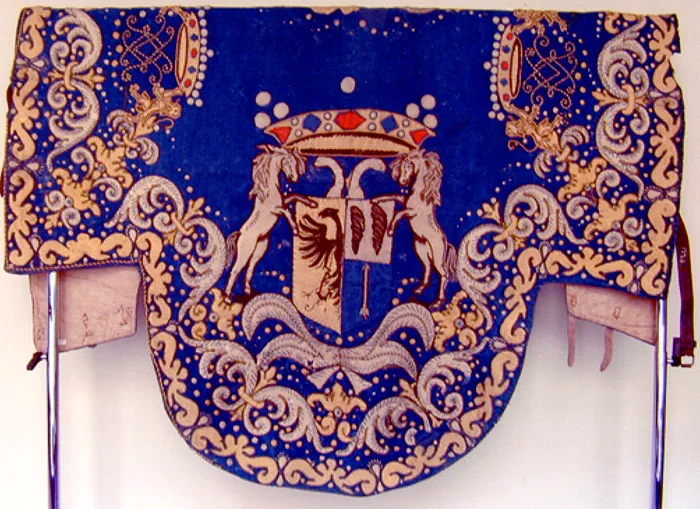
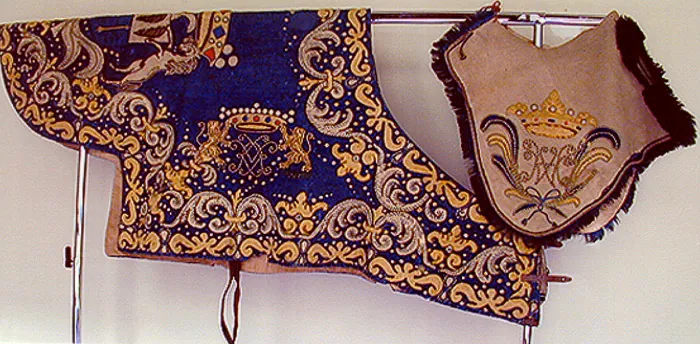
The largest part was laid directly behind the saddle, over the horse's back. This part bears the Kingma coat of arms, with two horses as supporters. The whelks (Wulken) in the coat of arms are not exactly depicted true to nature, but that is actually always the case, as for instance on the stone in the floor of the church in Zweins. The eagle's leg looks somewhat untidy, which is because the embroidery has come loose. The crest, a "rising swan," is applied twice, without a helmet. This is probably related to the fact that the coat of arms lay in the middle of the horse's back, and the observer looked at it from the side, so always saw only half of it.
The smallest part of the saddlecloth was hung in front of the horse's chest and around its neck.
It is a rarity for a saddlecloth to have survived. The Fries Museum owns only one, and that happens to be Ignatius's.
To take the photographs, the saddlecloth was taken out of storage and hung, in a room with sufficient daylight, over a clothes rack that happened to be available — a horse was of course not available. This brought certain limitations, which I have tried to work around as well as possible.
Kees Kingma
Wetenswaard
Actually the term goudgulden is a bit odd, since gulden means golden. The name gulden has its origin in the golden florenus that was already struck in Florence as early as the 13th century. Later the term gulden florene became common throughout Europe. After that came the "Karolus gulden" issued by Charles V, which was also made of gold. The designation Karolus soon fell out of use. During the Eighty Years' War, coins with too low an intrinsic value were issued to help finance the war. Those were probably not made of gold, or made with a lower gold content. To distinguish them, I think, the old guilders were then referred to by the name goudgulden.
The recently published book "De laatste Gulden" says about the value of the gulden: "In de 17e eeuw liggen de lonen in de industrie op ongeveer een gulden per dag."
That means that at the time a weekly wage came to 6 guilders and a monthly wage to 24 guilders. If we assume that a monthly wage today is roughly a hundred times that, then the State, by today's standards, was sold for 367,000 guilders. For a house like that, again by today's standards, that is remarkably little. If that guilder per day was not a gold guilder, then the calculation of course does not hold. The riddle of the value of the sale amount, it seems, has still not been solved. Who can say something sensible about this?
Kees Kingma
A black sheep in the family?
And here we are, boasting about our Kingmas.
Never knew that 'vagrant' was a profession.
By the way, how did Brigadier Rijken bring K. back with him? On the back of his horse?
And note also the wise lesson at the end.
Now, as it happens, my neighbour across the street is called René Klink. Naturally, I showed him this article too. And what do you know? His grandparents lived on a farm in Heino, on the Raalte side. His father was born there in 1903.
Perhaps our 'black sheep' once visited the house where my neighbour's grandparents lived.
As befits these times, I offered a heartfelt Mea Culpa on behalf of the family.
From the Raalter Courant (c. 1905)
Eene Kingma, van beroep landlooper, had j.l. Zaterdag te Heino bij Klink een paar klompen ontvreemd terwijl de huisgenoten lagen te slapen; toen de Marechaussees alhier dit vernamen, werd K. door den Brigadier Rijken alhier te paard achtervolgd; hij had de richting op Almelo genomen; zeer spoedig kwam hij met den persoon terug; daar het alleen maar een paar oude klompen betrof en niets anders was ontvreemd, werd hij op vrije voeten gelaten, na voorzien te zijn van een paar schoenen; de zijne waren zeker versleten; een ieder zette zijn schoeisel liever binnen.
N.B. Should you, dear reader, have editorial contributions that might shed light on or enliven our family history, do not hesitate to send them to the editors.
Kingma Kronkels: Extremes

Joost Kingma
Our Kingma family too has its extremes.
And I have recently gotten to know two of them better.
Last year's Kingmadag in Zweins was graced by several dozen visitors from foreign parts. Kingmas from far away.
This unique gathering thus prompted, among others, Cheryl and Aeger Kingma from Echuca, Australia, to visit the heitelan. Those who were there that day probably still remember him: a big man wearing an even bigger, typically Australian hat, if that was possible.
On that occasion, Aeger and Cheryl invited us to come and visit them sometime.
As it happened, our eldest daughter, Lotte, spent last year in Australia on a gap year after secondary school. A fine opportunity, then, for her parents to get better acquainted with both this country and these far-flung Kingmas. We visited Aeger and Cheryl in December. They run a very modern, large-scale pig farm with more than ten thousand animals in the state of Victoria, in the deep south of the vast Australian continent. Aeger emigrated as a small boy with his parents after the war. His family comes from the area around Franeker.
Via the winding path that information sometimes takes, I subsequently got in touch with a Kingma living in another extreme corner of our world: Tierra del Fuego.
After returning from Australia, I found an e-mail from a certain Carlos Kingma Gervola of Punta Arenas, Chile. A map of South America provided the answer: Punta Arenas is the southernmost city in that country. I had never realized that this part of the world was inhabited too. Carlos told me he had come across our foundation via a certain Yenny Kingma from New York, who had sent him a copy of our invitation letter for the Kingmadag. Unfortunately he had received the letter too late to take part, but he was planning to come to the Netherlands this spring and would love to meet one of us to hear more about his 'roots'.
On a Thursday in May, I unexpectedly received a call from Paris from someone who told me that Carlos and his wife would be in Amsterdam from the next day on, and asked whether they could meet me. That weekend I met Carlos (who turned out to speak only Spanish, a language I don't really have a command of) and his wife. Despite the language barrier, it turned out to be an exceptionally enjoyable meeting, in which I was able to tell him a thing or two about our search into the family history, and I myself learned a lot about Chile and the harsh climate at the southernmost tip of the American continent.
We now have a fairly good picture of the two most far-flung Kingmas (Australia and Chile). Or does anyone know of a family member positioned even more extremely?
Colophon
'De Kinkhoorn' is a periodical publication of the Stichting Kingma State.
The periodical is sent to donors of the foundation.
You can become a donor by transferring an annual amount of at least f 25,- (Dutch guilders, the currency in use before the euro) to account number 55.00.97.538 at the ABN AMRO bank in Arnhem, in the name of the Treasurer, Stichting Kingma State.
Print run: 150 copies.
Published two to four times a year.
Stichting Kingma State
Secretariat:
Sterrenboslaan 20, 3972 GD Driebergen
phone: 0343 521212
fax: 0343 517689
email: kingma@worldonline.nl
website: www.kingmastate.nl
Board
Chairman: C.S.J. Kingma, Emmen
Secretary: J.H. Kingma, Driebergen
Treasurer: J.M. Kingma, Arnhem
Board member: W.J. Kingma, Valkenswaard
Design and production
Drukkerij Bakker Baarn