IV De Kinkhoorn
De Kinkhoorn 5 — April 2002
Volume 3, number 1
This issue as pdf (Dutch) · Read the Dutch original · the German translation by Ralf J. Kingma
Foreword
Spring 2002. The Kingmadag of Simmer 2000 already seems long ago. More recent is the first meeting of donors on 24 November 2001 in Zweins, which drew excellent attendance. See the report of the meeting in this issue. Worth mentioning is that at the end of the meeting the board of our foundation was presented, by Ton Hilverda on behalf of the Zweins community, with a first stone for the new State, neatly packed in a small wooden box. It was a large old stone measuring 33x16.5x9 cm. According to Mrs Mulder-Radetzky the stone is probably older than the smaller monastery bricks and may date from the late Middle Ages. So perhaps the stone comes from Kingma State or Sate after all? We are grateful to the donors for this gesture.
It stands to reason that most can be found about the last inhabitants of the State. That is why we have already been able to publish a great deal about Ignatius van Kingma. He was, as is well known, the last Kingma to live at the State. But the truly last inhabitants were, after the van Ghemmenichs, the van Beijma thoe Kingmas. Since we are interested not only in the history and genealogy of the Kingma family but also in the history of the State and its associated inhabitants, we will devote attention to them as well. And here too it is easiest to start with the last inhabitants. Those were Julius Matthijs van Beijma thoe Kingma and his wife and children. You will therefore find a story about them in this Kinkhoorn, with photographs of painted portraits that I was able to take thanks to the kind cooperation of a descendant, Jhr. C.L. van Beijma thoe Kingma.
Kees Kingma
Chairman
Donors' meeting 2001
This first meeting, with some 40 enthusiastic participants, can in my view be called a success. To begin with, we showed, projected in colour, various photos that had already been published in the Kinkhoorn. Also a few not-yet-published photos of the memorial stone commemorating the accident of 6 January 1665, already recalled in various issues of the Kinkhoorn. In it, Johan Maurits van Nassau, in the company of Ignatius van Kingma, together with four more riders, fell through the bridge in the Dijkstraat. This memorial stone is set into the façade of the former Claerkampster orphanage, founded in 1597 (now a cultural centre for young people), on the corner of the Dijkstraat and the Godsacker, by the notorious, now modernized, bridge in Franeker. In Kinkhoorn 3, on page 4, a painting or drawing by Romeyn de Hooghe can be seen depicting the scene, which apparently served as the model for the relief on the orphanage, which incidentally shows the mirror image.
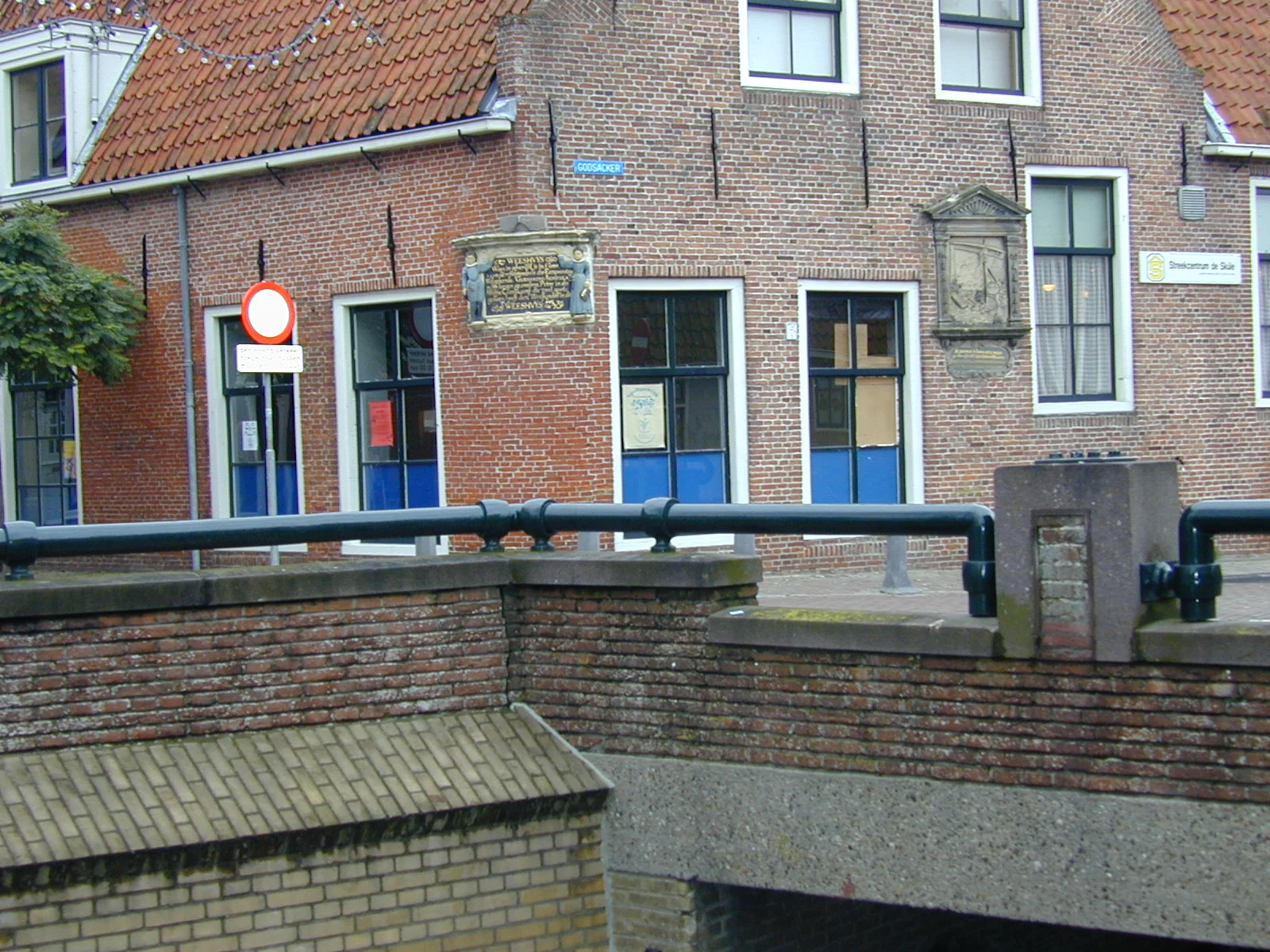
A photo of the present-day bridge with the orphanage behind it is enclosed. On the right of this photo the relief with its gate-like frame can be seen.
The inscription beneath it reads:
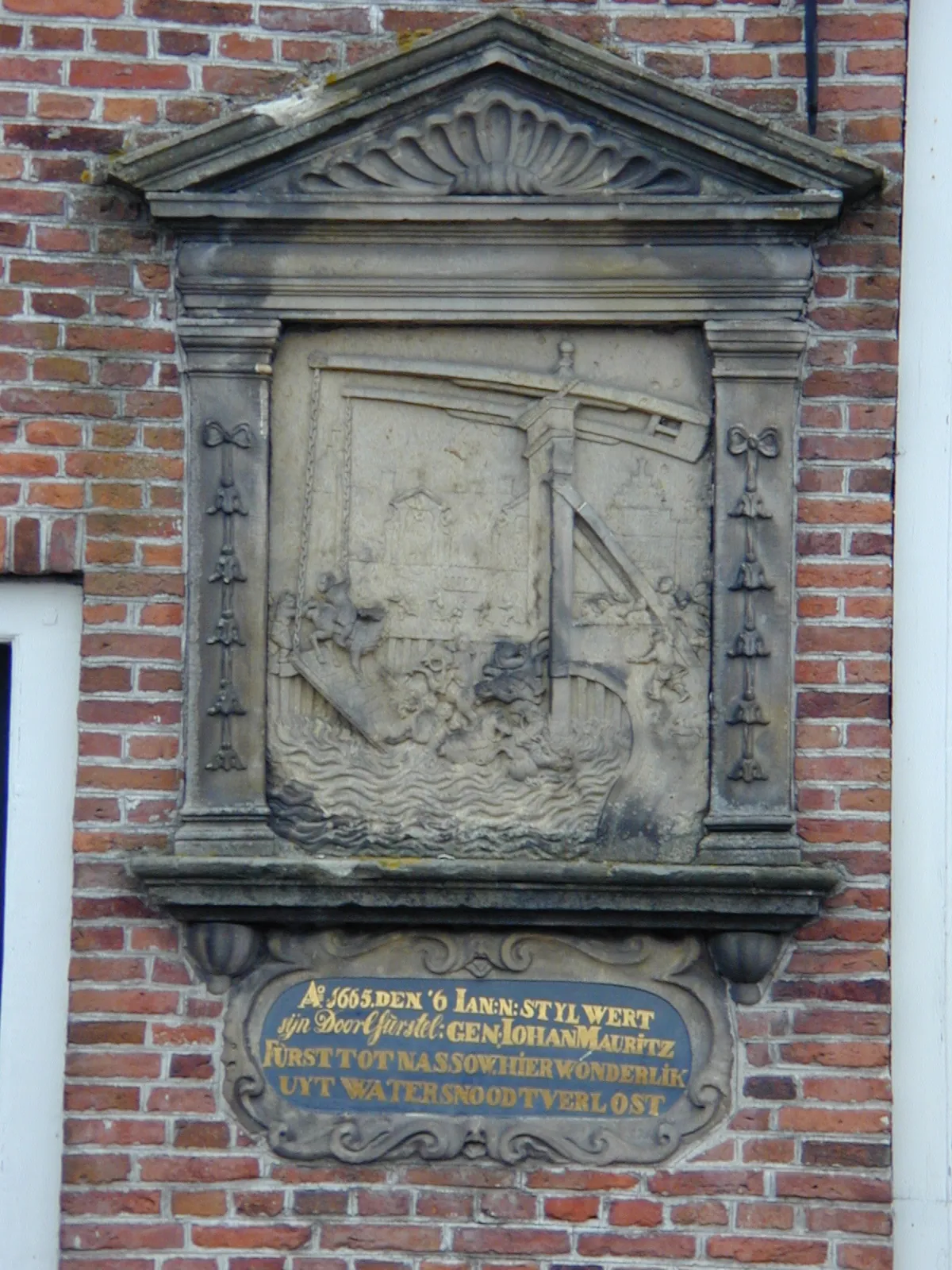
“Ao. 1665 den 6 Jan. n. stylwert1 sijn Doorl. Fürstel. gen. Iohan Mauritz Fürst tot Nassow hier wonderlik uyt watersnoodt verlost”.
Furthermore, a presentation was given about the plans and possibilities for the future and the considerations relating to them.
After that the floor and the projection screen went to art historian Mrs Mulder-Radetzky, who gave an interesting talk about the development of stinzen (fortified stone houses) and staten (Frisian manor houses with land).
1 STYLWERT: This refers to the use of the old calendar. Pope Gregorius XIII introduced the Gregorian calendar in 1582. In various Protestant countries and regions, however, people refused to adopt the Gregorian calendar. In Friesland, among other places, the Julian calendar continued to be used until 1700.
The last residents of Kingma State
The last residents, before the sale and demolition in 1864, were Julius Matthijs van Beijma together with his wife and children. His father was Coert Lambertus van Beijma, the well-known patriot who fiercely criticized the despotism of the stadtholder. For instance, the conflicts with the stadtholder over the appointments of *grietmannen* (the heads of Frisian *grietenijen*, roughly comparable to district magistrates) played a role. In 1787 Coert Lambertus led a coup in Franeker and became head of a counter-government. When the Prussian army, called in for help, invaded the Republic, many patriots fled. Most of them ended up in Saint Omer in northwestern France. Thus Julius Matthijs, born on 25 September 1781 in Ternaard, spent part of his youth in Saint Omer. In 1795 they returned in the wake of the French.
Julius Matthijs initially held various positions relating to government finances. From 1819 to 1820 he was a justice of the peace in the canton of Hindelopen.
Still holding this position, he submitted a request to King Willem I for permission to add “ de toenaam of tytel thoe Kingma ” to his name and to his family coat of arms. Apparently that could not simply be done.
Through a document dated 2 February 1821 he was granted permission for the addition to his name. This document begins with the opening:
“ Wij Willem, bij de gratie Gods, Koning der Nederlanden, Prins van Oranje – Nassau, Groot – Hertog van Luxemburg, enz., enz., enz. ”.
Then follows the description of the request, after which it continues: “ Gehoord het Rapport van onzen Minister van Justitie van den 31 Januari 1821, nº 360; Hebben goedgevonden en verstaan:
1º Aan voorn. Julius Matthijs van Beijma toe te staan om achter zijnen geslachtnaam te voegen den toenaam of tytel Thoe Kingma , en zich alzoo te schrijven en teekenen Julius Matthijs van Beijma Thoe Kingma ; met dien verstande niettemin dat van den alzoo aan te nemen toenaam, geen gebruik zal mogen worden gemaakt, dan één jaar na dat dit ons besluit in de Nederlandsche Staatscourant zal zijn aangekondigd, en behoudens ons regt tot intrekking van deze vergunning, indien daar tegen regtmatige vertoogen mogten worden gedaan”.
Furthermore, this document states that the report of the Minister of Justice and the petition of J.M. van Beijma must be handed to the High Council of Nobility 1 “ten einde, onder terugzending van een en ander, ons (de Koning) te dienen van deszelfs consideratien en advies, voor zooveel betreft het door den Suppliant gedaan verzoek, om permissie tot het aannemen van het wapen Thoe Kingma ”.
The Minister is charged with the “ executie ” regarding the addition to the name, with sending a copy to the High Council of Nobility “ tot informatie en nazigt ”, and with notifying the petitioner in the usual manner. Then follows the signature:
“Brussel den 2 n Februarii 1821.
/geteekend/ Willem.
Van wege den Koning
/geteekend/ J.G. de May van Streefkerk
Accordeert met deszelfs origineel
De Griffier ter Staats-Secretarie. ”
Illegible signature.
After that follows a document dated 9 March 1821, with the same opening and the same signature. 2 The text reads as follows:
“Nader gelet op dat gedeelte van de Rekwesten van Julius Matthijs van Beijma , vrederegter van het Kanton Hindelopen , en Lid van den Commissie van Landbouw in de Provincie Vriesland , betrekking hebbende tot het verzoek om vergunning, teneinde bij zijn geslachtwapen het wapen van thoe Kingma te mogen voegen.
Gezien het rapport van onzen Minister van Justitie; gehoord het advies van den Hoogen Raad van Adel;
Gelet op ons besluit van den 2 n Februarii Nº 88;
Hebben goedgevonden en verstaan het voornoemd verzoek in te willigen zoo als geschiedt bij dezen; zullende de Rekwestrant na dat aan de bepalingen van ons bovengemeld besluit zal zijn voldaan gehouden zijn, zich aan den Hoogen Raad van Adel te adresseren, welke nu voor als dan gemagtigd wordt om de Rekwestrant eene akte houdende vermeerdering van zijn geslachtwapen met dat van thoe Kingma op te maken en aan ons ter onderteekening aan te bieden.
En is de Hooge Raad van Adel belast met de uitvoering dezes, waarvan kennis zal worden gegeven aan onzen Minister van Justitie en op de gewone wijze aan den Suppliant.
With this, both requests were thus granted, although the implementation will probably still have taken some time.
His unmarried uncle Eduard Marius van Beijma was *grietman* of Franekeradeel and lived at Kingma State in Zweins. When he died in 1825, Julius Matthijs became *grietman* of Franekeradeel and resident of Kingma State. He also held numerous other positions, such as: member of the agricultural committee in Friesland, member of the Provincial States of Friesland, co-founder and board member of the Friesch Genootschap, and member of the committee for the preliminary inquiry into the levying of the extraordinary tax.
Besides owning the State together with its associated grounds — garden, driveway and *opvaart* (the private waterway linking a *state* to the wider canal network) — totaling about 5.8 ha, he also owned much of the land lying directly around the State (pasture and arable land). He was furthermore the owner of the brickworks on the tow-canal and owned 16 of the 18 houses of Kingmatille. The two tollhouses belonged to the city of Franeker. The tow-canal, or at least 14,640 m² of it, was also registered in the name of Julius Matthijs, but he was probably only the usufructuary (for tax purposes). The towpath along the tow-canal, in turn, belonged to the city of Franeker.
In addition, Julius Matthijs owned nine more houses in Franeker and a great deal of land in a wide area around Zweins. 3
Besides Julius Matthijs's request to be allowed to add “thoe Kingma” to his name and coat of arms, he also requested to be recognized as belonging to the nobility. 4 In 1814, namely, a constitution had been adopted that provided for representation of the estates, through which the nobility, via the provincial *ridderschappen* (the colleges representing the nobility in each province), regained a constitutional function. The *ridderschappen* were thereby given the task of choosing a number of members of the Provincial States from among themselves. The Provincial States in turn chose the members of the States General.
This request was granted as well. In this connection a document can be found in the Ryks Argyf, dated 10 April 1842. 5 Here too the opening is “Wij Willem” etc., but now it is King Willem II.
Then follows a list of Julius Matthijs's most important positions, and the statement that, on the grounds that he descended from the noble family of van Beijma, he was recognized as “ als te behoren tot den Adelstand der Nederlanden met het predikaat van Jonkheer Hoogwelgeboren, in alles met zulke regten als hem en zijne kinderen, als van ouder tot voorouder uit een geslacht gesproten hetwelk vroeger in de Nederlanden voor Adelijk was erkend, zouden competeren ” (toekomen).
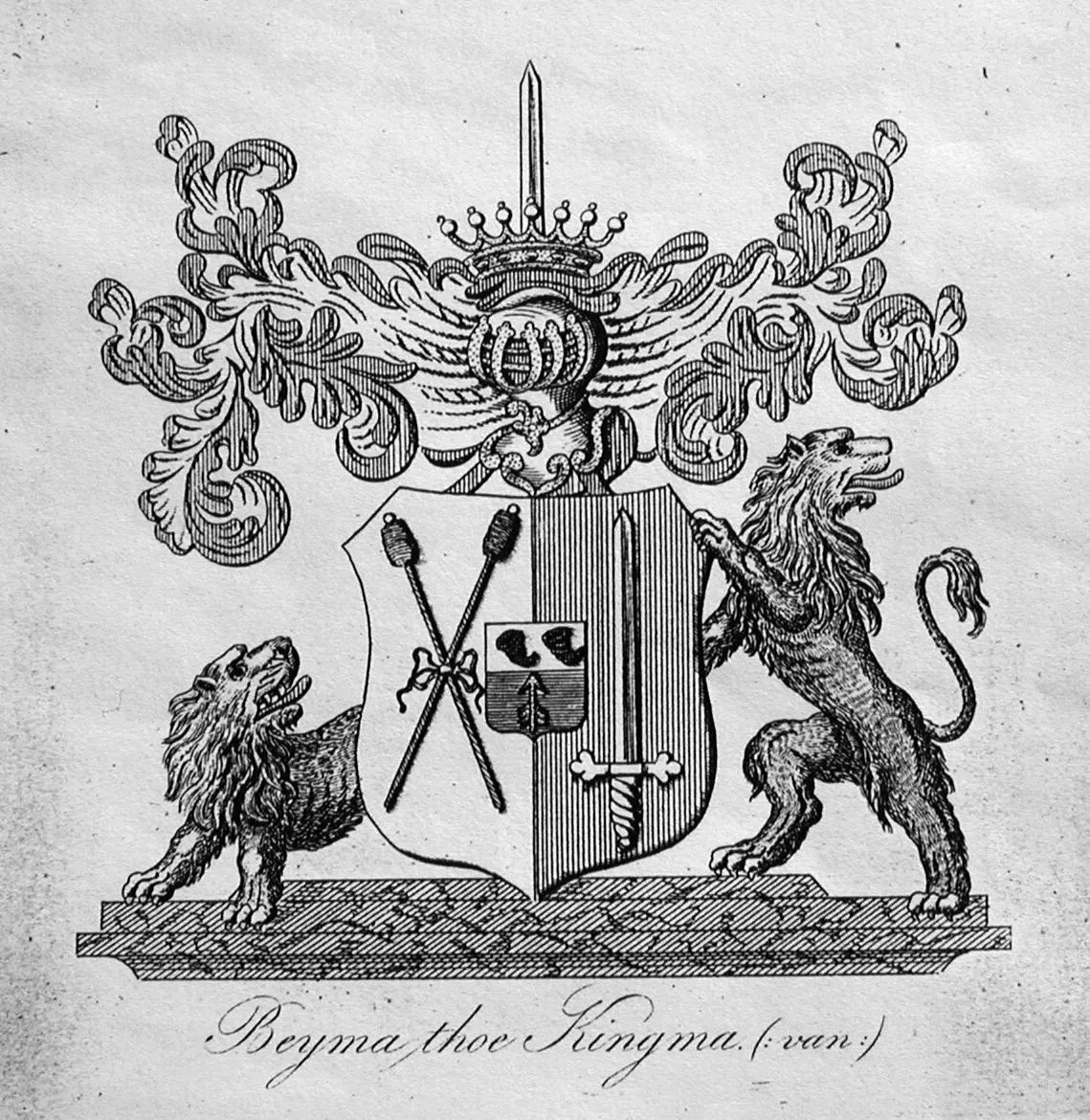
Then follows permission “ het aloud Adelijk wapen van zijn geslacht te blijven voeren ”, after which the following description of the coat of arms follows: “een schild parti 6 waarvan de eerste helft van zilver beladen met twee kruislings geplaatste en met een zwarte band te zamen gebonden waterlischen (=Lisdodde) in deszelver natuurlijke kleuren. Het tweede gedeelte van keel (= rood) beladen met een zwaard van zilver de punt opwaarts, voor Surtout 7 , Coupé 8 , het bovenste van zilver beladen met twee Tritonshoorens van sabel (=zwart), het onderste van lazuur (=blauw) beladen met een gouden pijl, de punt opwaarts. This last part refers to the old Kingma coat of arms, still without the Frisian half-eagle. It is remarkable that here the term “Tritonhoorns” [Triton's horns] is used, and that they are also depicted that way, rather than as “Kinkhoorns” [conch shells]. This mix-up, incidentally, is encountered quite often. Gold is also mentioned as the color of the arrow, whereas it should be silver.
Then follows a description of the “ schilddekking ” (the crest and mantling above the shield), which consists of a barred helm of silver, “ op dezelve eene kroon van goud met zeven paarlen van zilver ”. This is remarkable because seven pearls belong to the coat of arms of a baron. For a *jonkheer* (a rank of untitled Dutch nobility, ranking below baron) there should be five. 9 The crest is the sword that also appears on the shield. Furthermore, mantling, and a walking lion and a rearing lion as supporters (see accompanying illustration).
After that, a number of formal matters are mentioned, followed by various signatures “vanwege den Koning” and on behalf of the High Council of Nobility and the Provincial Executive of Friesland.
On 29 June 1806, Julius Matthijs married Agatha Wilhelmina Sybrandsdochter van Voss. They had seven children.
Julius Matthijs died on 14 September 1847. Three of his children had already died by then. His youngest son Ulbo Jetze Heerma succeeded him as *grietman* of Franekeradeel and afterwards lived with his mother at Kingma State.
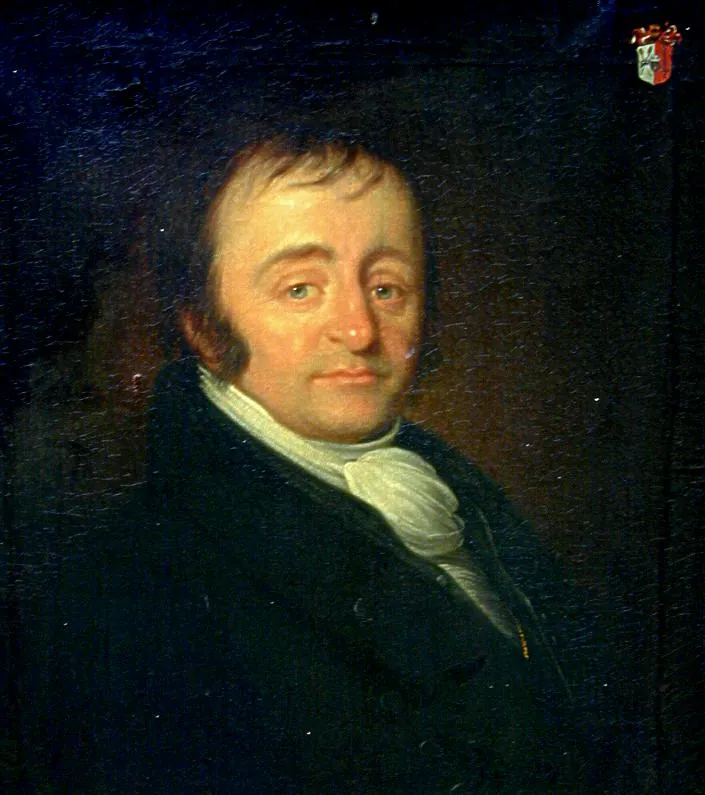
The will of Julius Matthijs stipulated that his wife would receive full usufruct of all his possessions. On 20 April 1848 she relinquished all her rights in favor of her four sons, namely Coert Lambertus, living in Joure, Sijbrand Willem Hendrik Adriaarn, living in Leeuwarden, Frederik Hessel, living in Heerenveen, and Ulbo Jetze Heerma, living at Kingma State near Zweins. In return, Agatha Wilhelmina van Voss could use all the furniture she deemed necessary, and the four sons would each pay her a thousand guilders (the currency then in use, before the euro) annually in two installments. 10
As of 12 May 1856, Agatha Wilhelmina rented a house in Leeuwarden located on the north side of the Eewal. She lived here until her death on 12 August 1861. On 6 August she apparently felt her end approaching. She then sent a courier on horseback to Zweins. This is evident from a bill for this of ƒ 6.-. She was brought to Zweins by boat in a coffin and buried there on 14 August.
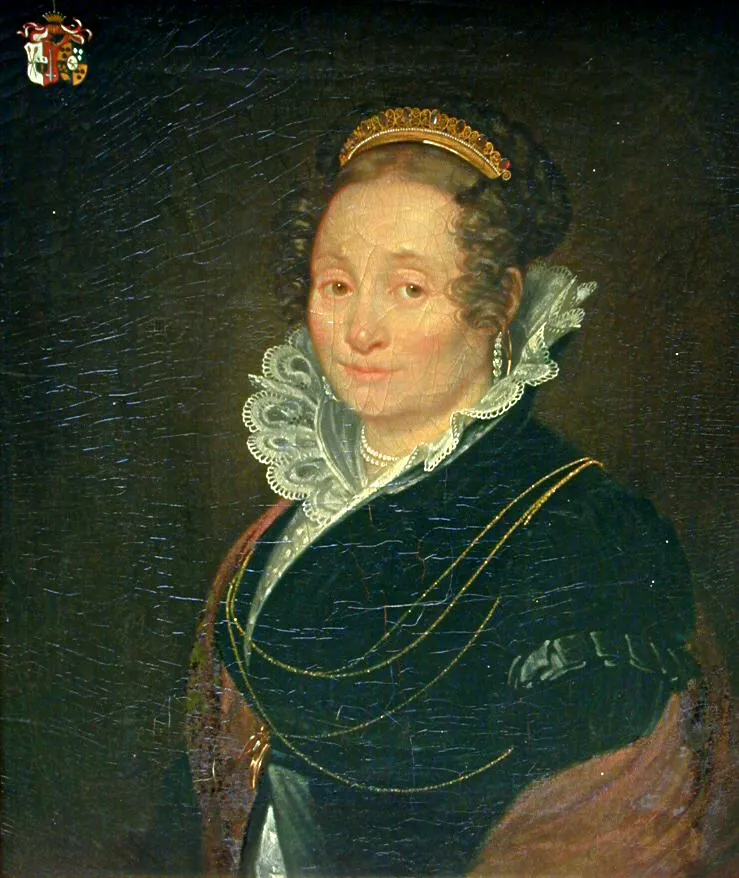
Various bills relating to her funeral have been preserved in the archive, and they give an interesting idea of the value of the guilder in that period: upholstered coffin ƒ 50.- ; shroud ƒ 9.50 ; cloth over the coffin ƒ 21.50 ; caps (?) ƒ 17.88. Further funeral costs ƒ 120.30 + ƒ 9.50 for transport by boat.
On 15 and 16 October 1861, goods belonging to the estate of the heirs of Jhr. J. M. van Beijma thoe Kingma were sold in a *boelgoed* (a public sale of a household's goods) presided over by notary Zeper. A document has been preserved with a long list of goods and their prices. 11 I mention only a few simple items that nowadays we would probably simply throw away (and without a notary). Feather duster ƒ 1.10 ; jugs ƒ 1.35 ; potato bin ƒ 0.30 ; etc.
On 5 and 19 September 1864, the public sale finally took place of “Het buitengoed KINGMA STATE, met deszelfs roijaal Woonhuis, Stalling, Wagenhuis en Woningen, Boomen en Plantagie, Moestuin, Wandeldreven, Lanen en Cingels, Vijvers, Duiventil en Zwanendrift, Visscherij en verdere annexen, aldaar gelegen, bij den HWGeb. Heer Jhr. U. J. H. van Beijma thoe Kingma in eigen gebruik ”. Along with this, also a *Zathe* (an old spelling of *sate*, a Frisian farmstead) and several meadows.
But more about that another time.
Kees Kingma
1. Established in June 1814.
2. Both documents can be found in the Ryks Argyf in Leeuwarden: under access number 319, inventory no. 347. Both documents bear a pre-printed heading and a stamp with a crowned coat of arms featuring the Dutch lion and the text 7½ St Zuid-Holland.
3. The data on ownership come from “Kadastrale Atlas fan Fryslân 1832 ; Diel 4 - Frjentsjerteradiel en Frjentsjer”. The bridge-keeper's house and other possible properties south of the Trekvaart lie in the municipality of Littenseradeel, formerly Hinnaarderadeel, and are therefore not listed in “Diel 4”.
4. Recognition in the Dutch nobility could be granted to members of families who, before 1795 (that is, before the start of the French period with its “égalité”), had belonged to the nobility of the provinces of the then Republic of the Seven United Netherlands. (In addition, the King could at that time elevate someone to the nobility, for instance on the grounds of merit. Members of families that had belonged to foreign nobility could be incorporated into the Dutch nobility.)
5 Also to be found under access number 319, inventory no. 347. This document must be a copy of the original, since it is a ruled double folio sheet without official pre-printing and without a stamp or signature. The text is written around a depiction of the Beijma coat of arms, drawn in the middle of the sheet, with crest and supporters.
6 *Partie* = divided. Heraldic term meaning “vertically divided”.
7 Surtout = above all. This refers here to placing another coat of arms, depicted small, in the center of one's own coat of arms — a so-called inescutcheon (*hartschild*).
8 Coupé = cut through. Heraldic term meaning “horizontally divided”.
9 See: “Familiewapens, oud en nieuw” by drs. J.A. de Boo, published by the Central Bureau for Genealogy, ’s Gravenhage, 1982.
10 See the document drawn up by the Dowager and her sons; Ryks Argyf Leeuwarden: access number 319, inventory number 401.
11 Access number 319, inventory number 426.
Who was Bernardus Kingma?
On 11 May 1649 a certain Bernardus Johannes Kingma marries in Engwierum to Tryntje Dircks. It was her second marriage. She had previously been married to Lieuwe Fockes Donia, who was not only judge and receiver in Engwierum but also lived at Donia State. Donia State is one of the most important places in Engwierum; in 1698 the farm measures no less than 160 pondemaat (about 58 hectares).
Bernardus Kingma must certainly have been a suitable partner for Trijntje.
From this marriage of Trijntje and Bernardus a girl is born, at any rate in 1651 or '52: Trijntje Bernardus Kingma.
Trijntje marries twice: her first husband is Arrien Pytters, her second Gerryt Gerrits. From the latter marriage five children are born, including, in 1677, my ancestor Arjen Gerrits.
The name Kingma then disappears from the family. Not until 1777 does the name resurface, when Eelse Gerrits (grandson of Arjen Gerrits and thus great-grandson of Trijntje Bernardus Kingma) becomes bijsitter (a lay judge, or alderman) in Oostdongeradeel and adds that surname to his own. There appears to be a parallel here with Hylke Jans from Makkum who, in 1772, (when he becomes bijsitter in Wonseradeel) at the urging of the grietman (the head of a Frisian grietenij, roughly comparable to a district magistrate), who knows that Hylke is, through the female line, related to the Kingmas of Zweins, adds the name Kingma to his own.
Back to Bernardus Johannes Kingma. Research in the archives of Oostdongeradeel and the surrounding grietenijen and in the existing genealogies of the Kingma family (in the Ryksargyf Fryslân) has so far yielded me no further knowledge about Bernardus. Since Bernardus bears Johannes as a second name, it may be expected that his father was named Johannes. Was he then a son of Johannes Pieter Kingma, who farmed in Oentsjerk, Lichtaard and Reitsum, and who died in the last-mentioned place between 1675 and 1679?
Has research already been conducted into this Johannes Pieter?
F. Thoomes Kingma
Spieghellaan 2, 1217 RL Hilversum, telephone 035-6237962, e-mail fw.thoomes@trouwweb.nl
Kingma Kronkels: Wanderers

Joost Kingma
As the board of the foundation, last year we spoke with Coert Lambertus van Beijma thoe Kingma, and about the unique photo of the state that we showed earlier in the Kinkhoorn. And about the last residents of Kingma State, of which this time there is an extensive account.
In the conversation he told how his father had still seen, in 1945, the stone lions that once adorned the entrance gate to the state (a Frisian manor house with land). Coert Lambertus himself still saw one of the lions, in damaged condition, at the doctor's house in Dronrijp.
By then those lions had already become wanderers.
Just like all sorts of other things that had belonged to the household effects of the state. Take the wall clock now owned by Bauke Saakstra. It once belonged to the inhabitants of Kingma State. He himself now lives, in his old age, in Franeker. But his ancestors ran the pub in Kingmatille and bought that clock on the boelgoed (public sale of household effects) day of the state.
We have a photo of that clock together with its proud, current owner. We'll picture it next time. Because now we have no room left.
By the way, speaking of wanderers, we certainly shouldn't forget that Kingma, by profession a 'vagrant', whom we encountered in the previous issue in Heino in 1905.
And of course not our own Ignatius van Kingma either. He, after all, had a 'love child' with his girlfriend in Utrecht during his student days there.
This boy, Johan Uitdenbongaert, named after his mother's family name, became a 'merchant in silk fabrics' and was thus not exactly a homebody either.
Those Kingmas certainly aren't, as I already noted when I got to know the Kingmas from Australia and from Chile.
Meanwhile we know that the African continent, too, has not been spared Kingmas.
Our chairman, wandering through South Africa this autumn, riding in a bus about 150 kilometres east of Cape Town in the town of Montagu, suddenly spotted, looking out of his window, a sign reading: Kingma Lodge. In an attempt to make telephone contact from the next village, he discovered that there are no longer any Kingmas connected with this establishment. Unfortunately, however, he was unable to judge for himself the quality of the hospitality built up by Kingma hands.
That will have to be done by a future wanderer from among us. We do assume that he or she will repay this free travel tip with a concise travel report on the matter in this Kinkhoorn.
Request for donations 2002
Dear donor,
The Stichting Kingma State has now existed for more than two years. The enthusiasm of the first small group of Kingmas who started this has only grown in these three years. We are pleased to note that we are not alone and that more people want to hear about their family history and in particular the history of the Kingma State that stood in Zweins. As you know, the foundation was established to make it possible to carry out the research needed for this and perhaps realize the dream we have, namely to rebuild the state in due course. This was discussed enthusiastically together at the well-attended gathering in Zweins last November.
As mentioned, we are not alone and we do not carry out our research only for ourselves. We consider it very important to be able to share our findings with other Kingmas and interested parties. Wherever possible we try to work together with others and make use of available information to learn more about our history. A good example of this is bringing together the genealogical data from the various sources so that the Kingma family tree can be mapped out as accurately as possible. You can read more about this in the new Kinkhoorn.
De Kinkhoorn is our periodic publication with which we keep interested parties such as yourself informed of our activities. As you will understand, publishing this magazine and gathering information involves costs. Thanks to your donations we have, in the two years of our existence, been able to bring five issues of the Kinkhoorn into the world. We also organized, as a (modest) follow-up to the Kingmadag in July 2000, an autumn gathering. Given the large turnout, this will certainly be organized again this year. In short, we are clearly not the only ones curious about our past and we would therefore like to continue the work.
We hope that you will once again wish to make a contribution this year. To cover our costs, a contribution of 20.50 euro per year is needed. To give as many interested parties as possible the chance to stay informed of our work, we are setting, as last year, a minimum contribution of 12 euro. As a donor you will receive the Kinkhoorn and invitations to the activities we will be organizing this year.
For paying your contribution there are two options:
- You can transfer the amount to ABN AMRO account 55.00.97.538, in Arnhem, in the name of Stichting Kingma State, stating "Donatie 2002".
- It is also possible to have your contribution debited automatically from your account every year. If you would like to make use of this, you are requested to fill in the enclosed form and send it in. If you have already done so, the amount you indicated will be automatically debited from your account as of 1 May 2002.
We hope to be able to count on you again this year.
Many thanks in advance for your financial and moral support!
Kind regards,
STICHTING KINGMA STATE
Kees Kingma
Chairman
Colophon
'De Kinkhoorn' is a periodical publication of the Stichting Kingma State.
The periodical is sent to donors of the foundation.
You can become a donor by transferring an amount of at least 15 Euro annually to account number 55.00.97.538 at ABN AMRO bank in Arnhem, in the name of Penningmeester Stichting Kingma State.
Print run: 150 copies.
Published at least twice a year.
Stichting Kingma State
Secretariat:
Sterrenboslaan 20, 3972 GD Driebergen
tel: 0343 521212
fax: 0343 517689
e-mail: kingma@worldonline.nl
website: www.kingmastate.nl
Board
Chairman: C.S.J. Kingma, Emmen
Secretary: J.H. Kingma, Driebergen
Treasurer: J.M. Kingma, Arnhem
Board member: W.J. Kingma, Valkenswaard
Design and production
Drukkerij Bakker Baarn
This publication is registered with the Koninklijke Bibliotheek under ISSN: 1569-8645