
IV De Kinkhoorn
De Kinkhoorn 7 — April 2003
Volume 4, number 1
This issue as pdf (Dutch) · Read the Dutch original · the German translation by Ralf J. Kingma
Foreword
We began the year 2003 with a change on the board. Wieb Kingma of Valkenswaard, co-initiator and valued board member since the founding of our Foundation, has stepped down from his position due to lack of time. We are sorry, but we understand his decision. He was also the man who took charge of the genealogy and maintained contact with others interested in genealogy.
Fortunately we have found Tjeerd Kingma of Zwolle willing to take the vacant seat. However, he will not be concerned with the genealogy but will take on other tasks. To begin with, finding a new coordinator for the genealogy. On behalf of the other board members as well, I warmly welcomed him during our last board meeting.
The donors' gathering at the end of last November in Zweins once again attracted a great deal of interest, and the interesting talk by Mr. Veldman of Franeker was listened to with much appreciation. Especially for those who could not attend the gathering, Mr. Veldman has put a summary of his talk on paper, and you will find it on the following pages.
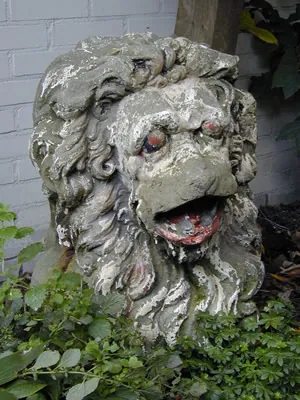
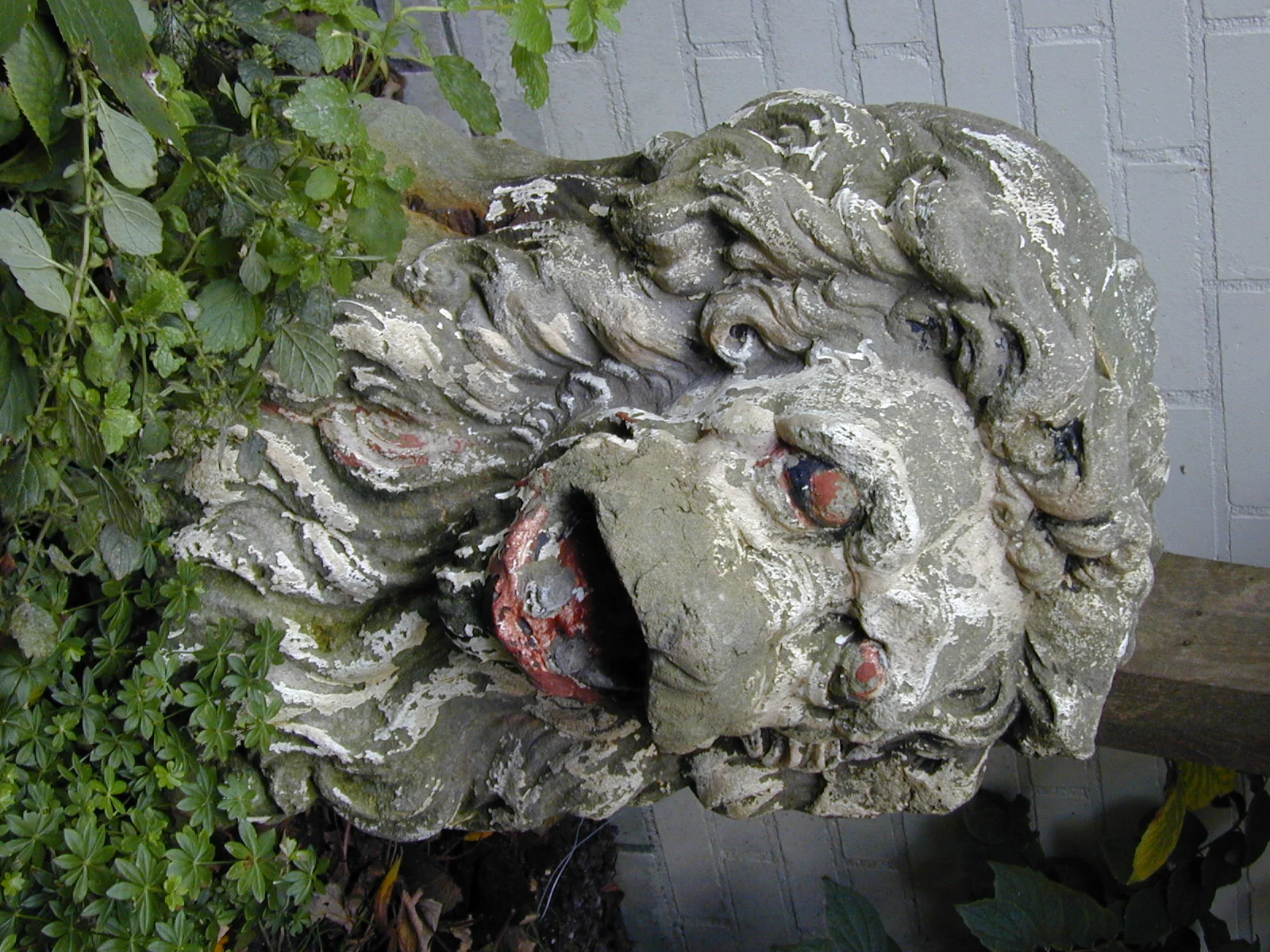
At this donors' gathering I again projected in color the photos published over the past year. But alongside those, also the photos I took of the lion found in Harlingen, which is claimed to have come from the State. There is serious doubt about that. Hence the question posed with the photos: could this really be a lion from the State, and is there anyone who knows a bit more about this? That produced no result, so here is a repeat of the question and a photo in this Kinkhoorn.
Kees Kingma
The lions of the State
Previous issues of De Kinkhoorn have already mentioned a statue of a lion that may once have stood at the State. This lion was owned by Dr. van der Kooi, who was a general practitioner in Dronrijp at the time. After he retired from practice, the lion moved with him to Harlingen. The doctor has since passed away, but I was able to track down the lion by chance and take photographs of it. See the accompanying image.
The big question now is: is this actually one of the lions that stood at the State?
If we look at the well-known watercolor by Martin, it shows two pillars at the entrance to the State grounds, topped, it seems, by seated lions. As far as can be seen, they hold a coat of arms with one front paw. This could have borne the Kingma coat of arms, but it could equally be the van Beijma thoe Kingma coat of arms (we do not know, after all, when these lions were placed). The coat of arms is not visible in the image, and the depiction is too small to make out any details.
The Harlingen lion is not a seated lion, but little more than a head with a long mane. Hence the doubt.
Inquiries with people who might know more, such as Bauke Saakstra, a former resident of Kingmatille now aged 90, brought no certainty. I then projected the photographs of the lion during the donors' afternoon, held this past November in Zweins, asking whether anyone could help us further. This produced no result.
Investigations by a helpful resident of Leeuwarden into possible descendants of the two buyers of the State, Kuilenberg and Hillebrand, who both came from Leeuwarden, have likewise produced no result so far.
The deed of sale for the 23 plots of land which were sold in a separate public sale, though on the same day as the State, states the following for plot seven: "De steenen beelden en losse steenen in het houtgewas blijven buiten de koop".
If this refers to the lions, it would mean that they remained in the possession of Ulbo van Beijma thoe Kingma. But this is not certain, because plot seven concerns the opvaart (the waterway leading to a state or sate), where the term used is "boomgewas". Plot six, however, concerns "Een cingel of laan met koepel ….kadaster nummer 504 … en wel van af den trekweg tot den kunstweg". This clearly refers to the driveway, where the term used is "houtgewas". By kunstweg is fairly certainly meant the sand road leading to the church, which is so clearly visible in Martin's watercolor. But the phrase quoted above, "tot den Kunstweg", could also mean that the lions were not included, since they stood on the other side of the kunstweg.
It becomes even more complicated when we take into account that, according to Bauke Saakstra, lions also stood at the entrance to the driveway, that is, by the trekvaart (the towing canal along which barges were pulled). According to him, these were reclining lions.
There may also have been more statues, since according to a sketch in the Ryksargyf (4160-7 Nr. 750), four statues stood in the garden of the State — at least if the sketch reflects reality and not a plan that was never carried out. These garden statues represented: Diana (goddess of the hunt), Ceres (goddess of agriculture), Juno (goddess of marriage) and Automatia (the goddess who brings about events that occur without human intervention). The last is not so well known under this name but is also called Thykê (Greek) or Fortuna (Latin). (with thanks to Roel Kingma of Zwolle)
All in all, there are still many question marks, and so there is still much to be found out.
Here, then, is a photograph of the "Harlingen" lion, in the hope that someone might yet turn up who can shed some light on this matter.
Kees Kingma
The little church of Boer
Boer is a small village in Franekeradeel, located about 3 km northeast of Franeker along the road from Dongjum to Ried.
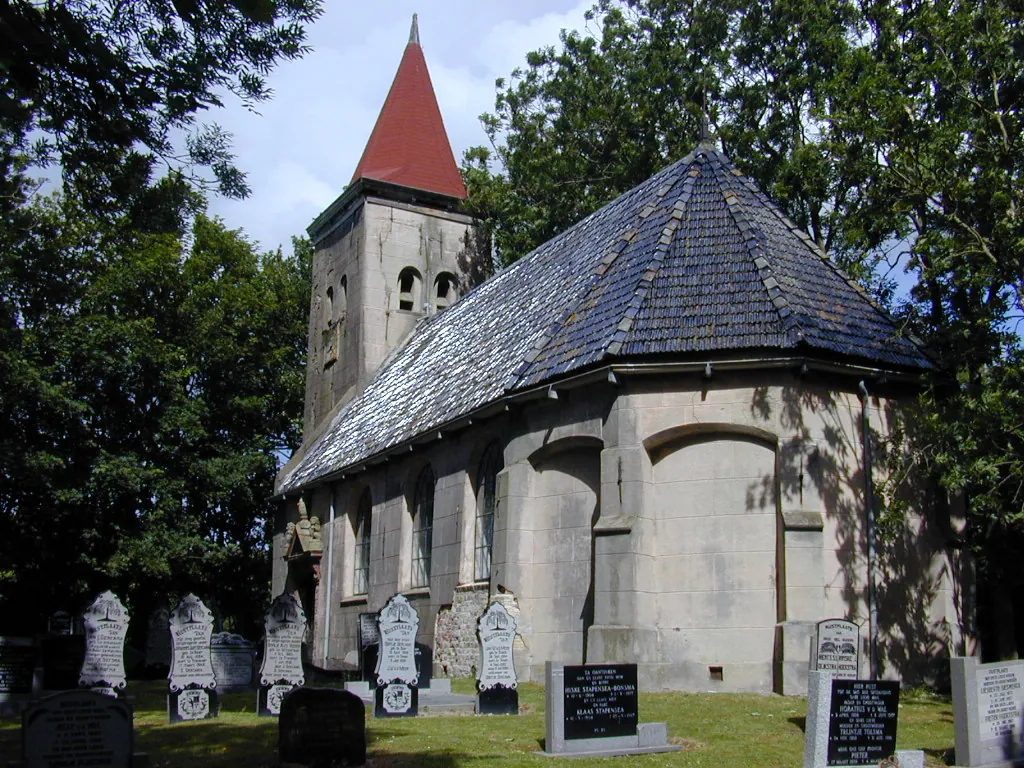
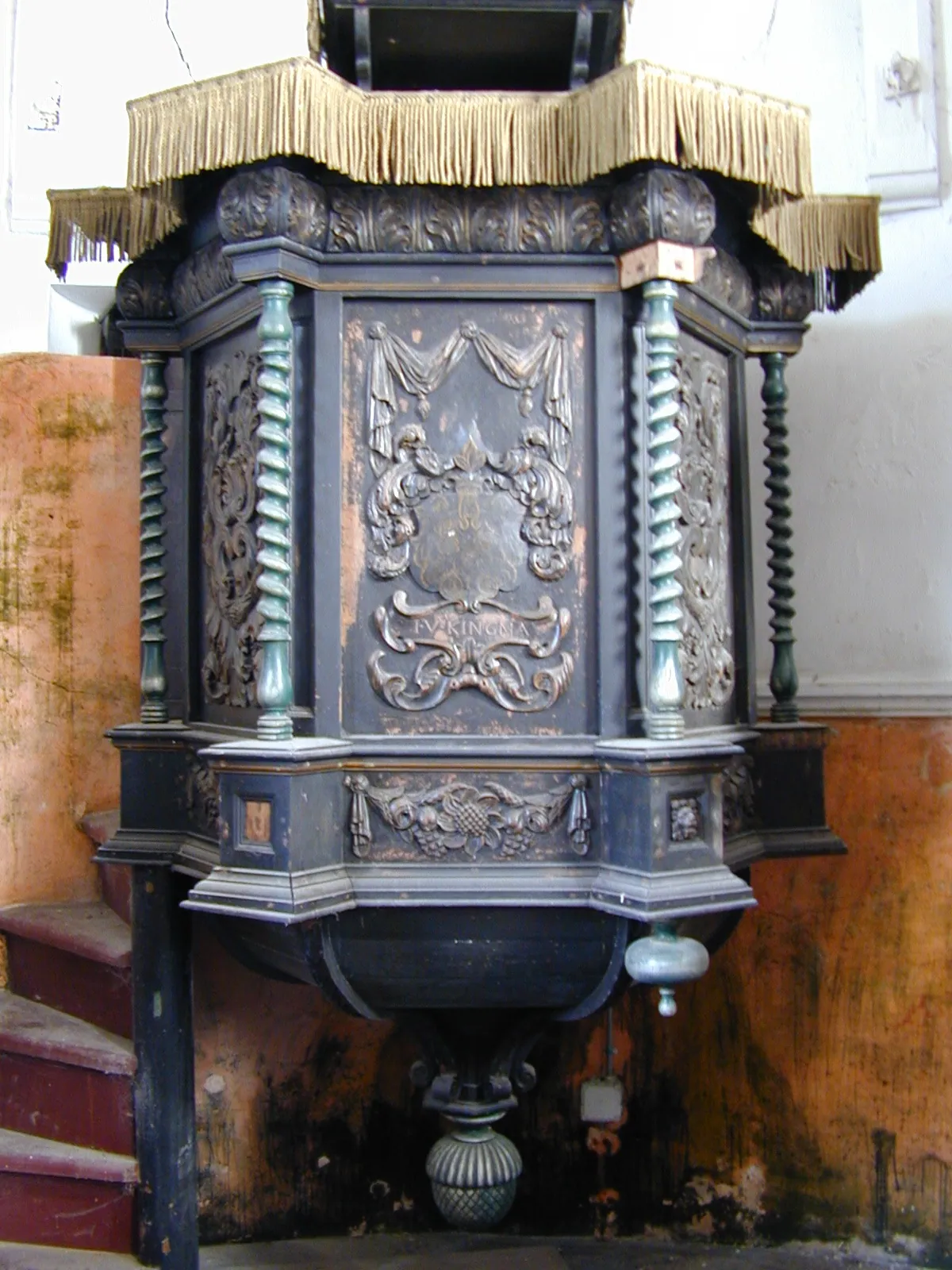
What makes the little church especially interesting to us is the pulpit. It was donated to the church in the 17th century by the well-known Colonel Ignatius van Kingma.
The church dates from the latter part of the 12th century and was built of brick in Romanesque style. The church and tower were later completely plastered. The tower has a spire that replaces the original saddleback roof. The semicircular choir has arches built between the buttresses, which were added at a later date.
On the south side there is an entrance porch, flanked by pilasters with festoons (garlands), topped by a fronton (a classical crowning feature of a façade or entrance, here in the shape of a triangle) with two shield-bearing lions and the year 1664. This porch came from the demolished Elgersma State, which once stood nearby.
The wooden barrel vault, fitted with tie beams, dates from 1570.
Originally it was a Roman Catholic church dedicated to the Holy Virgin. After the Reformation it became a Dutch Reformed church.
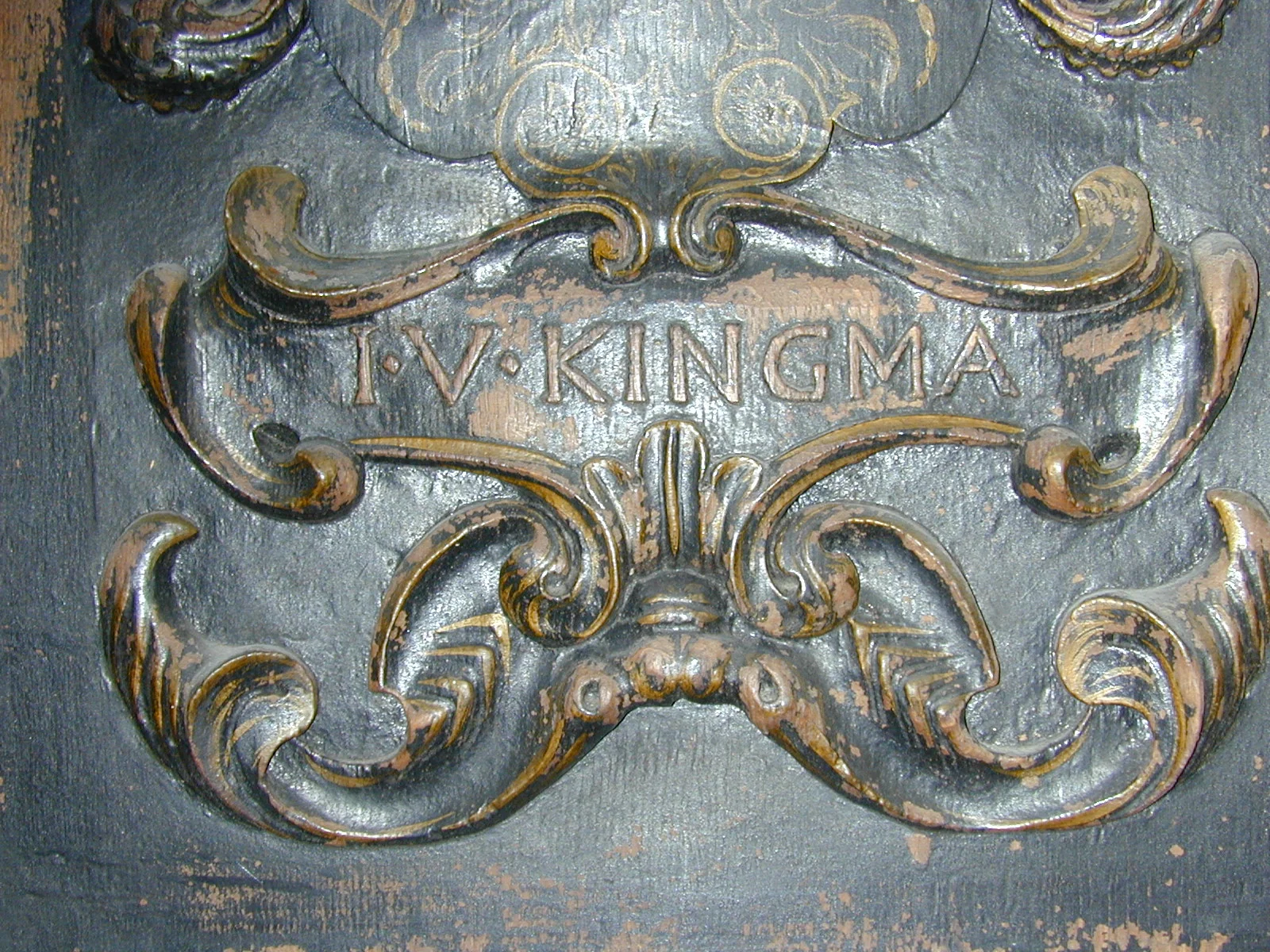
The most important part of the furnishings is the oak pulpit. It has ornamental carving on the panels and twisted balusters (carved spindles) on the corners. On the front panel is a coat of arms from which, unfortunately, the armorial device was removed (during the French period). Below it is inscribed the name of the donor, "I.V.KINGMA".
Given the donor, the arms were undoubtedly the Kingma coat of arms. After its removal, a kind of floral motif was apparently added to the shield.
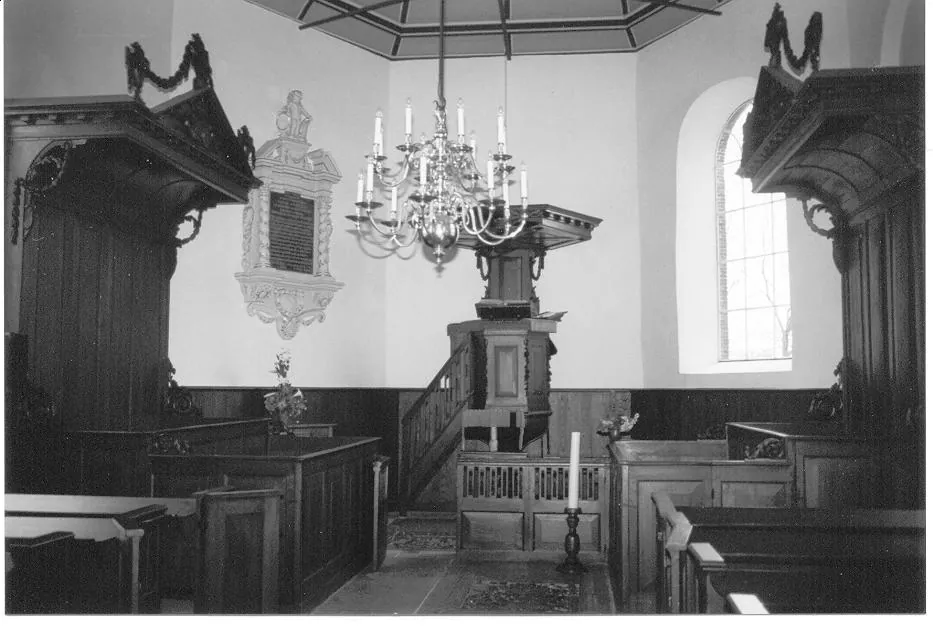
In front of the pulpit, closing off the choir, is a likewise 17th-century baptismal screen with turned balusters.
The church also still contains a 19th-century cabinet organ, a 17th-century tower clock, and a bell cast in 1561 by Wilhelm Wegewart. On either side of the pulpit stand 16th-century biers, housed there for lack of space.
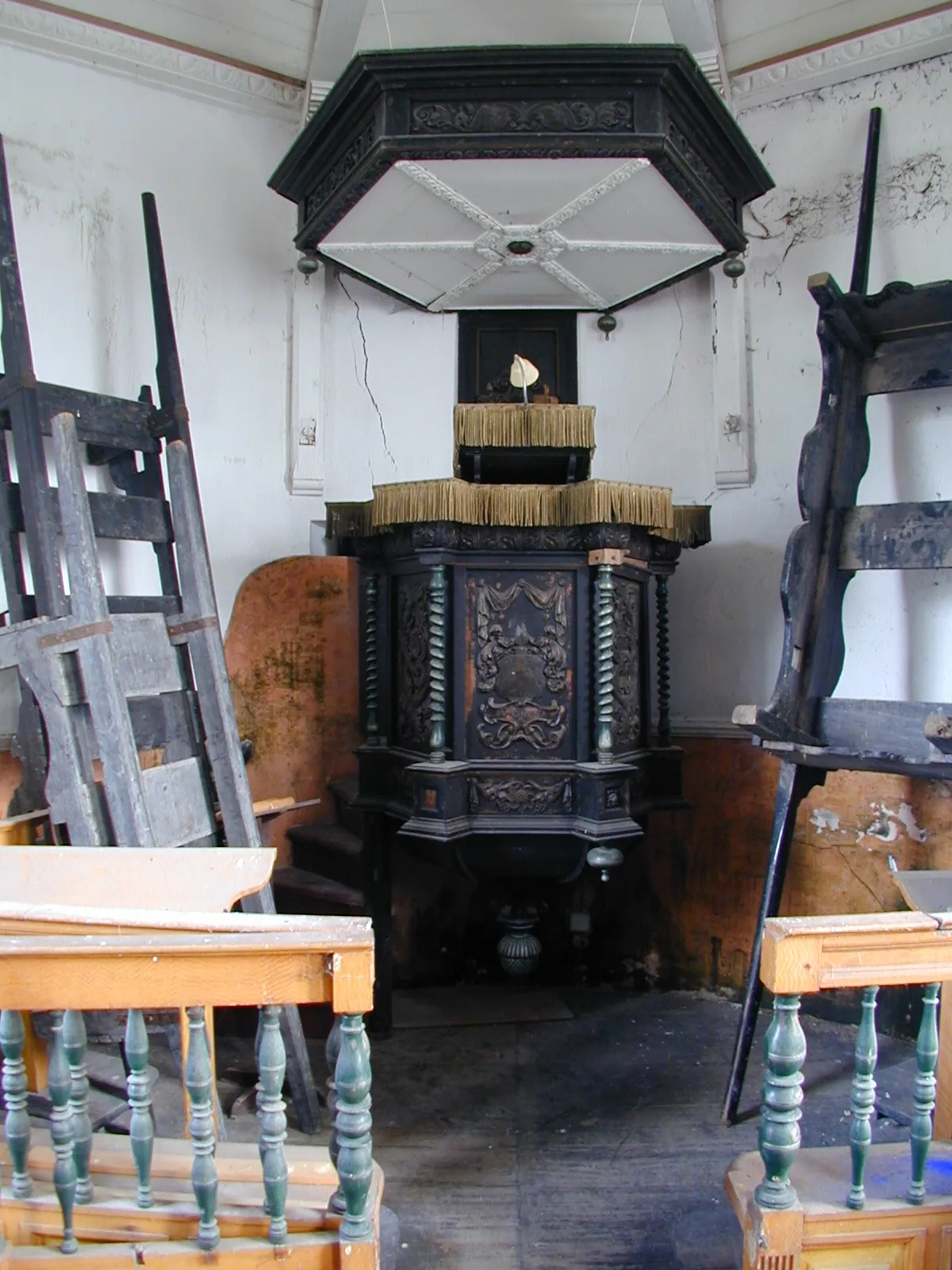
The church building is in very poor condition and has long since ceased to be used as a church. It was taken over in 1975 by the Stichting Alde Fryske Tsjerken (the population of Boer had by then already dropped to 65, and is presumably much lower now). A restoration plan was drawn up immediately at that time. For various reasons, however, the restoration still has not been carried out. One problem is, among other things, finding a purpose for the church. Since 1986 the Franeker artist Cees Launspach has used it as a studio and exhibition space. He has said, however, that after a restoration he no longer wants to work there, because of the changed "cleane" atmosphere that would result.
Some distance to the west of the church stands the former parsonage, a brick building from around 1500 with dovecote holes in the top of the side gable.
Why did Ignatius donate a pulpit to the church of Boer?
It was customary at the time for well-to-do people to further the salvation of their souls by making a donation to, for example, a church or orphanage. In addition, he had a particular connection to Boer because he owned property there, namely the farm he inherited from his wife Ida.
It is to be hoped that the little church and the pulpit will be preserved. But for that, a restoration of the church is absolutely necessary.
With thanks to Mr. Ulbe Zwaga, of the Stichting Alde Fryske Tsjerken, for the information provided.
Kees Kingma
Report of the talk by Mr Veldman
Report drawn up by Mr Veldman of his talk, given at the donors' afternoon on 23 November 2002 in Zweins.
Kingma State
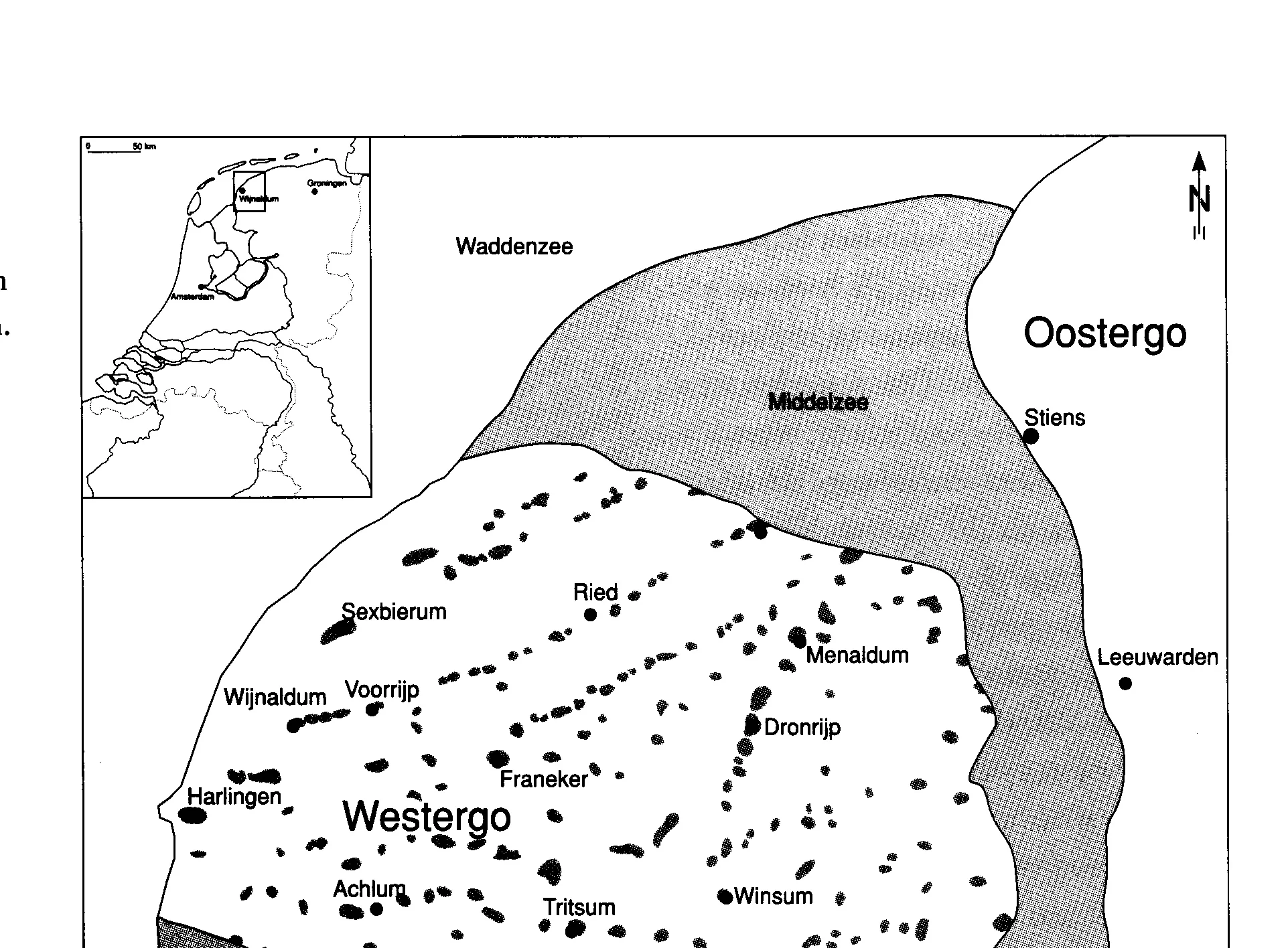
The area in which this state (a Frisian manor house with its surrounding land) lay was, just over two thousand years ago, a large tidal wetland — call it the Bangladesh of the Netherlands — a great delta area of the river Oer-Boorne. The village of Oldeboorn is named after this river.
In this landscape of tidal pools, creeks and channels, the so-called levees or salt-marsh levees formed along the channels — raised sand flats running alongside a channel. It was there that the heaviest silt particles settled. The soil there is sandier than further away, where the lightest silt particles settled because the water was calmer. This deposit is called knipklei (a heavy, blocky clay characteristic of these tidal-flat soils).
People first settled on these saltmarsh ridges, but when sea levels began to rise, they started raising their dwelling sites. This is how the wierden or terpen came into being.
The saltmarsh ridges in this area mostly run east-west. Thus there are saltmarsh ridges with terpen south of this area around Kingma State, though they all run more or less parallel to one another.
To the north there are also a number of terp rows, including the terp row Franeker-Schalsum-Peins-Slappeterp. A few years ago, the oldest small sea dike in the Netherlands was excavated near Peins. It consisted of stacked turf sods.
Another important saltmarsh ridge is that of Wynaldum-Dongjum-Boer-Ried-Berlikum. The terp excavation at Wynaldum gained international fame through the discovery of a magnificent gold cloak pin set with precious stones.
The Salverderweg from Franeker more or less follows the saltmarsh ridge of Kingma State. On that ridge lay four terps that still have names of their own: Edum - Sjaarda - Salverd - and Kinghum. (-verd = wierde; -um = hiem, homestead). We can therefore assume that farmers were already living on the terp Kinghum just over 2000 years ago. The habitation of these terps is thus very old. But the terp has told us nothing, because the excavation at the end of the 19th century was not carried out scientifically. There follows, then, a dark period of over 14 centuries in which we hear nothing of human presence.
Around 1400 the farms on this saltmarsh ridge were owned by the Sjaarda family. In the "Ordinatie van de rechtsomgang in Franekeradeel" and also in the accompanying register, which runs from 1406 to 1438, we find Kinghum listed as the enfranchised state of Sweins. There were no other enfranchised states in Sweins either.
An enfranchised state had the right, once every several years, to appoint one of the eight judges of Franekeradeel. One of those eight was appointed grietman (mayor).
Thus Sikke Sjaarda was judge of Kinghum in 1413, judge of Sjaarda in 1409, and judge of Salverd in 1408. The order was such that Kinghum could appoint a judge once every seven years.
The conclusion may well be that in 1413 Kinghum was owned by Sicke Sjaarda, who could also count Salverd, Sjaarda, and Edum as his property. The Sjaarda family was a powerful lineage in Westergo from the 13th through the 15th century. In 1237 a Sicco Sjaarda was potestaat (supreme magistrate) of Friesland, and in 1449 the Sjaardema's even had a proper castle built within the moats of Franeker. There is a hypothesis that the Sjaarda's could be heirs of the so-called king's men of the Frankish king Louis the Pious.
Kinghum is also mentioned in the will of Edwer Sjaarda in 1510. In it she bequeaths to her granddaughter Lutske Sjaarda, married to Gerrolt van Herema of Tzum, that "gued thoe Kinghum," which yields 9 florins. Also the feeding of a stallion every other winter. Should Lutske die first, it is not her husband who inherits; rather, that "gued thoe Kinghum" must remain with the Sjaarda's.
In the "Aanbreng" (land and tax register) of 1511, these 9 fl. turn out to be part of a yield of 40 fl. and 22 stuivers from the farm used by Pieter Jelle zoen thoe Kinghum. Used — is he a tenant?
We now come onto familiar ground.
Jelle Pieters Kinghum, freeholding farmer at Kingma State. In the previously mentioned Register van de Aanbreng of 1511 he is listed as owner of 16/40 of Kingma State, while Johannes Pieters, most likely a brother, owns 14/40. Together, then, they own 75%. Who owns the other quarter? The Sjaarda's, still?
Pieter Jelles is the occupant of the state. He is also authorized representative of Franekeradeel. His eldest son Jelle Pieters subsequently becomes farmer at Kingma State. He has four sons: Pieter Jelles, Dirk Jelles, Hendrik Jelles, and Ynte Jelles. Pieter Jelles lives at Kingma State and dies in 1610; Dirk Jelles is farmer at Sjaarda-state in Dronrijp;
Hendrik Jelles is "tot Peyns wonende."
The oldest deeds of sale concerning Kingma State date from 1610 and 1611.
In the deed of 1611 Hendrik Jelles declares that he has sold Kingma State to Saeckle Yntes Kingma (# 1585 - 1652) and to Bucke Thomas dr. (1593 -1626), his wife, who live in Balk, and to Ruurd Saeckles from Kubaard. Saeckle Yntes is a son of Ynte Jelles Kingma and Trijntje Seackles dr. Hendrik Jelles and Ruurd Saeckles are uncles of Saeckle Yntes.
The sale comprises "de huisinge, schuure, hovinghe, bomen ende p1antagie, de visserhuysinge gerechtigd tot ende aende visserij, zwanejacht en andesins sampt lasten en profytte wijders daartoe aen ende op behorende exempt tytel, waepen ende legerstede,'t welck vercooper aan mij reservere en onderholden van Kingmatille,van mijn olderen aanbeerft”. In addition, "dertichste halve pondemaat land" (29 ½ pondemaat — an old Frisian unit of land area) was purchased; (1 pondemaat = 36.75 are). The sale price came to 3670 carolus gld. (guilders — the currency in use before the euro) of 28 st. (stuivers) each. Ruurd Saeckles (died 1618) will have acted as the money-lender.
The other deed of sale is from November 1610. This deed concerns 130 pondemaat of land in Kingma State. Thomas Stoffelsz. from Sneek declares in it that Saeckle Yntes has the right to half of the land should Thomas unexpectedly "blijft hangen" [get stuck with it]. At the provisional sale, Thomas will have made the highest bid.
Many deeds of purchase have been preserved in the archive:
We come across Jelle Pieters Kingum in deeds from 1571, 1579, and 1580;
Hendrik Jelles Kingma buys land in Peins in 1612, 1620 (3x), 1621, 1622, and 1642;
Saeckle Yntes is active in 1630, 1633, 1635, 1637, and 1642.
The deed of sale from 1635 is especially interesting. The sole heir of Hendrik Jelles, his son Rynik Hendriks, who studied in Leiden, has died, and Saeckle Yntes is appointed curator of the estate by father Hendrik Jelles. Rienk's possessions are sold, since there are nine heirs. Saeckle Yntes becomes the buyer of all the possessions of Hendrik Jelles and his son. Most likely this "estate" also included the coat of arms and the title of Kingma State, which Hendrik Jelles had retained from the sale of 1611.
Between 1666 and 1692, Ignatius van Kingma, son of Saeckle Yntes, is actively engaged in expanding the landholdings of Kingma State with farms around Peins.
Ynte Saeckle van Kingma (1621–1700, Sweins)
He grandly styles himself Ignatius.
Ignatius (it does sound like a Catholic baptismal name) was one of the five children of Saeckle Yntes and Buke Thomas dr. Four children died young.
Ignatius studied in Utrecht, probably law. In Utrecht he had a relationship with:
1st, Margaretha Uitdenboogaart. A son, Johan, was born from this relationship. He was not allowed by his family to marry Margaretha. Ynte did not finish his studies and chose a military career instead. Was it defiance? His son Johan later brought a lawsuit against Zacheus van Ghemmenich to obtain a share of the inheritance.
2nd, he married Jaecke van Viersen, daughter of the Master of the Mint of Friesland. Friesland had its own mint at that time.
Thirty-three weeks later, on 28 July 1652, Jaecke died along with her prematurely born baby. On her monument in the church of Sweins it reads: "wort door een hete koorts met 's lijfsvrucht weggerukt".
3rd, two years later Ignatius marries Ida Hoytesdr. Meinsma in Leeuwarden on 15 October 1654. Two children are baptized in Leeuwarden: Intia in 1660 and Inte in 1662. Both died young. Did the family live in Leeuwarden during the winters?
Ida died on 30 November 1671 and was buried in the family grave in Beers. From Ida Meinsma, Ignatius inherits a farm in Boer (Ignatius's name is on the pulpit in Boer). Ida Meinsma was Catholic.
A separate case is that of Petrus Mestrum. He was a missionary/Franciscan in the mission station of Oosterend/Roodhuis. He came into conflict with his superiors over his place of residence (Sneek). He left the order and had himself retrained in Franeker (theology). As a candidate minister he drew many listeners, including Catholics. He was called and accepted by cavalry captain Ignatius van Kingma into the church congregation of Peins/Sweins and was confirmed on 31 August/10 September 1662. He died there in 1672. On his gravestone it reads: "Den Eerwaardigen, Godzaligen en Welgeleerden Petrus Mestrum in den Heer zeer christelijk ontslapen op 19 januari 1672, 52 jaar oud”.
The main motive behind this appointment was that Ignatius hoped in this way to convert his wife. Petrus Mestrum did not manage this well, especially when Gabbe van Meinsma, Ignatius's brother-in-law, was present, "die telkens weer met zijn argumenten de predikant het zweijgen oplegde".
Petrus did not always have a good rejoinder for the missionary of Franeker at the time, either. Several more stories about this minister Mestrum are still in circulation.
Military career of Ignatius
1647 Cornet (ensign) in the cavalry of the Provincial States of Friesland;
1648 Colonel of a regiment of horsemen;
1655 Cavalry captain of "een compagnie Harquebusiers";
1662 Sergeant-major of the newly formed regiment from the seven old cavalry companies;
1667 Suspended (relieved of duty) for insults against grietman van Gosliga of Franekeradeel and notary Rudolphi;
1667 Discharged (dismissed) by the College of the Provincial States;
1668 Reappointed;
1671 “Kolonel te paarde van een regiment ruiteren in het leger der StatenGeneraal ".
He served as a soldier during a fairly quiet period: the Peace of Münster in 1648; the last attack by the Spanish in Fryslân was in 1622.
1672: the government rudderless, the people reasonless, the country beyond rescue.
Attack by Louis XIV of France, England, and the Bishop of Münster. Attack by the French; at Lobith across the Rhine, through the betrayal of a ferryman who pointed out a fordable spot (a very dry spring and low water levels). Battle of the Tolhuis. A Frisian infantry regiment under the command of Hans Willem van Aylva was stationed there. This regiment suffered heavy losses.
The Frisian cavalry regiment under Ignatius's command was stationed at Huissen and had no influence on this battle. This regiment withdrew to Muiden, to field marshal Johan Maurits the Brazilian (1604 - 1679), to protect Amsterdam and to occupy the locks of Muiden.
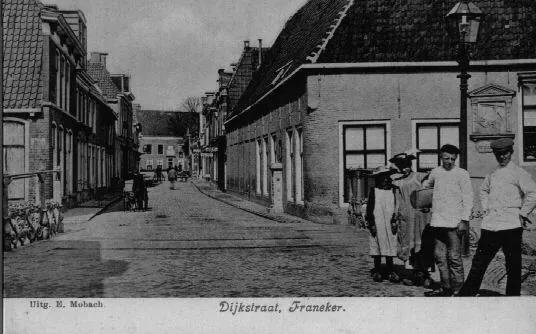
This Johan Maurits is the same one who, in 1665 in Franeker, fell through the so-called Mauritsbrug with his horse. Ignatius van Kingma was also part of this entourage and likewise ended up in the water. A memorial stone at the corner of Dijkstraat - Godsacker keeps this event alive.
Kingma Kronkels: A Rich Past

Joost Kingma
On 27 January I attended a conference in Tresoar (the former Ryksargyf) in Leeuwarden with 'the Frisian Nassaus' as its theme.
During this conference the starting signal was given for a magnificent exhibition on the rich history of the Frisian stadtholders. On this occasion, Crown Prince Willem Alexander and Princess Maxima also opened up the stadtholders' archive inventory to the public, via the internet and a beautifully designed book.
From 1584, members of the House of Nassau, starting with Willem Lodewijk (Us Heit), held the stadtholderate in Friesland. In 1747 the Frisian Nassaus acquired the stadtholderate in all provinces of the Republic.
They conducted an extensive correspondence on appointments, military affairs, and foreign policy.
Curious, I immediately went looking in the now well-accessible archive for possible correspondence between stadtholders and Kingma ancestors. And sure enough: the inventory refers five times to correspondence with a Kingma.
The Nassau archives are found partly in the Royal Archives (Koninklijk Huisarchief) in The Hague and partly in Tresoar in Leeuwarden.
In the Royal Archives I found a letter from 1652 from stadtholder Willem Frederik to captain Kingma, letters from 1661, received from (by then) cavalry captain Ignatius van Kingma to the stadtholder, and a letter from 1653, received from the serviceman S. van Kingma from Texel. All handwritten, and therefore hard to read. Work on deciphering them is still ongoing.
It is always surprising and interesting to lay eyes on such personal correspondence from a couple of hundred years ago, quite apart from its content.
Incidentally, a rough comparison of the handwriting and signature of Ignatius van Kingma's letters with those of S. van Kingma suggests that the archivist made a mistake, and that the latter is in fact also a letter from Ignatius.
The inventory of the Nassau archives in Tresoar mentions correspondence with J. van Kingma twice, from 1662 and 1664 respectively. I have not yet requested these, but here too it might well concern Ignatius.
The first and last years of the above-mentioned correspondence with stadtholder Willem Frederik, 1652 and 1664 respectively, coincide (by chance?) with striking moments in this stadtholder's life.
On 2 May 1652, the 39-year-old Willem Frederik, after a laborious series of attempts to reach agreement with his intended mother-in-law Amalia van Solms, finally marries the then 18-year-old Albertine Agnes van Oranje Nassau, daughter of Amalia and the Dutch stadtholder Frederik Hendrik.
The marriage takes place in Kleef and the festivities last a whole week *.
The stadtholder's 1652 letter to captain Kingma he writes on 8 May, from Kleef, so still during the festivities. Perhaps the letter concerns the necessary preparations for the stay, to be organised in great haste after the wedding festivities, of mother-in-law Amalia at the court in Leeuwarden. The new mother-in-law had, namely, unexpectedly let slip during the celebration that she wanted to come to Leeuwarden with her entire retinue, some 100 people. Panic ensued. No one had reckoned on the arrival of her highness, and a suitable reception therefore had to be arranged with great haste. Among other things, all Frisian residents who owned a somewhat presentable carriage were ordered to keep their carriage ready for transporting mother-in-law and her retinue from the Frisian border to Leeuwarden. The list of selected carriage owners comprised 31 people. Could our cavalryman captain Ignatius van Kingma have been one of them? Or was he written to in order to pay military tribute? Once the letter to Ignatius has been deciphered, we will know. What we do already know is that not long after, namely on 28 July of that year, the captain's first wife died in childbirth after 33 months of pregnancy.
Willem Frederik's marriage, too, was unfortunately not fated to last very long. In 1664, the year of the last correspondence between J. van Kingma and the stadtholder recorded in the Nassau archive, the latter accidentally shot himself through the neck while cleaning his pistols and died shortly afterwards. Not exactly a heroic death for such a striking figure.
That a glorious existence quite often fails to find expression in heroic symbolism, and can therefore lead to serious disappointment among one's descendants, became clear to me when, in the Light Scheurkalender on 13 February last, I came across the following poem. It is by someone who, just like me, hoped to enrich his family history in The Hague:
Heraldry
I searched for ancestors, laid to rest in splendour,
But came away from The Hague disillusioned and defeated.
There is a vacuum cleaner on our family coat of arms.
So if it was nobility, it was fairly low-ranking.
Levi Weemoedt**
Then we are better off, with a heroic arrow and conch shells in our family coat of arms.
Conch shells, coils and all!
* For this and the following passages about the marriage of Willem Frederik, see:
Luuc Kooijmans, 'Liefde in opdracht. Het hofleven van Willem Frederik van Nassau'
** From: Rijk verleden. Ad. Donker, 1999
Colophon
'De Kinkhoorn' is a periodical publication of the Stichting Kingma State.
The periodical is sent to donors of the foundation.
You can become a donor by transferring an annual amount of at least 12 Euro to account number 55.00.97.538 at ABN AMRO bank in Arnhem, in the name of Penningmeester Stichting Kingma State.
Print run: 150 copies.
Published at least twice a year.
Stichting Kingma State
Secretariat:
Sterrenboslaan 20, 3972 GD Driebergen
tel: 0343 521212
fax: 0343 517689
e-mail: kingma@worldonline.nl
website: www.kingmastate.nl
Board
Chairman: C.S.J. Kingma, Emmen
Secretary: J.H. Kingma, Driebergen
Treasurer: J.M. Kingma, Arnhem
Board member: Tj. Kingma, Zwolle
Design and production
Drukkerij Bakker Baarn
Errata in issue 6, October 2002
Page 11: The sentence about deed No. 177 should read: 'The accompanying deed No. 177 covers only one page and follows below.'
Page 16: 'friskia lijders' should be 'Friese Rijders'
This publication is registered with the Koninklijke Bibliotheek under ISSN: 1569-8645