
IV De Kinkhoorn
De Kinkhoorn 13 — April 2006
Volume 7, number 1
This issue as pdf (Dutch) · Read the Dutch original · the printed original
Foreword
The board members have once again been working hard lately to get the texts for this Kinkhoorn ready. And every time it turns out to take more time than you expected beforehand. Which makes sense really, since it generally concerns stories based on research. That research takes time, and once what was being sought has been found, the find has to be studied and worked out. It often involves old manuscripts that first have to be transcribed. Finally an article about it has to be put together, checked, corrected and sent off. Then comes the proof, which also has to be checked, corrected and sent back to the printer. The printer then takes care of the rest, and the result is, as you read this, in your hands.
This time it is, among other things, about Eduard Marius van Beijma, the second-to-last resident of the State, and the claim that the Makkumer Kingmas made, in the middle of the 18th century, on the estate of Ignatius.
That estate also comes up in the article about the will of Ignatius van Kingma. Here it is not so much about Ignatius himself, but it is interesting to see how a well-to-do person of that time arranged his estate by means of his will. What elements it contained, the language with all its roundabout wording needed to keep the property and the power and influence that came with that property together as one whole and to secure it for the family far into the future. One complication in working out such a will is the habit of shortening the time needed for writing by using many abbreviations. Those abbreviations have to be resolved. Furthermore, extensive use is made of terms that have now fallen out of use and are therefore often obscure, frequently Latin or derived from Latin, which have to be explained with the help of all sorts of books.
Fortunately, all of this, though time-consuming, is enjoyable work. I hope reading it will give you pleasure too.
Kees Kingma
Chairman
Report of the donors' meeting of 17 December 2005
The donors' meeting on 17 December 2005 was devoted entirely to genealogy.
Frans Kingma, who within the Stichting Kingma State is part of the genealogy working group, and Henk Nicolai, who as a historian has done a great deal of research into the Makkumer Kingmas and has also published on the subject, were invited as speakers.
Frans began his talk by pointing out that genealogy is more than just collecting data on births, marriages and deaths, going back in time as far as possible. The value of this kind of family-tree research along the male line is quite relative, and is actually only reliable along the female line. Genealogy becomes interesting when documents and stories can be traced through oral tradition and placed within a particular period, so that things become recognizable.
Frans gives a fascinating picture of his family research, going back in time partly through oral tradition and partly through archival research.
He eventually arrives at Gosse Jans Kingma, born in 1799 in Wanswert. Thanks to the necessary searching, it is fairly well known how this Gosse Jans eventually ended up with the civic guard in Groningen, by way of Leiden, where he possibly performed his military service as a substitute. And so a fascinating family story emerges, placed within a particular social context and, through the stories of family members from the past, made recognizable in the present day.
Henk Nicolai's talk follows on from this seamlessly. Henk points out that not only genealogy but also topography (surroundings) and memories attached to objects are important parts of family stories.
In his research into the Makkumer Kingmas, objects play an important role, as do the almanacs kept by the family, in which daily notes were made. This tradition was continued from father to son, resulting in a wealth of information about the family. This way of dealing with the past, through preserving objects and keeping almanacs, amounted to a deliberate stewardship of family information for future generations. Thanks to this way of dealing with the past, there exists, for the Makkumer Kingma lineage, a rich source of information for future generations.
Preserving the family past in connection with these objects will become increasingly difficult. Present-day generations deal with the past differently, and family relationships have become looser.
With their talks, both speakers showed in a fascinating way that genealogy is more than just collecting data, and that it is precisely the passing down of stories and objects that makes family history vivid and recognizable.
Tjeerd Kingma
Hylke Jansz Kingma and the Inheritance of Ignatius van Kingma
It is 3 April 1754. Fokke Jaargs, Trinitie Jaargs, Inte Jaargs, Floris Jaargs and Eike Jaargs, children of Jaarg Goris (Kingma), and Hylke Jansz, Gerben Jansz and Gorrit Jansz, children of Bauke Goris, the sister of Jaarg Goris, are sitting with the notary to sign an agreement. An agreement in which they arrange to investigate whether they can lay claim to Kingma State and the associated rights, obligations and property as left behind by Ignatius van Kingma. I try to imagine what the mood was like in the room where they gathered to put their signatures to the agreement. There must have been a tense atmosphere hanging over it. The State was a rich possession, and so there was quite a lot at stake.
The agreement shows that they expected the investigation "niet sonder veele moeite en kosten kan geschiede". The thought of perhaps losing a considerable sum without achieving the intended result will not have made the tension any smaller. Was that also the reason they decided to conduct the investigation jointly? Or did the initiator want to avoid a sudden flood of visits from his (or her) happily surprised cousins after having put in all that effort and expense himself, should the inheritance turn out to be claimable. Who knows what pressure was brought to bear before all participants were willing to sign the agreement.
Whatever the history leading up to the signing may have been, the final agreement was that the costs and proceeds of the undertaking would be divided equally. These arrangements had been well thought through. Provision was made for the possibility that one of the participants might die in the meantime. In that case rights and obligations would pass to their children. Should there be none, their share would be divided equally among the still-living cousins. But probably even more important was the arrangement that, should the fideicommis result in only one of the participants acquiring the State, the others would still profit equally.
What exactly was their case? The heart of it lay in the fideicommis. In essence it is a legal principle that enables a testator to attach, by means of a will, conditions to the inheritance of the estate. These usually concerned the indivisibility of the property, the manner in which later inheritance had to take place so that the property stayed in the hands of the family, or rather the bloodline, and sometimes even the obligation to adopt the testator's name. Ignatius too made use of this in his will. He appointed Zacheus van Gemmenich, his sister's son, as sole heir to the State and its associated affairs. He prescribed indivisibility and required the addition of "thoe Kingma" to the name and the incorporation of the Kingma coat of arms into one's own. Conditions that were also declared applicable to any later heirs.
As already described in one of the first issues of De Kinkhoorn, Zacheus's daughter inherited the State after his death. When she died she no longer had any living children to whom the State could pass. Her husband at the time, Coert van Beyma, was consoled for the loss of his wife with the by no means insignificant possession of the State. In accordance with Ignatius's will he then added "thoe Kingma" after his name and added the Kingma coat of arms to the van Beyma coat of arms.
What led them to conduct this investigation in 1754? Ignatius had already died in 1700, Zacheus, the first heir, in 1720, and his daughter Catharina too, the last owner of the State descended from a Kingma, had died two months after her father. Perhaps it was the inheritance passing from Coert van Beyma to his son from his second marriage, Julius Matthijs, in 1748. Even then, the investigation only started six years after the fact. Be that as it may, the cousins thought that the fideicommis might impose the condition that the State had to remain in the family's possession and therefore could not pass to van Beyma, who was not related by blood. As the accompanying, greatly abridged, genealogical overview shows, the cousins were the oldest living relatives and, if there was anything to inherit, they were first in line. Incidentally, there was also a Johan Kingma/Uitdenboogaert, a son of Ignatius, who between 1701 and 1707 brought a case against Zacheus over the inheritance and lost. More about this later.

Interestingly enough, no documents have yet surfaced showing that an investigation was carried out or what it yielded. Nor have any court records been found showing that the case was ever brought. The fact that the name van Beyma thoe Kingma still occurs, and that their ancestors were the last residents of the State in 1864, seems reasonable evidence that the investigation did not have a positive outcome.
In researching this story, another interesting insight surfaced. Hylke Jans, the progenitor of the members of the "Vereniging Familie Kingma", was, as Henk Nicolai already wrote in the Kingma kroniek, reluctant to accept the name Kingma. In 1772 he wrote about this: "onze sekretaaris voegt agter mijn naam dat van Kingma dat ik anders in myn gebruyk nooit gedaan heb …". Although reluctant about using the name, he was apparently already well aware, for years, of his descent (through the female line, like many of us). This had already become clear from a visit he had earlier paid to the little church in Zweins. Had he become a co-owner of the State, he would probably have adopted the surname much earlier.
Jeroen Kingma, with thanks to Herre and Marijke Kingma for their hospitality and contributions, including providing the agreement from the association's archives, in writing this piece.
Will of Ignatius van Kingma from 1696 (1)
Will of “De Heer Old Brigadier Ignatius van Kingma” te Sweins, 1696
This archival document, to be found in Tresoar under: access number 319, inventory no. 689, contains the first and last page of the 1696 will. Added to it is a handwritten copy of the entire will. This copy, given its much more legible handwriting, was probably made a number of years after Ignatius's death and comprises 14 pages in folio format.
In making this copy, the rules for transcription were not observed. Words have been shifted onto the following lines, and even onto subsequent pages. Moreover, the spelling has been somewhat adapted. The abbreviations used in the original have mostly been retained but not resolved, as they should be in a proper transcription. This copy can therefore better be called a rendering than a transcription. However, on the basis of the two available images of the original, I do have the impression that the style and content have not been altered.
So what is striking about this will, made in 1696? Ignatius was a wealthy man with many possessions, which brought with them influence and voting rights, which made it important for the property to stay together and within the family — and a will is needed for that. On top of that, he had a career as a military man, in which he naturally ran more than the ordinary risk of dying, for instance from wounds sustained in battle or by being killed outright. Certainly in that period, with medical possibilities still limited and the average life expectancy already low to begin with. Even in his later, high military office, risks remained. It is therefore very striking that he, born in 1621, only made his will in 1696, that is, at the for that time very advanced age of 75. It is true that this will may have been merely an amendment to a will from 1683. At that time he was 62, which was still above the average age. So, late for a will in any case, not knowing that he would reach the extremely advanced age of 79. That 1683 will is also held at Tresoar, but cannot be consulted. Possibly because it is in a poor, and therefore fragile, condition. I will make another attempt to at least get to see it once.
Because of the importance already mentioned above, it was necessary to keep the possessions together and not have them fragmented through division among several heirs. This is why Ignatius made use of the so-called "fideicommis", also known as "erfstelling over de hand" (an entailment passed down "by the hand"), a construction derived from Roman law to make the ancestral or family estate inalienable. One person, the "fidei-commissaris", received the entire inheritance but at the same time the duty to keep that inheritance together and maintain it (for instance, maintaining the State but also living in it). In effect, the fidei-commissaris was merely the temporary administrator of the property, and while he was allowed to expand it, he was not allowed to sell off any part of it. He also had to leave the inheritance as a whole to a succeeding heir. Who that heir would be was laid down in advance in the will. This was called "de hand uit het graf" ("the hand from the grave").
Arranging this last point takes up about five pages of the will. Apparently there was as yet no clear legislation regarding inheritance succession. Ignatius accordingly speaks of "best naar (gewoonte) regten en usantie".
After commending his soul to the "grondelose genade van God Almagtig", and his body having been buried in the church of Zweins "sonder uiterlijke pompe of statie", the heirs shall be "gehouden zijn te geeven een vatsoenlijk leed of uitvaerts maeltijdt".
He then confirms the fideicommis already mentioned in the will by "institueren" 2 his "wel beminde neef doctor Zachaeus de Gemmenich 1 advokaat voor den Hove van Frieslandt" as universal heir.
He then arranges the order of succession by writing that " wat ik tegenwoordig besitte en namaels mogte becomen na versterven van mijn institueerde erfgenaem in het geheelen sonder enige deelschap of detractie 3 van trebellanica 4 sullen erven en devolveren 5 op sijn oudste soon of bij defect van een soon op zijn oudste dogter, indien enige geïnstitueerde erfgenaem geen kinderen primogendus 6 mogte komen natelaten, dan kindskinderen of voor dese descendenten sullen de vastigheden onder dit praerogativ 7 oft majoraet 8 begrepen int geheel en sonder enige deelschap of detractie als voren erven en devolveren op sijn oudere mannelijke descendent of bij defect van mannelijke descendent op sijn oudste vrouwelijke descendent, als dan in leven zijnde".
And this is then repeated many more times for every conceivable situation in which the intended heir at that point is no longer alive or has no living children or grandchildren left. If an heir is a minor, a guardian must be appointed who temporarily takes over the administration and answers to the commissioner of the Court of Friesland.
Should Zachaeus de Gemmenich die before Ignatius and without a succeeding heir, his brother Jacob would then become the fideicommissaris, and if he dies, then, and so on and so forth.
Striking for that period is that daughters, too, are consistently mentioned as possible heirs; however, they only inherit if there are no sons.
He then adds to the estate two farms in Peins, which he inherited from his father. And also the wall-hangings, bedsteads, his paintings, beds with their fittings, chairs, etc., "beneden in 't huis van Kingma State". And he stipulates that these last-mentioned items must remain in the State, that the owner must reside in the State or "ten minsten dienstboden, vuur en ligt daer op sijne costen te houden, sonder het groothuis aen een vreemd te mogen verhuiren".
He then obliges his heir, within three months of receiving notice of his death, to have the will registered in the fidei-commis registration book of the Court of Friesland, together with a "pertinente inventaris van de bewaerde vastigheden", and in the presence of the witnesses who co-signed the will, and to have the same done in the mortgage register of Franekeradeel.
This inventory must also be renewed every ten years before the "commissaris van den Hove of 't Edle Geregte van Franequeradeel met de namen van de naestlegers en gebruikers" 9. In addition, the "geslagt register" had to be completed. What is meant by this is the updating of the register of successive heirs with regard to potential heirs who had died or been born. Should he neglect any of the above, the fidei-commissaris forfeits, as the will states, the sum of one hundred Carolus guilders each time, for the benefit of the Nieuw Weeshuis in Leeuwarden. The orphanage's governors are informed of this by means of a copy of this provision, so that they can claim the fine if necessary.
Then follows an elaborate section on the honest upkeep of Kingma State, to which the fidei-commissaris is obliged, and for which he has been left sufficient means, including for repairing any decay that might occur.
He may, it continues, keep his family name, but must add "thoe Kingma" to it and add the Kingma coat of arms to his family arms 10. Here too a penalty clause is attached of a hundred Carolus guilders to the same orphanage "voor de eerste reise en sulks so lang en meermalen so hij zulks bij halstarrigheid en vilipendentie 11 van mijn despositie 12 en begeerte quame te doen".
That covers up to and including page 8 of the will. To be continued.
1 Up to now I have never seen the name written other than as "van Gemmenich"; in the will, however, it is consistently written as "de Gemmenich".
2 "Institueren", to institute, (van Dale).
3 "Detractie", deduction, withdrawal or reduction, (Practisyns Woordenboekje).
4 "Trebellianique portie", 't vierde part van eene overhands gemaakte erffenisse in den boedel, (P.W.).
5 "Devolveeren", afkoomen, afwentelen, (P.W.).
6 "Primogendus", probably the same as "Primogenitus", firstborn, (van Dale).
7 "Pr(a)erogatief", a right that a person or group has above others, (van Dale).
8 "Majoraat", the privilege of the oldest member of a family in matters of inheritance, or the right of inheritance of the eldest son; undivided family property that must pass to that oldest member, (van Dale).
9 "Naestlegers en gebruikers" (the neighbouring occupants and users): stating the owners and users of adjoining plots was a method, in the absence of a land registry, of establishing the location of a plot.
10 Whether van Gemmenich also added the Kingma coat of arms to his own is not known to me. The last van Beijma at the State, Julius Matthijs, officially requested permission from King Willem I to add "thoe Kingma" to his name and the Kingma coat of arms (as an inescutcheon) to his own arms. He received this permission in 1821 (see access number 319, inventory no. 347, Tresoar).
11 "Vilipendentie", contempt, disdain, (P.W.).
12 "Dispositie", an orderly ordinance or provision, (P.W.).
Grietmannen in soorten: rehabilitation for Eduard Marius van Beyma
In January 1978 the well-known Frisian historian Dr J.J. Kalma wrote an article in the Friesland Post about Eduard Marius van Beyma. This Beyma was a resident of Kingma State.
The article offers a nice glimpse into life at the state (a Frisian manor house with its surrounding land) at the start of the 19th century. Below, several interesting passages are reproduced.
With kind thanks to Mr C.L. van Beyma thoe Kingma of Ambt Delden, from whom we received the article.
GRIETMANS OF VARIOUS KINDS
Every Frisian knows – or at least ought to know – Coert Lambertus van Beyma, the great patriot, 'de held der Braaven', who had to flee in 1787 for his convictions and, after a turbulent period full of quarrels and even imprisonment in France, appears here on the political stage in The Hague. No, one cannot speak of a successful life. But his name lives on all the same.
But who knows his brother Eduard Marius, who was also active in politics? He was one of the three men who brought about the 'quiet revolution' here in February 1795. He too was fully caught up in politics in Leeuwarden and The Hague during the first years after the turnabout, likewise had to flee, but returned and eventually withdrew as well, became grietman (head of a Frisian grietenij, roughly comparable to a district magistrate) of Franekeradeel, and lived, unmarried, at Kingma State in Zweins for many years until his death in 1825.
The elder brother Coert Lambertus (1753-1820) has a great name, but the funny thing is that Frisians, who feel so nationally minded, completely forget that he was a centralist with a federalist streak, a proponent of the unity and indivisibility of the Batavian Republic, and thus in effect a forerunner of the later kingdom. In that respect there is every reason, precisely as a Frisian, to give all due credit to the somewhat less loud younger brother Eduard Marius (1755-1825). He was a federalist and remained one. Unlike the revolutionary Coert, he calmly held on to the old ways, and he remained true to that, even when it was not taken kindly.
A Good Nobleman
Just like real antiques, the Frisian nobility is becoming rare. There are various causes. Many Frisian noble families have died out. Other lineages left their ancestral land long ago. Absenteeism is a frequently mentioned and much-hated phenomenon, about which we actually still know too little, but which occurred strongly after 1800.
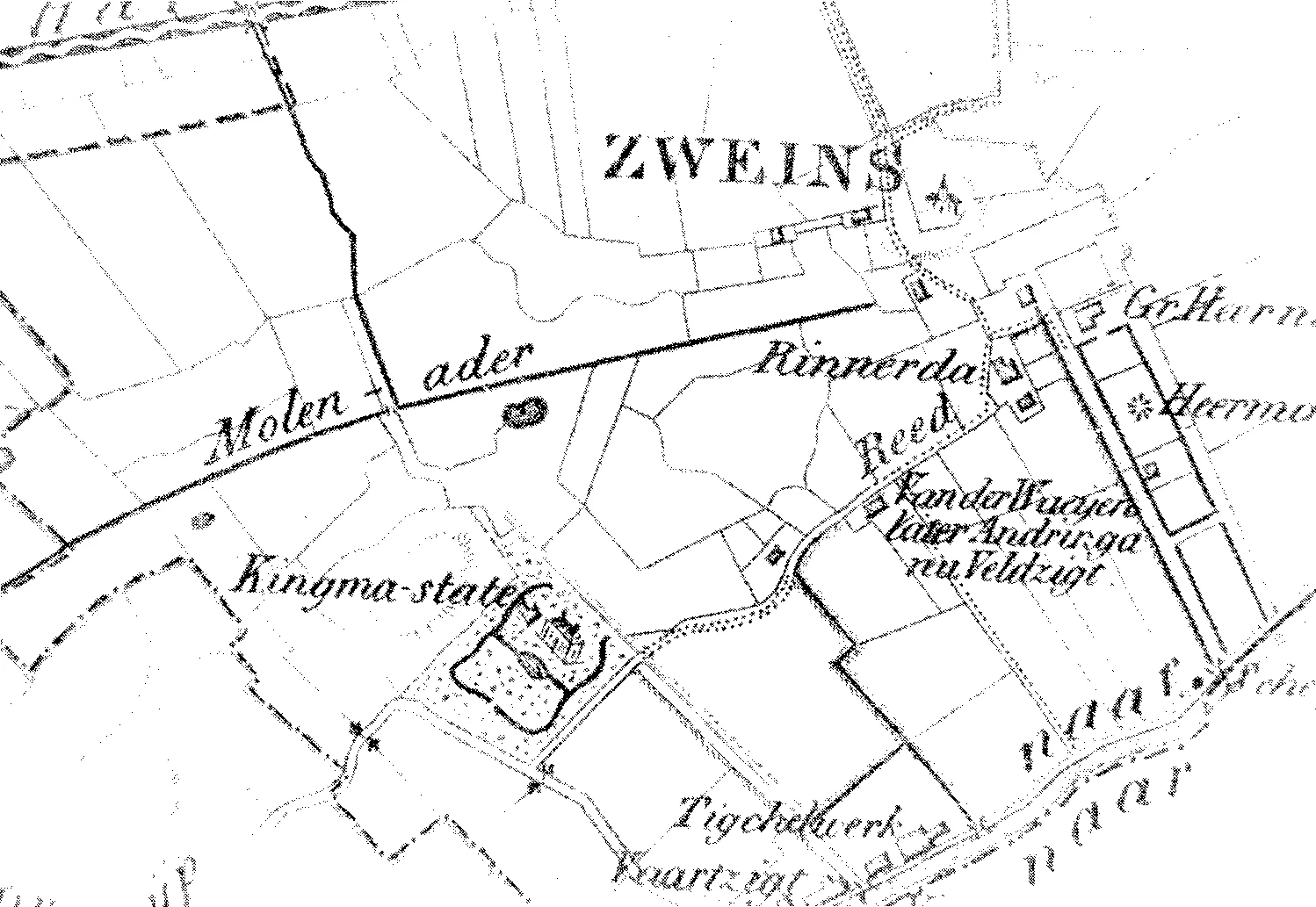
However one may feel about the phenomenon called 'nobility', there is no denying that the old Frisian farming nobility, and the younger nobility too, once gave colour to our villages. You would be in for quite something if all those old states from earlier times still existed today. How much more attractive little Zweins would be if, on the south-west side, Kingma State, surrounded by trees and moats, still stood there.
Our Eduard Marius van Beyma remained well known for a long time, not only in the vicinity of Keimpetille but elsewhere in Friesland too. An original gentleman, a Frisian of the old school through and through, showing it even in the way he dressed, but who through his conduct was also a living advocate for genuine Frisian customs and manners, which we can praise so highly on suitable occasions.
We will not sketch his political career here. That is impossible within a short space, since precisely that period of 1787-1815 is highly confused and almost every decision has to be explained at length. That his biographer, Dr J.C. Ramaer, was nevertheless wrong to call Beyma a weak and timid man becomes clear again and again when one examines his life more closely. It is, for instance, questionable whether the refugees of 1787 were so much more courageous than those who stayed, of whom Eduard Marius was one. Longer than his quick-tempered brother, who withdrew from politics after August 1798, Eduard Marius continued to take on the various risks, which always included the possibility of imprisonment or worse. When we hear that he sat, for instance, on a constitutional committee in 1797, and that in 1799, by refusing to become a member again of the Representative Body of the Batavian Republic, he lost his voting rights and was barred from government office for five years, it is clear that he was not afraid, for the Beymas were not well-off.
Beyma as landowner
Throughout the 19th century he remained well known for a long time as a landowner with special qualities, actually a kind of enlightened despot of a new type, who kept standing out for his characteristic behaviour. He owned several farms in Peins and Zweins, but it would have taken something unusual for him to give a tenant notice. On the contrary, he lived with them as with friends, but they were under his fatherly supervision and had to keep their distance.
He tried, when necessary, to educate them, preferably by way of a joke. For instance, all the tenants kept a greyhound of Beyma's at board. These dogs had to be well fed. When that was not the case with one of the farmers, Beyma came round and said: 'Your dog seems to run fast!' The farmer did not immediately catch on. 'Yes, because the supe (a thin, watery buttermilk feed) in his body cannot keep up that fast.' A quiet hint, which was indeed understood. Another, somewhat vain tenant spent too much time at the inn and let the thistles run riot in his field. Beyma sent an official message by way of his liveried servant: 'Greetings from the master, and if the farmer is threshing thistle-seed, the master would like some of it too.'
Beyma's motto was: Get on with it, get up early, and pay attention! When, in his opinion, one of the tenants regularly got out of bed too late, Beyma would personally drive the man's cows into the jister (the cattle shed), go and stand in front of the farmer's bedroom window, and ask: 'Are you forgetting to milk this morning too?' He did the same sort of thing with farmers who went out too late for the ûngetiid (the Frisian term for the proper working hours of the day). Then he would walk through the meadow, striking the seeded-out grasses with his walking stick, and the man in question would know well enough what time it was.
By tradition, the Beyma family sided with the underlying party. That is why the common man stood closer to him than the highly placed did, and why he had more of an eye for little Friesland than for the great Republic. Eduard Marius had no craving for power or office and was far more level-headed than his famous brother, who often misjudged people. When a young squire from the area repeatedly made use of Beyma's road but, to the great displeasure of the farmers, left the gates open while doing so, Beyma arranged with his manservant Sape that the gentleman would see a drawbridge go up just as he reached it. The squire first had to go back to close the gates, and only then could he cross the bridge. When Beyma, who was grietman of Franekeradeel (1816-'25) and therefore often had to be at Dekemastate in Franeker, was travelling to town in his yacht, he was once teased by rowdy students from the Athenaeum. The skipper and his manservant wanted to go after them, but Beyma remembered that it happened to be 28 December, Holy Innocents' Day. Let them be, they don't know any better!
Like various other regents, Beyma too could be stubborn. What he had set his mind on, he saw through. In the autumn he had trees cut down from his garden, but he had introduced the rule that all the sawn-off pieces could only be split once. The women will surely have complained now and then, but once the wood fire was burning, one did not have to keep throwing on more little blocks. When he had sold a fat barren cow to a butcher from Harlingen, and the man came to collect the cow, a dispute arose over the cost of transport. Beyma was simply 'ut de rie' (beside himself). He calmly kept the cow back, but he did rule: once sold, stays sold, and so he distributed the meat – said to be 2,200 pounds! – free of charge to his fellow villagers.
The hamlet of Keimpetille, actually Kingmatille, remained well known right up until the start of this century. Kaatsen matches (a traditional Frisian handball game) were held there, and in the 1890s political speakers came to have their say. This was also partly because there was a brickworks there. To the astonishment of those around him, Beyma had this built late in his life. They called him 'mad'. But when someone dared to make a remark about his age, he said – and the thought is not so mad after all – 'Yes, I still always hope to live another 40 years, even though I might die tomorrow.'
J.J. Kalma / Joost Kingma (ed.)
Kingma Kronkels: Land

Joost Kingma
Land is a lasting asset.
That must have been what Hylke Jansz thought too when, in 1754, he made an agreement with his family to have it investigated whether they could still assert rights to the inheritance of Kingma State. As the article in this Kinkhoorn shows, he had too little grounds for a lawsuit. That must have cost him a fair penny all the same. Or did lawyers have more modest rates in those days?
Land also had to stay together.
That much is clear from the fideicommis (a legal arrangement, derived from Roman law, binding an estate to pass on whole to a single heir), which was meant to prevent the family property from falling apart. For only as an undivided estate was it able to bear the costs of maintaining the grand house that constituted the state (a Frisian manor house with its surrounding land). The disappearance of that fideicommis in the Napoleonic period is therefore one of the causes of the decline of the great country estates from the nineteenth-century Frisian landscape. Yme Kuiper, who regularly publishes on this subject, will tell us more about it at the autumn meeting.
The will of Ignatius van Kingma shows that, towards the end of the seventeenth century, he had managed to expand Kingma State into an estate of considerable size, hundreds of hectares, spread across various villages in Franekeradeel. He may not, as far as we now know, have made an unforgettable impression in military history, but he had taken good care of the family property.
If you doubt whether our claims have any grounds, type www.historischgisfryslan.nl into your browser and you will find, on the website of HISGIS, the Historical GIS Friesland, the land that Ignatius owned in 1700 and the cadastral properties of Grietman (the head of a Frisian grietenij, roughly comparable to a district magistrate) Julius Mathijs van Beijma thoe Kingma in 1832. No, when they died, these men were by no means down to their last acre.
Colophon
'De Kinkhoorn' is a periodical publication of the Stichting Kingma State.
The periodical is sent to donors of the foundation.
You can become a donor by transferring an annual amount of at least 12 Euros to account number 55.00.97.538 at ABN AMRO bank in Arnhem, in the name of Treasurer Stichting Kingma State.
Print run: 150 copies.
Published at least twice a year.
Stichting Kingma State
Secretariat:
Sterrenboslaan 20, 3972 GD Driebergen
tel: 0343 521212
fax: 0343 517689
e-mail: info@joostkingma.nl
website: www.kingmastate.nl
Board
Chairman: C.S.J. Kingma, Emmen
Secretary: J.H. Kingma, Driebergen
Treasurer: J.M. Kingma, Arnhem
Board member: Tj. Kingma, Zwolle
Design and production
Drukkerij Bakker Baarn
This publication is registered with the Koninklijke Bibliotheek under ISSN: 1569-8645
When reproducing the content of articles from De Kinkhoorn, in whole or in part, please credit the source.