
IV De Kinkhoorn
De Kinkhoorn 10 — October 2004
Volume 5, number 2
This issue as pdf (Dutch) · Read the Dutch original · the German translation by Ralf J. Kingma
- Foreword
- Announcement of the Kingmadag 2005
- The clock ‘of the state’
- Correspondence of Ignatius van Kingma with the Frisian stadtholder Willem Frederik
- Letter to Ignatius van Kingma, 18 May 1652 (no. 497)
- Letter from Ignatius van Kingma, 22 June 1661 (no. 557-2)
- Genealogy of the Birdaard Kingmas
- Kingma Kronkels: New Year's Wish
- Announcement of the autumn 2004 meeting
- Colophon
Foreword
Time moved faster than we thought. That is admittedly always the case, but even so it has left us a bit late with the new Kinkhoorn.
This time it is once more about the clock of the State, probably for the last time. The clock is going to, so to speak, keep the "lion of the State" company.
The correspondence between Ignatius and the Frisian stadtholder Willem Frederik van Nassau is discussed. Here the course in "old script" that I followed this past winter is bearing its first fruit. Although the revelations made this time cannot yet be called dramatic.
This time we are also devoting some attention to genealogy.
Meanwhile we are preparing for the upcoming donors' afternoon. The speaker we have found willing to cover the main topic of the afternoon will talk about "heraldry"; the Kingma coat of arms will naturally also be addressed.
Furthermore, we are also already occupied with the preparations for a second international Kingmadag in Zweins. This lustrum, which we want to hold next year in early July, partly at the request of several Kingmas from abroad, will take on an even more international character than the first Kingmadag in 2000. That is why we are working on gathering as many addresses of Kingmas from abroad as possible.
Genealogy will be an important topic, and furthermore several speakers have already, in principle, declared themselves willing to take part.
For now I wish you an interesting and pleasant afternoon on Saturday 20 November next, in the village hall of Zweins.
Kees Kingma
Chairman
Announcement of the Kingmadag 2005
After 5 years, it's time once again to bring together as many Kingmas as possible on ancestral ground.
We would like to build on the success of the Kingmadag in 2000.
The gathering will be devoted to the search for our ancestors and 'roots'. The main theme is therefore:
Genealogy
Among other things, we are thinking of a genealogy 'market', with computers loaded with family trees; stalls where everyone can show their own activities in this field; and of course another historical tour of the state (a Frisian manor house with its land) grounds, the tea house and the graves in the church; possibly an exhibition of historical Kingma objects; interesting speakers and of course Frisian culture with, for example, horses, music, food and drink.
Save the date in your diary: 2 July 2005 (reserve date 9 July 2005).
This time we are going to do our best to get even more Kingmas from abroad enthusiastic about coming. We are currently putting together the mailing lists.
So if you have any suggestions for the mailing, please let Tjeerd Kingma know ( tj.kingma@planet.nl ).
The clock ‘of the state’
In Kinkhoorn no. 6, p. 14, there is a short piece about the clock of Bouke Saakstra, with a photo of the clock and its owner. This clock, which according to Bouke Saakstra was bought by his parents at a boeldag (an auction day for selling off the contents of an estate), was said to have come from the estate of Kingma State. It turns out that several examples and varieties of this type of clock exist. This became clear, among other things, from a response we received from Dr. Herre Kingma, a dermatologist in Canada. He wrote that his clock had belonged to his grandfather and that the name "C. de Looze, Leeuwarden" was on the clock. He added that this de Looze had had a clock shop on the Nieuwestad in Leeuwarden, and that his daughter Foekje (1853-1932) had married Tjeerd Herre Kingma (1838-1930) 1. It is possible that some clocks entered the Kingma family by this route. It is also known that a grandson of Foekje and Tjeerd had one. All this prompted me to look into the background of these clocks.
So I called Bouke Saakstra again and paid him a visit, since there was supposed to be something on the back of the clock as well. He received me kindly, but was not willing to take the clock off the wall, because it would then be very difficult to get it running again. I could not blame him for that. He also could no longer remember what was written on the back of the clock. So there was nothing for it but to take another close look at the front. With the help of a magnifying glass, a remnant of a name could still be made out on the dial. It turned out that, below the twelve and the one, the letter combination MMLER appeared. Apparently the last part of a name.
In the library in Leeuwarden (Tresoar) I found the book "Friese klokken en uurwerkmakers uit de periode 1700-1925" by Herman Bossink. It contains a large number of names of clockmakers in Friesland, including G. de Looze, who had been active around 1902. For the striking letter combination "MMLER" I found one name into which that combination fitted, namely "Carl August Tümmler", born in 1841 and active as a clockmaker and dealer in Sneek from about 1882 to 1906. Given the rare letter combination, it is indeed very likely that this Tümmler was the supplier of Saakstra's clock. His name suggests that he originated from Germany, and perhaps, like so many others, came to Friesland as a "hannekemaaier" 2, or with wares to sell — clocks, for instance — carried on his back, and later started a clock shop. By around the age of forty he was apparently able to sell clocks bearing his own name.

A clockmaker in Zwolle told me that this type of clock is often referred to as "Oeil-de-boeuf" (bull's eye). This turned out to be a good keyword for finding more information. This name is derived from the round or oval windows used under Louis XIV at Versailles. These are wall clocks with a round, oval or angular shape, in a great many varieties, often with a wavy edge. They are spring-driven movements with a short pendulum. Incidentally, in France these clocks are called "pendule-à-tableau".
The clocks we are dealing with here come from the French-Swiss Jura and are unanimously dated to the late 19th century 3. They have a value of around €1,000 4.
This dating, together with the period during which C. A. Tümmler was active, makes it highly unlikely that Bouke Saakstra's clock ever hung in Kingma State, which was already demolished in 1864. Perhaps this story was brought up at the boeldag at the time to raise the value of the clock somewhat.
That does not make the clock any less of a clock, but this is where the story ends.
1 See: Henk Nicolai, "De Kingma-kroniek", inside cover.
2 German mowers (seasonal labourers) who helped with the hay harvest. They started on the feast day of St. John (24 June), hence the name.
3 See e.g.: "Het Klokken Lexicon" by Jaap Zeeman, and the Internet.
4 From: "Wat zijn antieke klokken en barometers waard", ed. R. Stuurman, 1998.
Correspondence of Ignatius van Kingma with the Frisian stadtholder Willem Frederik
In Kinkhoorn 7 I reported having found correspondence in the archive of the Royal House from the 17th century between Ignatius van Kingma and the Frisian stadtholder Willem Frederik van Nassau-Dietz.
It concerns a letter from the stadtholder to Captain Kingma, written in 1652, and four letters from Ignatius to the stadtholder: one from Texel in 1653, and in 1661 two letters from Wesel and one from Leeuwarden.1
The letters are handwritten. This makes them difficult to read for those not familiar with these old handwritings.
Kees Kingma has made a transcription of this correspondence, which makes the text more accessible. Even with the transcription, though, it is not always easy to establish the meaning of what was written unambiguously.
Quite apart from understanding the exact content, it is already fascinating to hold in your hands correspondence from a few hundred years ago between a prominent Kingma and a Frisian stadtholder.
We were able to photograph the original letters at the Royal House Archives thanks to the willing cooperation of the chief archivist, Mrs. Charlotte Eymael.
We have included two of these letters in this article, along with their transcriptions.
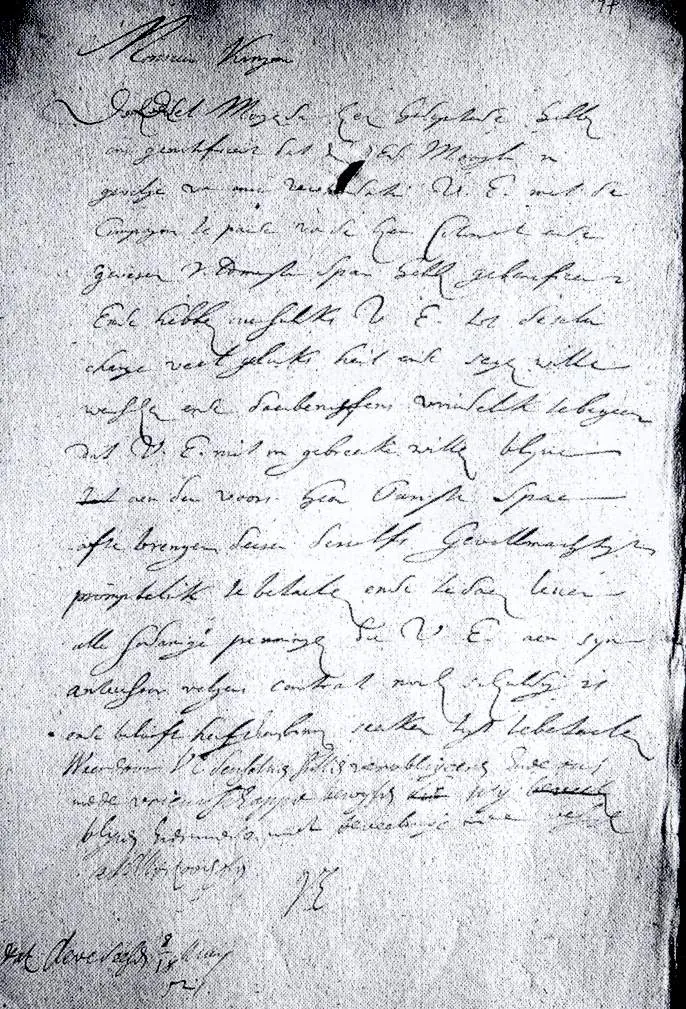
Transcription of the letter of 18 May 1652, later in this issue
The preceding pages show the letter that the Frisian stadtholder wrote to Captain Kingma on 18 May 1652.
At that time Willem Frederik was probably still in Cleves. The place name is difficult to decipher.
He had married here on 2 May (see his biography at the end of this article) and remained in Cleves for some time afterward.
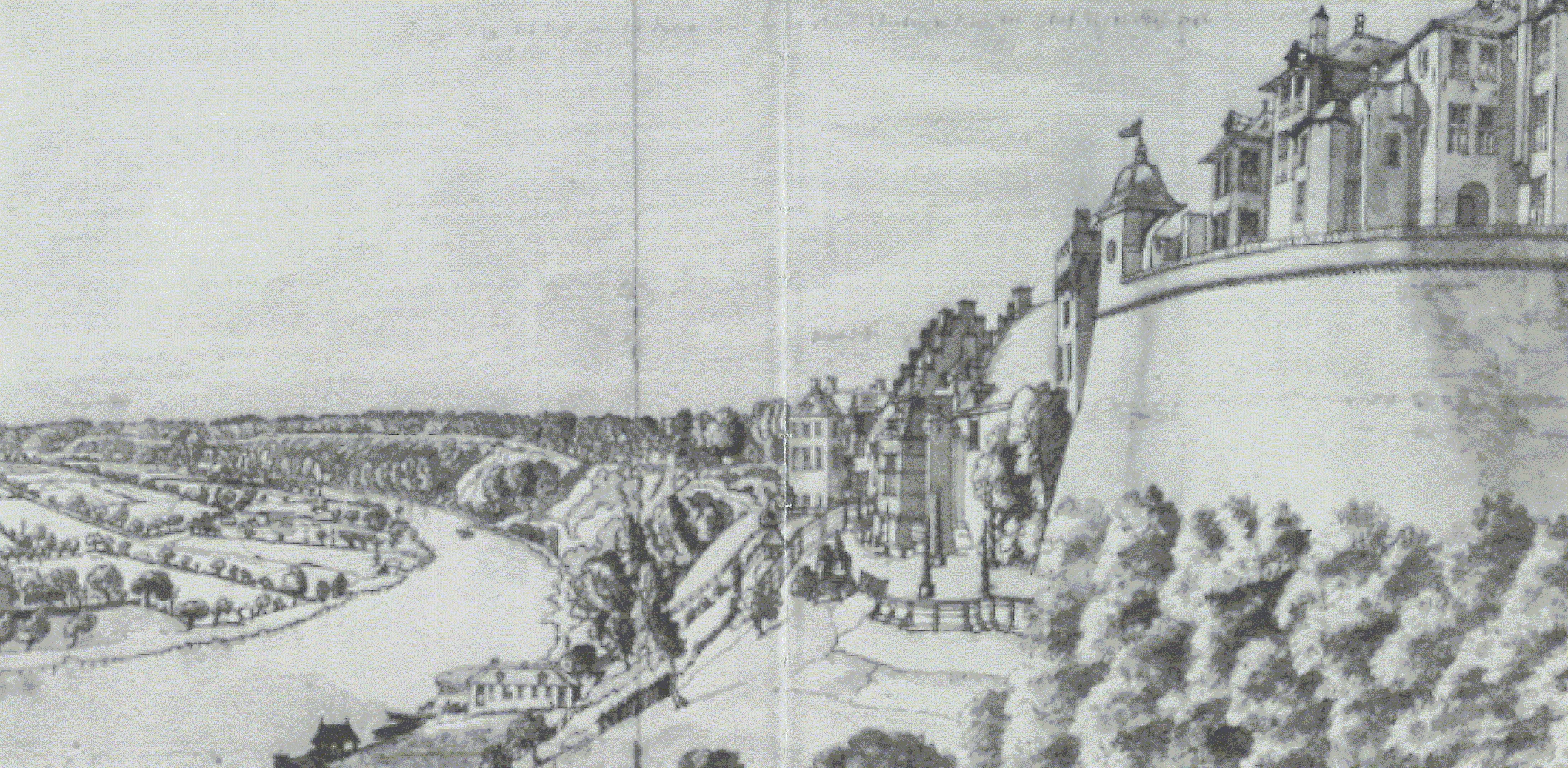
Contrary to what I expected in Kinkhoorn 7, the letter is not a call to contribute to the reception of his newly acquired mother-in-law, Amalia van Solms, in Leeuwarden.
In the letter he notes that 'monsiur' Kingma, with his mounted company, has done a certain Colonel Span a favor, and he then asks Kingma to settle his outstanding accounts with a certain Mr. Cun in Spa.
At that point in his military career, Ignatius was ritmeester (= captain) of a company of harquebusiers, lightly armed cavalry. It is remarkable that the stadtholder, from his position, addresses himself directly to a ritmeester. We see in the other letters that the reverse is also true. Ritmeester Kingma turns directly to the stadtholder with requests. I do not know whether that was customary at the time. The stadtholder and the ritmeester must have known each other well as officers in the small Frisian military top ranks.
The letter is personally signed by Willem Frederik (W.), and possibly also written in his own hand, given the not very neat handwriting. According to Mrs. Eymael letters recorded by 'writers' (scribes) generally have, in fact, a neat, very regular handwriting.


Why did Ignatius owe money to Mr. Cun of Spa? The letter does not make this clear. Was this an outstanding bill in connection with deliveries of the spring water from Spa, known for its medicinal properties? But then why would the stadtholder concern himself with this? Willem Frederik led a rather extravagant and costly life, for which he ran up debts, and he himself regularly used this spring water to combat his ailments. Had Ignatius advanced him this spring water, and had Cun asked the stadtholder for payment for his deliveries? An open question.
The year in which this letter was written, 1652, had begun for Ignatius with his newly concluded marriage to Jaecke van Viersen, followed on 12 February by the death of his father Saeckle Intes, through which he inherited Kingma State.
On 28 July he was stationed in Brouwershaven when his wife died in childbirth.
He was probably there in connection with the reinforced coastal watch against the English fleet during the First Anglo-Dutch War (1652-1653).
From a subsequent letter, not reproduced here, this time from Ritmeester Kingma to Willem Frederik, it appears that Ignatius was stationed on Texel on 27 June of the following year. He informs the stadtholder that, in connection with an order from the States of Holland to Mr. Van Noordwijk (probably Colonel Wigbolt van der Does van Noordwijk2), he has been ordered to remain on Texel with his company because of a threatened English invasion of the island. This threat had existed since March of that year.
He himself, his major Slijp, and other officers complied with this under protest. In the margin he remarks—somewhat grumpily—that his cornet left for a few days 'sonder den Commandeur ofte mij af te spreeken men degt na Vrieslant, of het sijn hovaerdi ofte onwetenthiten can het niet weten'.
Ignatius's company here on Texel formed part of the coastal watch in the English war and, together with three other Frisian companies, formed a regiment under Major Slijp.
Van der Does van Noordwijk had been sent from Rotterdam to Texel during an attempt by the English to land there. In this war, seven major naval battles took place between the home fleet, led among others by Tromp, and the English, who had set their sights on wealthy Holland. In the spring of 1654 a truce was concluded with England, after which a militarily quiet period followed until the early 1660s of this turbulent 17th century.
For Ignatius, too, a quieter time began. On 15 October 1654 he married for the second time, now to Ida Hoitesdr. van Meinsma. The marriage took place in Leeuwarden, where in '60 and '62 his two children who died young (Intia and Inte, respectively) were also baptized.
On 22 June 1661, Ritmeester Kingma was stationed in Wesel, a garrison town for cavalry of the States Army along the Rhine. From there he wrote a request 'Aen sijn doorluchticheit d'heere prins Wilhelm Fredrick van Nassau, etc..' for leave to settle his private affairs in Friesland, with the promise that he would return as soon as possible. This letter is reproduced on the preceding pages together with the transcription. It also shows the fine signature of I. van Kingma.
Strangely enough, there is another letter from his hand of the same date in which he makes the same request for leave, but 'in about three weeks', on the condition that nothing serious happens during that period.
In the preceding months, May and June, the States' troops had provided support to the city of Münster, not far from Wesel, which had been occupied by Bishop Christoffel Bernard van Galen, 'Bommen Berend'. The garrison of Wesel had probably been reinforced with the Frisian cavalrymen in view of this.
After this occupation, which the States' troops had been unable to prevent, little happened militarily up to and including 1662. Ignatius therefore got his leave without trouble, I assume.
In any case, he was in Leeuwarden on 11 October 1661, where he again wrote to the stadtholder by letter.
This relatively quiet time was apparently, in his view, a good moment for a promotion. He requested, namely, 'als oudste ritmeester op dese repartitie' (he was then 40 years old) to be considered, without salary, as successor to the deceased Major Count van Stirum.
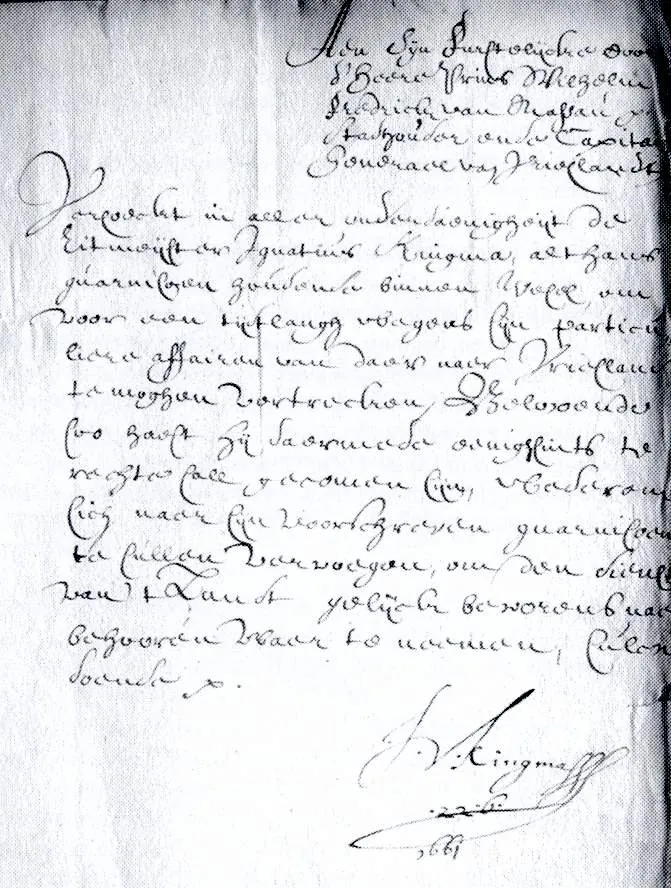
Transcription of the letter of 22 June 1661, later in this issue
This probably refers to Count Georg Ernst van Limburg Stirum, major in the Sommelsdijk regiment since 1641.
In the apparent conviction that a lasting peace had now arrived, the States General began a regrouping and reduction of the States Army. As a result, in April 1662 a new Frisian regiment was formed from seven existing cavalry companies, consisting of 6 companies. On 3 August, Ignatius van Kingma was appointed major in this new Sommelsdijk regiment by the Provincial States of Friesland, and his promotion had succeeded.
Short biography of stadtholder Willem Frederik
Willem Frederik, Count of Nassau-Dietz, was born in Arnhem on 7 August 1613, just over a year after his brother Hendrik Casimir I, from the marriage of Ernst Casimir and Sophie Hedwig van Brunswijk-Lüneburg. After his brother's untimely death in 1640, he was appointed stadtholder in Friesland. In Stad en Lande and in Drenthe, the Holland stadtholder Frederik Hendrik managed to seize the stadtholderate for himself. These appointment struggles revealed the rivalry between the two branches of the family.
As with his brother and his father, Willem Frederik's career took place mainly in the army. In the year the Eighty Years' War ended (1648), Willem Frederik reached the rank of general in the artillery. Shortly afterward, the Frisian stadtholder took part in the attempts of his young Holland colleague Willem II to undo the cutbacks in the army through a show of military force and to gain lasting greater influence over the governance of the Republic. The action failed, and shortly afterward Willem II died (6 November 1650). The provinces where he had held the stadtholderate no longer filled this, in their eyes troublesome, office in peacetime. Stad en Lande and Drenthe were an exception, and in 1650 they went ahead and appointed Willem Frederik stadtholder of their province. Two years later, Willem Frederik finally succeeded in obtaining Amalia van Solms's consent to a marriage with her daughter Albertine Agnes, which was solemnized in Cleves on 2 May 1652. That same year also saw his elevation in rank by the German emperor Ferdinand III: the Count of Nassau-Dietz became the Prince of Nassau-Dietz. In his military career, Willem Frederik in 1664 successfully took action against the invasion of the prince-bishop of Münster into the eastern Netherlands. Shortly afterward he was fatally wounded while checking his pistols. Willem Frederik died in Leeuwarden on 31 October 1664 and was buried there in the Grote Kerk.
Joost Kingma
1 Letter from the Frisian Stadtholder Willem Frederik van Nassau-Dietz, 18 May 1652, to Captains Aysma, Dixtra and Kingma. Royal House Archives, The Hague: inventory no. 497.
Letter from Ignatius van Kingma, Texel 27 June 1653, to the Frisian Stadtholder Willem Frederik van Nassau; Royal House Archives, The Hague: inventory no. 558.
Letters from Ritmeester Ignatius van Kingma, Wesel 22 June 1661, to the Frisian Stadtholder Willem Frederik van Nassau; Royal House Archives, The Hague: inventory no. 557(-1) and no. 557(-2).
Letter from cavalry captain Ignatius van Kingma, Leeuwarden 11 October 1661, to the Frisian Stadtholder Willem Frederik, Count of Nassau; Royal House Archives, The Hague: inventory no. 557(-3).
2 Het Staatsche leger, 1568–1795, part V
Letter to Ignatius van Kingma, 18 May 1652 (no. 497)
Transcription:

Letter from the Frisian Stadtholder Willem Frederik, Count of Nassau-Dietz, 18 May 1652, to captains Aysma, Dixtra and Kingma. Koninklijk Huisarchief, The Hague: inventory no. 497.
- Monsiur Kingma
- De edelmogende he ren gedep u te er de 1 hebben
- ons. genotficert 2 dat U E del moog ende in
- gevolge van onse ver---dati 3 U E dele met de
- Compagni te pae r de van de heer colonel ende
- gewesen veldwagter Span hebben gebenificeer d 4 .
- Ende hebben omsulk U E dele tot deschen
- charge veel geluk heit ende segen wille
- wenschen ende daerbeneffens vrindelik te begeer
- dat U E dele niet in gebreeke willen blijve
- dat aen den voor schreven heer Cun te Spae
- af te brengen deesen desselfs gevollmachtigt
- promptelik te betaelen ende te doen leveren
- alle sodanige penningen die U E dele aen sijn
- anteceseur 5 volgens contract noch schuldig is
- ende belooft heeft hem binnen seeker tijt te betaelen.
- Waardoor U E dele denselven sullen verobligeeren 6 ende ons
- mede vriendschappe bewijsen. del Wij beveel
- blijven herinnere met beveelinge mee bes onders
- des Allerhoochsten.
dato aevedeesen 8/18 may 1652
1 transcription uncertain up to this point.
2 genotificeerd: brought to notice.
3 word not fully legible due to damage.
4 beneficiëren: to bestow a favour (on).
5 anteceseur: actually antecesseur, predecessor.
6 verobligeeren: to render a service, to place under an obligation.
Letter from Ignatius van Kingma, 22 June 1661 (no. 557-2)
Transcription:

Letter from Cavalry Captain Ignatius van Kingma, 22 June 1661,
to the Frisian Stadtholder Willem Frederik, Count of Nassau-Dietz.
Royal House Archives, The Hague: inventory no. 557(-2).
- Aen sijn furstelijcke doorl uchticheit
- d'heere prins Wilhelm
- Fredrick van Nassau etcetera,
- stadhouder ende capitain
- generael van Vrieslandt etcetera.
- Versoeckt in aller onderdaenigheyt de
- ritmeyster Ignatius Kingma, althans
- guarnisoen houdende binnen Wesel, om
- voor een tijdtlangh wegens sijn particu-
- liere affairen van daer naer Vriesland
- te moghen vertrecken. Belovende,
- soo haest 1 hij daermede eenigssints te-
- rechte 2 sall gecomen sijn, wederom
- sich naer sijn voorschreven guarnisoen
- te sullen vervoegen, om den dienst
- van 't landt gelijck bevorens nae r
- behooren waer te neemen sulcx
- doende etcetera .
I.v.Kingma
.22.6.
1 haest: quickly.
2 terechte: in order.
Genealogy of the Birdaard Kingmas
Descendants directly in the male line from Jelle Kinghum
In 1952, H.G. van Slooten wrote an article in the “Jierboekje fan it Genealogysk Wurkferbận fan de Fryske Akademy” about “De Reders- en Koopmansfamilie Kingma te Makkum” [The Ship-owning and Merchant Family Kingma of Makkum]. He wrote in this article that the family in question (the Makkum Kingmas) derived its name from the now extinct family Kingma.
Other researchers, however, concluded that this statement by Van Slooten was not correct, and that there are many Kingmas who, through the male line, still descend directly from Jelle van Kinghum of Zweins.
Indeed, it seemed that at the end of the 17th century, with the death of Ignatius Saeckles van Kingma, an end had come to the Kingma family in the male line, leaving aside the illegitimate son of Ignatius, Johannes Uittenbogaart.
Also, with the death of Ignatius in 1700, the occupation of Kingma State in Zweins by the Kingmas came to an end, and the State passed by inheritance to the van Gemmenichs and eventually to the Van Beyma family, who then added ‘thoe Kingma’ to their name.
The only branch in which the Kingma family could have continued is the line of Pieter Jelles Kingma, who lived at Kingma State until about 1610 and died there.
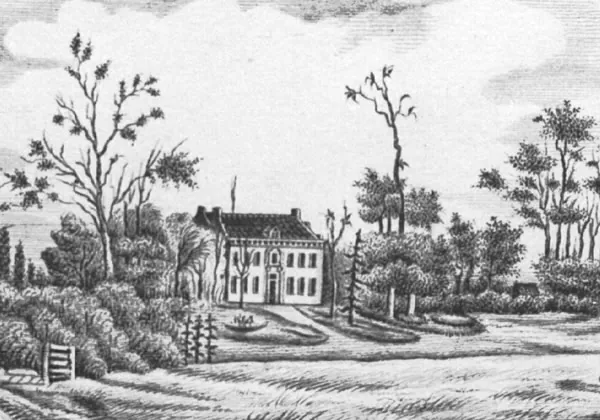

From the will of Renicus Kingma, son of Hendrik Jelles Kingma (brother of Pieter Jelles), much becomes clear about the generation of Kingmas then living.
Among others, Renicus named the children of his uncles and aunts as heirs, including his uncles Pieter Jelles and Ynte Jelles. He also stipulated that his estate had to remain within the family on his father's side, that is, the Kingmas.
Around 1635 Renicus died, and his nephew Saeckle Yntes Kingma, son of Ynte Jelles and father of Ignatius, bought out the co-heirs from the estate. Here we get a good overview of the nephews and nieces of Renicus.
The ten parties each sold their share of f. 1.025,-. The nephews and nieces are mentioned mainly in the deeds of sale, and this is how we come across the name Joannes (Johannes) Kingma in Oenkerk. The deed of sale to his nephew Saeckle Ynte Kingma states that the amount did not have to be paid immediately.
The surviving deeds show that interest was paid regularly. In 1659 Pieter Johannes Kingma of Blija declared, “zoon van Johannes Kingma, mijn wijlen vader”, that he had obtained a claim on Saeckle Yntes Kingma (and heirs) through (estate) division.
This brings us to the conclusion that Joannes (Johannes Pieters) Kingma, living in Oenkerk, must be the son of Pieter Jelles Kingma and was born in Zweins before about 1610.
Johannes Pieters Kingma was married to Gatske Wybrens Buma, and besides Pieter Johannes they may have had another son named Johannes.
Pieter Johannes Kingma was married to Brechtje, daughter of Jan Feijtes, and lived in Blija. They had six children, the eldest of whom was Johannes Pieters. Johannes Pieters was a farmer in Genum and married to Jisseltje Reynners. Around 1685 their son Jan Johannes Kingma was born. Jan Johannes Kingma married Trijntje Jacobs and was an innkeeper in Birdaard.
Jan Johannes Kingma is the ancestor of the “Birdaarder” Kingmas, who descend directly in the male line from Jelle Kinghum of Zweins.
Tjeerd Kingma
Sources: Taede Kingma, Ype Brouwer.
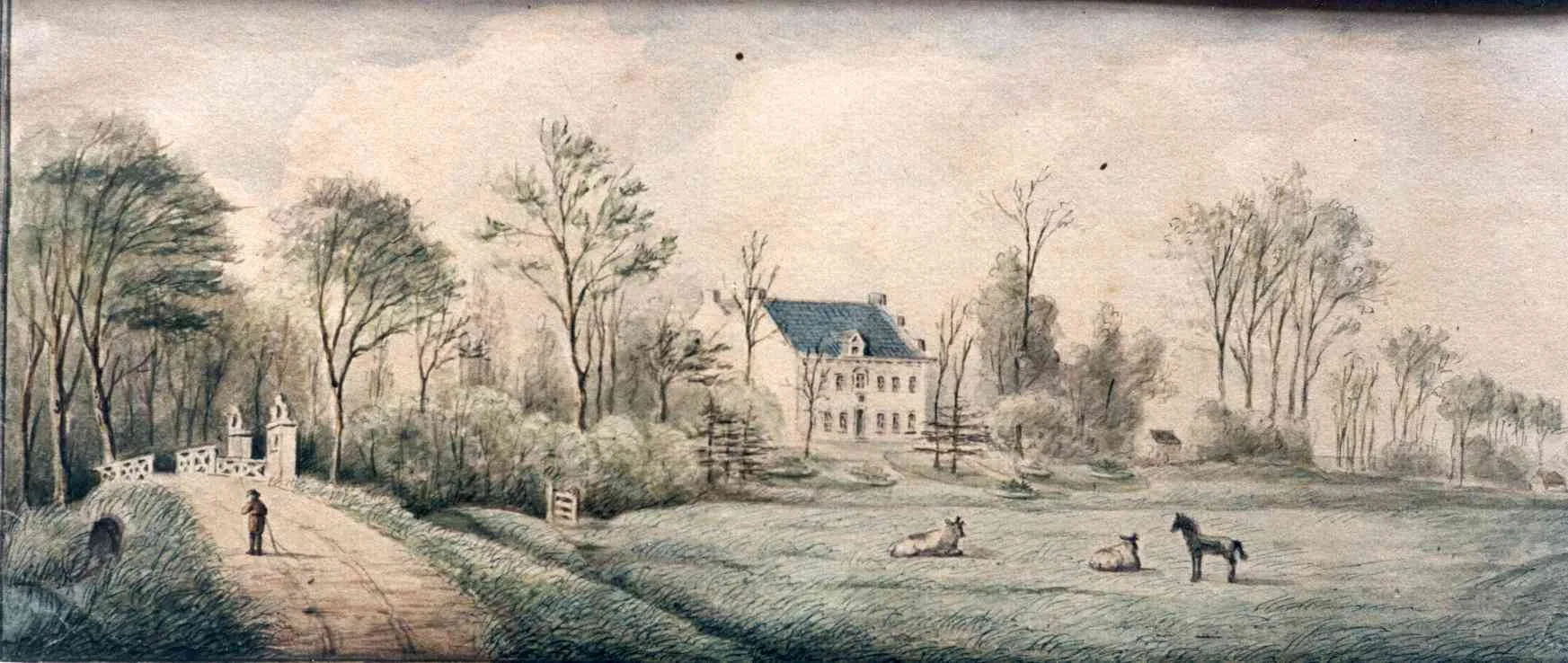
Kingma Kronkels: New Year's Wish

Joost Kingma
New Year's wishes have a long history.
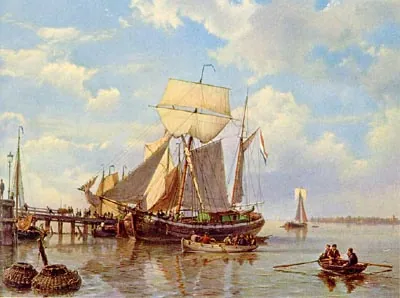
Ever since Christoffel Bernard van Galen (‘Bommen Berend’) wielded the episcopal sceptre in the bishopric of Munster, from around 1659, he never failed, towards the end of the year, to wish the States General of the Seven Provinces "een gelucksalige Nieuwe Jaar." He would then always receive "een beleeffde missive" back from them. 1
Gentlemen among themselves.
Notwithstanding the fact that mutual quarrels sometimes threatened to disturb the good understanding between the gentlemen, the customary courtesies were usually still observed.
What would such a New Year's wish have looked like, anyway? Certainly not a fine picture postcard à la Anton Pieck with a snowy landscape.
These days, the New Year's card is somewhat going out of fashion with us.
The electronic version is taking over.
But Bommen Berend too, so called because of his heavy bombardment of Groningen in 1672, was selective about it.
For in the year 1663 the episcopal New Year's wish was withheld, in connection with new plans to attack Borculo.
So watch out if someone suddenly stops sending you a New Year's wish. He or she might just be planning to seize your possessions.
Putting together a Kinkhoorn is always a bit of a race against time. But fortunately it has once again landed in your letterbox well before the end of the year. That, at any rate, gives me the chance to wish you – in good time – all the best for the year 2005. Wouldn't want you suspecting me of coveting your possessions.
And feel free to send me a courteous missive in return:
info@joostkingma.nl
1 Het Staatsche leger, 1568 - 1795
Announcement of the autumn 2004 meeting
The autumn meeting for donors will take place on Saturday 20 November 2004 in the village hall in Zweins, from 1.30 pm to approx. 4.00 pm.
Mr Terluin, vice-chairman of the Fryske Rie voor Heraldyk, will give a talk as guest speaker on Frisian heraldry and the Kingma coat of arms.
The programme for the Kingmadag 2005 will also be explained.
You are warmly welcome.
Colophon
‘De Kinkhoorn’ is a periodical publication of the Stichting Kingma State.
The periodical is sent to donors of the foundation.
You can become a donor by transferring an amount of at least 12 Euro annually to account number 55.00.97.538 at the ABN AMRO bank in Arnhem, in the name of Treasurer Stichting Kingma State.
Print run: 150 copies.
Published at least twice a year.
Stichting Kingma State
Secretariat:
Sterrenboslaan 20, 3972 GD Driebergen
phone: 0343 521212
fax: 0343 517689
e-mail: info@joostkingma.nl
website: www.kingmastate.nl
Board
Chairman: C.S.J. Kingma, Emmen
Secretary: J.H. Kingma, Driebergen
Treasurer: J.M. Kingma, Arnhem
Board member: Tj. Kingma, Zwolle
Design and production
Drukkerij Bakker Baarn
This publication is registered with the Koninklijke Bibliotheek under ISSN: 1569-8645
When reproducing the content of articles from De Kinkhoorn in whole or in part, please credit the source.