IV De Kinkhoorn
De Kinkhoorn 2 — November 2000
Volume 1, number 2
This issue as pdf (Dutch) · Read the Dutch original · the German translation by Ralf J. Kingma
Foreword
The Kingmadag in Zweins was already a while ago now, the holiday season is over too — high time for a new Kinkhoorn.
Looking back on the Kingmadag, we can say that the interest was even greater than we had estimated, that the enthusiasm was great and the atmosphere fantastically good. In short, the day was a success and we can look back on it with pleasure and satisfaction. Our thanks go out to all the participants who, with their presence and good mood, contributed to the success. Many thanks also to the many helpers who helped keep everything running smoothly and in good order. Our special thanks go out to the residents of Zweins and Kingmatille, without whose willing cooperation, enthusiasm and great personal contribution, it could never have become such a success.
Now that the Kingmadag, with all its extensive organization, is over, I would still like to mention that Joost (secretary), Jeroen (treasurer), Wieb (board member and our genealogist) and Lies (who, among other things, did a great deal of administrative work) deserve a great deal of thanks for all the preparatory work they did and their commitment on the day itself.
We now have our hands free to devote ourselves, as far as our time allows, to the tasks our foundation stands for. We will continue researching the family history, the genealogy, the history of the State and the meaning of the coat of arms. In addition, we would like to look into whether the State grounds can be given added cultural-historical value.
Kees Kingma
Chairman
Every Century (Kingmadag report)
By the time this Kinkhoorn appears, the Kingmadag 2000 is already several months behind us.
Judging by the reactions we received from many sides during and after the day, we gave a great many family members a lot of pleasure with this.
Turnout was even a bit higher than the 400 Kingmas we expected, and the enthusiasm exceeded our wildest expectations. But the cooperation we received from the residents of Zweins also contributed a great deal to the success of the day. That started right away with the welcome gates on the access roads to Kingmatille. And finally, the weather helped too, with a good dose of luck.
Quite soon after the welcome address and starting signal, most participants had found their group for the guided tour and the day could begin. The little carriage for the elderly arrived a bit late, but that was quickly remedied by putting cars into service.
Visitors to the tea house were treated by Sije Fokkema to a historical account of this only surviving building of the former Kingma State. In the garden, the Frisian bard Roel Slofstra sang moving songs while the tea was enjoyed.
Walking on toward Zweins, one could enjoy a demonstration of kaatsen, a very popular sport in this part of Friesland. And after the talks in the village hall and the Reginakerk, there was, at the end of the afternoon, a truly enchanting spectacle with black Frisian horses in the field next to the church. Amazons dressed in long blue robes gave a beautiful dressage show set to music.
For a walk across the State grounds, somewhat sturdier footwear was needed, but thanks to the necessary preparations made by the caretaker, almost everyone was able to go there without difficulty to hear the interesting story about the history of stinzen (fortified stone houses) and staten (Frisian manor estates with land) in Friesland.
For those who had difficulty walking, there was a simultaneous talk on the same subject in the tent. Here too, from early morning until evening, there was enormous interest in the family tree and the genealogy of the Kingmas. Quite a bit of puzzling went on to see whether people could attach their ancestors to the data already known.
Meanwhile, the little ones could go outside to the playground equipment and inside to the clown and television.
Thanks to the good weather, the excellent barbecue could be enjoyed both outside and inside.
The intended group photo with all the Kingmas present turned out to be a project with too high a level of ambition. Fortunately, many photos were taken by the photographer at the moment of arrival.
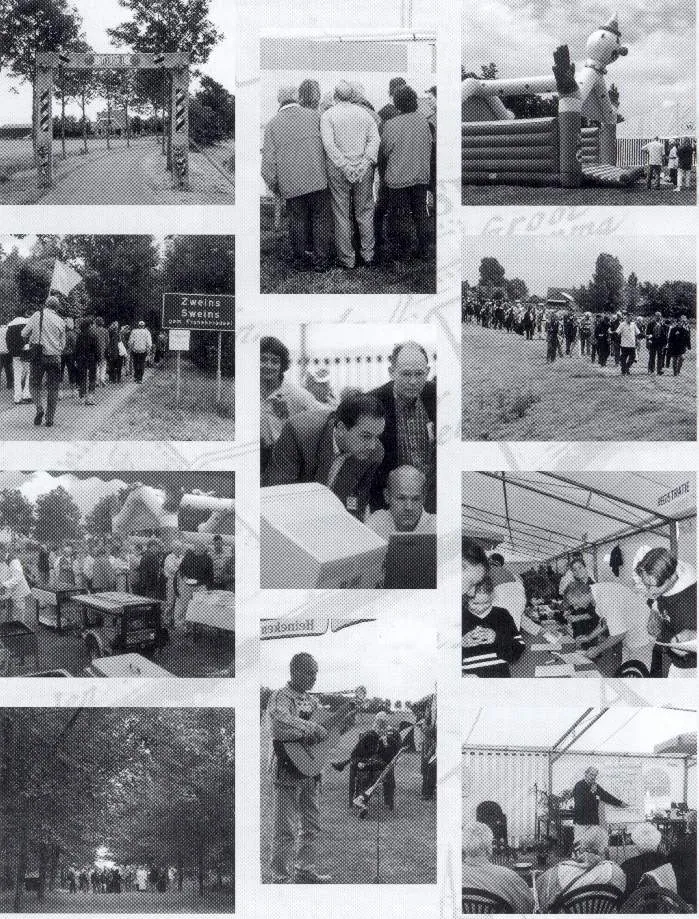
Thanks to the good interpreters, the foreign visitors were also able to follow the presentations at the various locations.
In short, a very successful day. And to the question of whether we intend to do this more often, we have consistently answered in the affirmative: at least once every century!
Kingma Kronkels: Butterflies and Swans
Joost Kingma
'As a Groninger I don't fling myself ecstatically around the neck of a Groninger from Toronto on the first day of a Groningen reunion in Appingedam. Watch out. Creep. But Toronto Frisians get butterflies in their stomachs when they drive across the Afsluitdijk: Frisians, Friesland, togetherness!'
At our Kingmadag on 8 July we did not quite have such intense scenes, but a bit of that butterfly feeling did come over some people on the drive to Zweins.
It is also hard to shake off, that butterfly feeling, when once again, on a beautiful sunny day in September, you look out over the fields around the 'Hofke', as the former State grounds are called locally, and try to picture what it must have looked like here when the building still stood in all its glory. That feeling became even more intense when, on that occasion, in the presence of the archaeologists from Archis, we discovered that you can still find the little swan island in the western corner of the old moat.
Swans have been a constant factor in the existence of the State's residents through the centuries. We find them again in the crest of the family coat of arms as an emerging swan's neck, and in the escutcheon in the shape of the arrow, which probably stands for the right to zwanendrift (the hereditary right to keep and herd swans). According to the Stads- en dorpskroniek van Friesland about the 19th century, published in 1934 by Dr. G.A. Wumkes, this right to zwanendrift was auctioned off in 1882 together with the house, yard, land and swan island on the former State. How this date relates to the demolition date of 1864 is not (yet) clear.
Swans are proud birds.
'Frisians are proud people. Groningers are not. We suffer from an inferiority complex,' says Jan Mulder in that same piece, CAMU.
'Abroad, they sometimes ask where you live.
'Groningen.'
'?'
'Groningen. Next to Friesland.'
'Áh, yes, I know!'"
After this summer, plenty of reunion-goers can rightly say that, hopefully still with a few butterflies in their stomachs.
Lecture by Taede Kingma
I want to begin with something about onomastics, the study of names.
And then first of all something about Frisian place names, toponyms. Many place designations in Friesland end in –um. That arose from –heem, -heim. What precedes that –um is very often (though not always) a personal name. Kingum, from which our family name is derived, then means: the home, it hiem, the yard, the dwelling place (in this case certainly a terp, an artificial dwelling mound) of Kinge, and that must be an Old Frisian first name. Already in 1413 the name Kingum appears in documents as the name of the sate (farm), but that name is certainly much older. This region had already been inhabited for a long time by then. According to a recent publication (De Vrije Fries 1999, p. 31), habitation of this area was possible as early as some 150 years before Christ.
Many Frisian family names are derived from personal names. A number of surnames, however, were formed from place names by adding –a (=of): Baarda, Holwerda, Ferwerda, etc. When it concerned place names ending in –um, you got names like Bierum, Hallema, and also Kinguma.
Many family names arose from personal names by adding –ma or –sma to a first name: Atema, Eisma, Feikema, Herkema, Hendriksma, Jansma, Pietersma. –Ma and –sma then mean roughly: children, descendants of…
There are also many Frisian family names ending in –stra. That developed from "sater" or "sitter", which evolved into satera, sittera, meaning "inhabitant of", and later wore down to –stra: Boonstra (from Boarn, Oldeboorn), Groustra, Veenstra, Zwaagstra, etc.
I am not a historian or a genealogist. However, a very long time ago I got intrigued by curiosity about my "roots". You start with your parents and grandparents. Tracing your ancestry back to the French period, around 1810, is not that difficult. For that you can use the civil registry records and the population register at the municipality or at the national archives. Also interesting is the register of surname adoption of 1811/1812. At that time everyone had to choose a surname. Many people did not yet have one. In certain families a family name had already been in use — sometimes for a very long time. Naturally it was registered then. In this way the name Kingma was recorded in as many as some 15 Frisian municipalities.
It becomes harder when you go further back. Then you end up with the church baptism, marriage and burial registers. In some parishes these go back further than in others.
I will not go into the further research possibilities here. De Fryske Akademy has published a "Gids voor genealogisch onderzoek" (guide to genealogical research). That points you in a very good direction.
More than 50 years ago I reached my ancestors in the 17th century – mainly in Ferwerderadeel – but then I actually got stuck. And that's when chance came to my aid. In the "jierboekje van it Genealogysk Wurkferbân fan de Fryske Akademy" of 1952 there was an article by H.G. van Slooten about: "De Reders- en Koopmansfamilie Kingma te Makkum" (The shipowner and merchant family Kingma of Makkum). In it, Van Slooten wrote: "Het behandelde geslacht heeft zijn naam ontleend aan een thans uitgestorven familie Kingma." [The family discussed derives its name from a now extinct family Kingma.] That sentence rather intrigued me at the time. I then got in touch with Van Slooten, who subsequently sent me his data on the Kingmas. He let me know that from his research he had concluded that the Kingmas of Kingma State in Zweins had died out, but that it was not impossible that that family lived on among the farming class. According to him, that would then be at a completely different social level than the original ancestors.
Thanks to that information from Van Slooten I was able to find, in the 17th century, descendants of the Kingmas of Kingma State who lived in Ferwerderadeel with the same first names as my ancestors in the same region; indeed at a different social level: farmers, innkeepers, farmhands, etc. But that one "missing link" was still missing. With the help of the genealogist Ype Brouwers I finally succeeded, some years ago, in finding the right connection. It then turned out that around 1650 there were two farmers in the same region called Johannes Kingma. I had ended up with the one from Reitsum, but I needed Johannes Pyters Kingma, who was a farmer at Lichtaard in 1640. So after many years I was finally able to conclude that, directly in the male line – via Sweins, Oenkerk, Ferwerderadeel, Dantumadeel (mainly Wanswerd and Birdaard) and Leeuwarderadeel – I descend from the oldest known Kingmas of the 15th century.
Surely there are many more Kingmas for whom that holds true. In addition, there are quite a few Kingmas who descend from those first Kingmas in the female line. Before the French period it was not unusual for someone who had no family name to adopt the family name already in use by their mother or grandmother. That was, for example, the case with the Kingmas of Kingma's Bank.
Another example. The daughter of Ynte Clases Kingma passed the name on to her descendants. Thus there is a family Kingma with Beers as its ancestral village, and one originating from Weidum. Quite a few Kingmas in what is now called the municipality of Littenseradeel (formerly Baarderadeel and Hennaarderadeel), or originating from that region, descend from her. The name Ynte occurred, and still occurs, fairly often among them.
I think that almost all Kingmas are descendants of the first Kingmas from Zweins known to us. "Almost", because an exception is formed by the family of the barge skippers/shipping entrepreneurs Kingma of Birdaard. Antje Aedes was married to Jan Johannes Kingma, who did descend from "our" family. Her cousin, Gosse Jans – who therefore did not belong to the Kingma family – in 1812 simply adopted the name Kingma, which he happened to know. This gave rise to a new family Kingma, which has had, and still has, quite a few descendants, especially in Birdaard and, among other places, Dokkum and the Dongeradelen.
It is of course not impossible that a similar case occurred elsewhere too, but those would still be exceptions.
I now return to the oldest known ancestors. These are Pieter Jellezn. Kingum, probably born around 1480 at Kingmasate, and his brother Jelle Jellezn., who died in 1555. From the fact that Pieter and Jelle are both referred to as Jellezn., we can deduce that their father was called Jelle. That takes us a bit further back in time. He must have been born around 1450. He must have died at Kingmasate in 1538. According to the Register van den Aanbreng of 1511, this Jelle owned 16/40 of the Kingmasate.
A Johannes Petri then owned 14/40 of that farm. Could that not have been a brother of Jelle's? If so, we also know the name of their father; Petri, after all, means: son of Pieter. And with that Pieter we already end up well into the first half of the 15th century.
16/40 + 14/40 = 30/40. A quarter of the farm thus belonged, in 1511, to someone else.
The noble lady Edwer Sjaarda, in 1510, bequeathed her share in "gued thoe Kinghum", which yielded 9 fl. together with the feeding of a stallion every other winter, to her granddaughter Lutke, married to Gerrolt van Herema. Of the farm's total yield of 40 fl. 22 st., that is roughly ¼. Pieter Jelle zoen toe Kingen is named in 1511 as the user of the sate. Let us say he leased it from his father and, not improbably, his uncle, and still had to pay an amount to the Sjaarda family as well. That family had strong ties to Kingum; in 1413 Sicke Sjaerda was "Ruychter van Kinghum". It would be interesting to find out what the relationship was between the Kingums/Kingmas and the fabulously wealthy noble family Sjaarda of Franeker. According to "Zorgen voor zekerhied" by Dr. Hans Mol et al., on the Frisian testaments from before 1550, the hoofdelingen (local chieftains, roughly the leading landed families of Frisia) often provided very well for their bastard children (and there were quite a few of those). They quite often ended up in the eigenerfden milieu. An eigenerfde was a farmer on his own land. The first Kingmas are repeatedly referred to as eigenerfde at Kingmasate. Might they perhaps also have had diluted blue blood in their veins? That seems to me an interesting question for further researchers.
The oldest members of our family were referred to by various names. For instance, Pieter Jellezn. Kingum (# around 1480) also appears as Pieter Jelles toe Kingma. His son Jelle Pieterzn., like his brothers, also called himself Kingum. After that it increasingly became Kingma, also alternating with Kinguma, Kingema and Van Kingma.
What sort of era did the first known Kingmas actually live in? That was a time when Friesland was torn apart by internal feuds. A sovereign territorial authority was entirely absent. Those hoofdelingen, together with the armed retainers they kept in their service, were constantly at war with one another, often calling their entire following (those who depended on them) to arms. Stinzen (fortified stone houses) were set on fire, women were abducted and held hostage, and from time to time they killed one another. At the end of the 15th century this culminated in the full-blown party struggle between the Schieringers and the Vetkopers. In that "civil war" between the power holders, the already-mentioned Schieringer hoofdeling family Sjaarda of Franeker, among others, played an important role. After 1498, when the Schieringers had called in the help of a foreign power in the person of Albrecht van Saksen, this chaotic, almost anarchistic period came to an end. It is true that this also put an end to the legendary Frisian freedom, but an orderly system of governance did emerge. Two years ago a less successful attempt was made to commemorate this, under the name "500 jaar Friesland" (500 Years of Friesland).
Jelle (born around 1450) and Pieter (born around 1480) consciously lived through that development. Perhaps they even had to fight as part of the Sjaarda's following. Who knows, their farm may well have been burned to the ground at some point.
I will leave it at this introduction. There is not much point in going through my line of descent. Anyone interested in that can take a look at it afterwards.
I hope that others will further build out this line of descent, using the material that is still available, into a complete genealogy — a book of Kingmas.
Presentation at Kingmadag
Several people asked after the presentation whether I had my talk on paper as well, so they could read it again. I did not have that, it was only in my head. So I have now put it on paper after all. You will find the accompanying images partly in Kinkhoorn 1.
Kingma State
The first image was a map of Friesland from 1622. On it, the name Kingma could be found twice next to a state (a Frisian manor house with land). The next image showed a detail of the map where this could be seen very clearly. One near Zweins, the other near Blessum. In the latter name, the m was incomplete due to damage from a fold in the original map. But 'Kingna' could be seen quite clearly. Further research into old maps has, however, revealed that this almost certainly read 'Ringia'. The top part of the R had apparently also been lost, turning it into a K. This has now been set straight.
The other Kingma State that I indicated, which lay on the Wadden coast, close to Peasens, can indeed be found on various old maps (e.g. Schotanus and Eekhof) and is also listed as a former state in the Aardrijkskundig Woordenboek from 1847. Who lived there is not yet known, but it was presumably a descendant of a Zweins Kingma.
Next, details were shown of two maps by Schotanus, showing the situation around Zweins circa 1718.
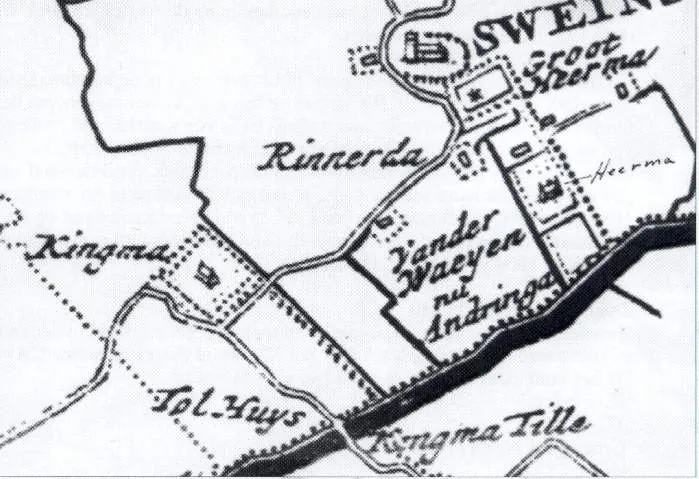
Then there is also a Military Topographical Map from 1854, which curiously still shows the terp next to the State.
Then photos were shown of the three depictions of Kingma State made by A. Martin, namely a pencil drawing, a watercolor and a lithograph. The originals are kept in the depot of the Fries Museum in Leeuwarden and all three show the State from the same viewpoint, see page 5 of the first Kinkhoorn and the cover.
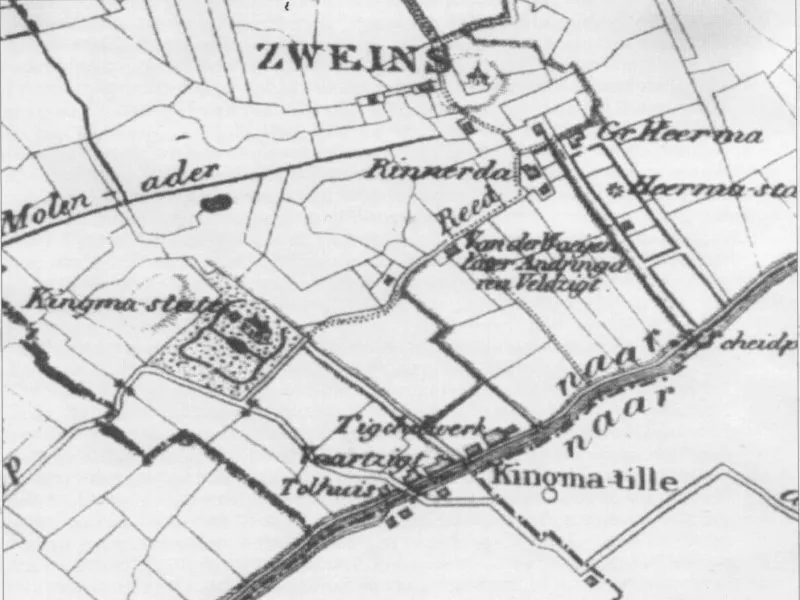
The Fryske Akademy publishes a number of Cadastral and Pre-cadastral Atlases from 1832 and 1700/1640 respectively; 12 volumes have been published so far. Volume 4, on Franekeradeel and Franeker, contains maps showing the situation around Zweins in the years mentioned. On the pre-cadastral map, five states are indicated in Zweins, which in my view must point to great prosperity. Kingma State stands out due to the size of the plot, on which even the moats are indicated. The map further shows a tollhouse and a brickworks in Kingmatille, and, northwest of Kingma State on the adjoining plot, a terp (an artificial dwelling mound) on which the sate (farmstead) that preceded the State may have stood.
The subsequently shown cadastral map from 1832 lists, besides Kingma State, only Heerma and Rinnerda (Groot Heerma had been demolished in 1814). The terp is no longer indicated and must therefore already have been dug away by then. On this plot, arable land and 'PlazierBosch' [transl.: pleasure wood] are indicated, along with a circular (walking) path accessible from the State grounds via a small bridge.
Both maps indicate the pool of water (swan pool) that lay about 200 ellen (an old Dutch unit of length) north of the State. The Kingmas held the right of zwanendrift (the hereditary right to keep and herd swans), meaning that they were permitted to breed swans (mainly for the swan's down).
Next we look at a sketch of the State grounds, which comes from the Ryksargyf Leeuwarden. The grounds consist of three parts. In the first part we can see that the 'Heerehuis' [transl.: manor house] stood centrally, with a barn next to it. In the second part, called the 'Binnentuin' [transl.: inner garden], accessible via a small bridge, something unclear is indicated centrally. Statues stand at the four corners, namely of Juno, Ceres, Diana and Automatia. The last is little known; it is 'the Goddess who governs the events that occur without human intervention', as I read in a Latin dictionary. In other words: she regulates the events over which people have no influence, such as, I think, sunrise and sunset and the ebb and flow of the tide. The third part of the grounds (where the tent stood on the Kingmadag) is referred to as the 'Keukentuin' [transl.: kitchen garden]; here, apparently, vegetables and herbs were grown.
A drawing of the bridge (tille) made in 1838, because the bridge needed to be renewed, shows that it was a simple wooden drawbridge. A sketch of the situation around the tille shows that the tollhouse stood on the north side of the tow canal, right next to the bridge, and the bridge keeper's house to the south of the canal. Both houses no longer exist; the bridge disappeared when the tow canal was widened shortly after the war and became known as the Harinxma Canal.
Detail of a map from the Schotanus atlas, 1718
The Kingma coat of arms
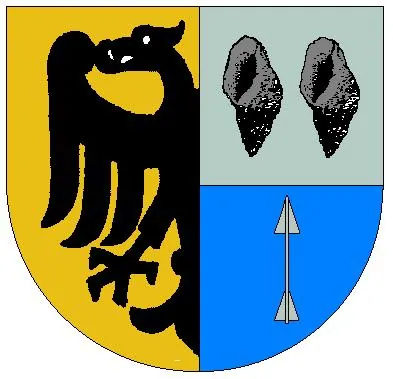
The coat of arms is divided vertically. On the right (in heraldic terms) it shows a Frisian half-eagle in black on a gold background. On the left it is divided horizontally, showing two black whelks on silver above, and a silver arrow on blue below.
The heraldic designations 'right' and 'left' arose because, in the Middle Ages, the armored, and therefore unrecognizable, knights wore their coat of arms on their tunic for identification. In such a case, what is on the right for the wearer is on the left for the viewer, hence.
The eagle originates from the German eagle and is connected with the confirmation by Emperor Sigismund in 1417 of the so-called Karelsprivilege, the supposed privilege of Charlemagne, by which he confirmed Frisian freedom. It is also generally assumed that the prominent figures who took part in the so-called 'Rechtsomgang' (the exercise of judicial power in rotation), as a sign that they administered justice on behalf of a higher authority (the Emperor), included the eagle in their coat of arms, although this was not a fixed rule. Kingma State, too, was a so-called 'Rechtvoerende State' [administering State]. (See: 'De Rechtsomgang van Franekeradeel 1406 – 1438', published by the Fryske Akademy).
There is also a Kingma coat of arms without the eagle, i.e. with only the two whelks and the arrow. That must therefore be an older version.
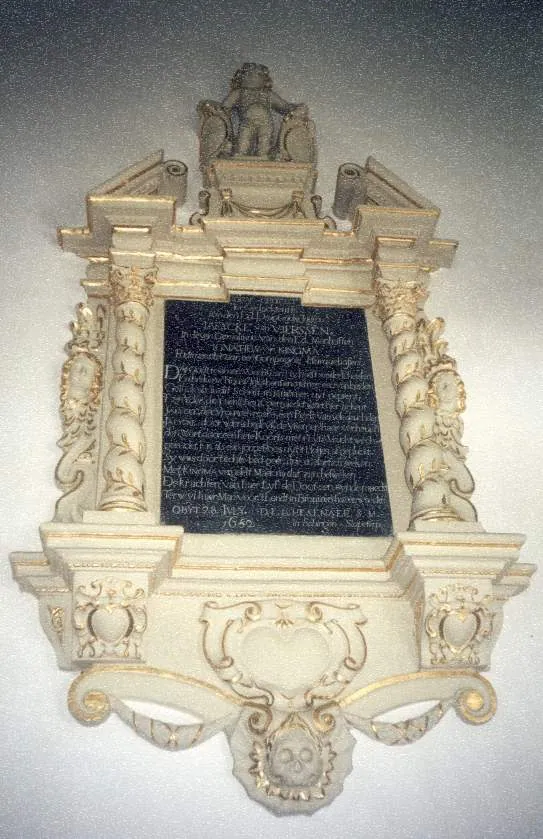
During the restoration of the Zweins church, a stone was placed in the floor which had apparently been discovered somewhere and which bears the Kingma coat of arms with eagle. The coats of arms on the grave slabs of the Kingmas in the church were unfortunately chiseled away during the French period, by order from higher up. Only on the grave slab of Colonel Ignatius can the bottom half still be seen: the eagle's leg and the arrow. Something must apparently have been placed over it at some point.
On the grave slab of Inte Jelles Kingma, the crest belonging to the coat of arms can be clearly seen. This is described as 'an emerging swan', showing a knight's helmet decorated with feathers, above which the head and neck of a swan can be seen.
The last image I show is the epitaph on the grave slab of Inte Jelles; it reads:
De doot die maeckt ons algelyck
In allen Stand tsy arm of ryck
Wanneer Tgebeent op hoope leidt
Siet men aldaer geen onderscheyt
This clearly shows that our distant ancestors, despite their status and wealth, were down-to-earth Frisians.
Kees Kingma