
IV De Kinkhoorn
De Kinkhoorn 14 — October 2006
Volume 7, number 2
This issue as pdf (Dutch) · Read the Dutch original · the printed original
Foreword
After this extremely hot and wet summer and the beautiful autumn, it is once again time to prepare the next Kinkhoorn and the upcoming Donors' Afternoon.
In the previous Kinkhoorn I began an article about the will of an important and wealthy gentleman in the 17th century, in this case Ignatius van Kingma, the last Kingma at the State.
The first part of this article was mainly about arranging the succession and the preservation of the State. This time it is mainly about the real estate included in the inheritance.
We have also heard that plans are being made to bring the little ferry of Kingmatille back into service. In this connection, Gryt van Duinen, of Omrop Fryslân, interviewed Bauke Saakstra, the very elderly former resident of Kingmatille. This has resulted in an article about Saakstra which, with Gryt's permission, we are including in this Kinkhoorn.
Then we also have a report from our German donor Ralf, who made a "genealogical" holiday trip to Friesland and reports on it here.
With an article about other prominent Kingmas in the 17th century and the usual "Kronkels" column, this will be a substantial Kinkhoorn.
Kees Kingma
Chairman
Will of Ignatius van Kingma from 1696 (2)
Will of “De Heer Old Brigadier Ignatius van Kingma” te Sweins, 1696 – continued from Kinkhoorn 13
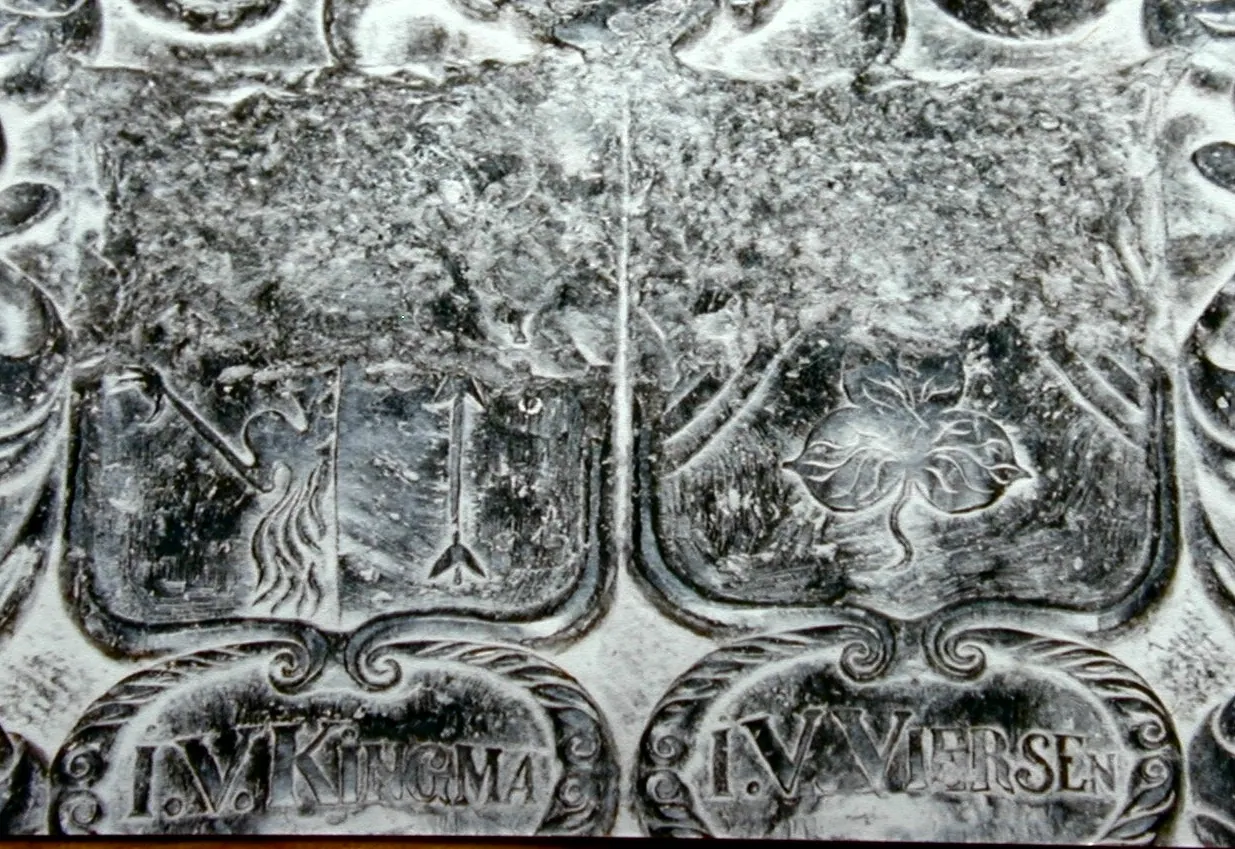
On page 9 the will continues with a demand regarding his gravestone: "Mijn erfgenaem of erfgenamen sullen ook gehouden wezen de namen en wapenen van mij testator en van wijl mijn vrouw Jaijke van Viersen mijn eerste huisvrouw binnen ’t jaer na mijn overlijden op de steenen in de kerk tot Zweins bij mij ten dien fine 1 daer laten brengen doen houwen, bij paene van 2 hondert rijxdaelders aen gedagte Nieuw Weeshuis te Lieuwarden te verbeuren". That this was carried out can be seen in the church of Zweins. Unfortunately, as a result of a decree in the French period 3, the upper half of the two coats of arms was hacked off. Presumably the lower half was spared because something stood in front of it at the time: see the accompanying photo.
Then, with much circumlocution, for the case that the owner of Kingma State has left behind an "onmondige" (minor) son or daughter, "de Edelmogende Heeren raden des Hoffs van Vrieslandt" are asked to "eerlijk man te verkiezen" to act as guardian. This person must then account to the "Commissaris van Hooggemelte Hove Provinciael", in which some of the "enige naeste en bequamste" blood relatives of the minor (new) owner must also be involved.
After that, twelve items, called "vastigheden" (real estate), are listed in the will:
- Kingma State met de Huisinge, Plantagie, vrije vissernije sig strekkende van Franeker aen Ripster rijdbrugge 4 , swanejagt gelijk ik en mijne voorouders dezelve altoos gerustelijk gebruikt en gepossideerd 5 hebben, de gestoelten in beide de kerken, sampt kelder en graven, met verdere praeëminenten 6 en servituten 7 van ouds er toe en aenbehorende groot een hondert pondte 8 gelegen tot Sweins bij mij testator jegenwoordig bewoond.
- Een sathe lands groot vijff en twintig pondemaat met de huisinge schuire cum annexis 9 gelegen aen Kingmatille bij Dirk geerts Rodenburg gebruikt.
- Vier camers aen de trekweg 10 mede alhier gelegen.
- Het tiggelwerk 11 met de huisinge, schuire groot vijff en twintig pondemaat bij Jacob Classen gebruikt, hem nog vijff en twintig pondemaat ’t cleiland genaemdt en bijna vertiggeld, bij Harmen Harmens gebruikt.
- Een sathe lands, Rinnerda sathe genaemdt mede tot Sweins gelegen groot sestig pondemaat bij Jan Yettes gebruikt.
- Een stemdragende 12 sathe of stelle of huisteed Bervert genaemdt ensgelijk tot Sweins bij Jan Yettes gebruikt.
- Een sathe lands gelegen tot Tzjom 13 , overre Tille genaemd, groot na naem en faem twee en veertig pondemaat bij Pytter Elings gebruikt.
- Een stemdragende plaets 14 tot Herbaijum 15 groot omtrent negen en twintig pondemaat en de huis en stjelp 16 met verzoek van mijne erfgenamen te willen vigileren 17 so veel doenlijk om bij occasie 18 agt of twaleff pondte 19 daer bij te copen en ten allen tijden onder de huisinge en meergedachte majoraet te laten verblijven.
- Een sathe lands gelegen in den dorpe Dronrijp groot vijff en tagtig pondemaat bij Pytter Classen cum uxore 20 gebruikt wezende. Hebbende de Heeren neven, Hector van Glinstra, Grietman over Tietjerksteradeel, Jacob van Gemmenich en de Kerk van Welschap ten naesten beswaerd jegenwoordig met huis cum annexis 21 , welke mijn geïnstitueerd 22 erfgenaem, indien ik de tauxatie 23 bij mijn leven niet mogt hebben betaeld, sal betalen en aflossen.
- Een sathe lands gelegen tot Peins, mede onder dit praerogatief of majoraet begrepen geregtigd met twee stemmen groot na naem en faem, hondert pondemaat Sijtse Tamminga genaemd, met de huisinge, schuire cum annexis bij de weduwe van Buwe Dirks jegenwoordig gebruikt werdende.
- Twee sathen landt met de huisinge cum annexis gelegen tot Peins de ene groot omtrent vijftig pondte, bij Gerrit Walles de andere bij Pieke Classen jegenwoordig gebruikt werdende groot twee en dartig pondemaat welke plaetzen onder conditie hier voren gementioneerd 24 mede tot onderhoudt van Kingma State sullen werden gebragt en onder dit meer gemelde majoraet ten allen tijden verblijven geënclaveerd 25 .
- Ten laesten een sathe lands met huising cum annexis gelegen tot Doijum onder de klokkeslag van Franequer 26 , groot drie en vijftig pondemaat bij Claes Jans als meijer 27 gebruikt werdende.
Adding up all the land, Ignatius owned approximately 576 pondemaat (an old Frisian unit of land area), which is ±192 hectares. Since no land registry yet existed, the exact size of the various plots is not known. This is also evident, for example, from descriptions such as "groot omtrent …." and "groot na naem en faem …. ". The latter means roughly "as large as is generally known locally".
So Ignatius owned the substantial state, a tiggelwerk, seven dwellings or farms, and another four "camers". What exactly is meant by the latter is not clear; possibly these were simple dwellings with only one room, for workers at the tiggelwerk.
Altogether, then, a substantial estate that must certainly have yielded a decent return, along with influence in the form of voting rights.
We have now reached page 11 of the will, which means there will be a further continuation in the next Kinkhoorn. This deals, among other things, with the settlement of Ignatius's social obligations towards his staff, which are also set down in the will.
To be continued.
1 Fine, from fin, end. (Practisyns Woordenboekje)
2 bij paene van, on penalty of. (P.W.)
3 A notice from the court of Franekeradeel states that before 1 October 1796 the "fideicommissaire wapenen en andere teekenen op Kingmastate en in de kerken voorhanden" must be removed. This is connected to the "equality" propagated in the French period. This meant that family coats of arms, which after all emphasized differences in rank, no longer fit in.
4 Rijpster rijdbrugge, the drivable bridge of Dronrijp.
5 Possideeren, to possess. (P.W.)
6 Preëminent, superior to others. (van Dale)
7 Servituut, servitude, easement. (van Dale)
8 Pondte, this must be an abbreviation of "pondemaat", indicating the area of the land belonging to the State. 100 pondemaat is ± 33 hectares.
9 Cum annexis, with appurtenances. (Latin used in genealogical research)
10 Trekweg, towpath along the Harlinger trekvaart (now Harinxmakanaal).
11 Tiggelwerk, or tichelwerk, brickworks.
12 Voting rights and the tax payable were related to one's possessions.
13 Tzjom, now Tsjom and in Dutch Tzum. A village 6 km as the crow flies south-west of Zweins.
14 Plaets, farm.
15 Herbaijum, now also called so in Dutch, in Frisian Hjerbeam. A village halfway between Franeker and Harlingen.
16 Stjelp, stolp, stelphuizing: a farm whose living and working quarters are entirely covered by a single roof. (Frysk Wurdboek)
17 Vigileren, to watch, to be alert. (P.W.)
18 Occasie, opportunity, occurrence. (P.W.)
19 Pondte, apparently this is a shortened form (not a standard abbreviation) of the word Pondemaat.
20 Cum uxore, with his wife. (Latin used in genealogical research)
21 Cum annexis, with appurtenances. (Latin used in genealogical research)
22 Institueren, to institute. (van Dale)
23 Tauxatie, meaning unknown! Possibly something like a loan or mortgage.
24 Mentioneren, to make mention of, to state. (van Dale)
25 Geënclaveerd, probably meaning enclosed, i.e. included in the inheritance described.
26 Doijum, now Doaium, a small village 2.5 km south of the centre of Franeker where, apparently, one could hear the bell of the Franeker church tower strike.
27 Meijer, tenant farmer, leaseholder; also someone who manages a farm or other business on behalf of the owner; synonym zetboer, rentmeester. (van Dale)
Residents of Kingma State up to 1700
In the article about the will of Ignatius Kingma we get an impression of the possessions of Kingma State around 1700.
How did this property come into being from the beginning of the 16th century onward?
In the Register van Aanbreng (Register of Assessment) of 1511, Jelle Kinghum, eigenerfde (freeholder), is named as owner of 16/40 of Kingma Sate. A certain Johannes Petri (Pieterszoon) owned 14/40 of the farm. Was this Johannes Petri a brother of Jelle Kinghum, and was the father's name Pieter?
Pieter Jelles, the eldest son of Jelle Kinghum, was born around 1480 in Zweins; his grandfather Pieter must therefore have lived at the beginning of the 15th century.
Pieter Jelles is named in the Register van Aanbreng of 1511 as the user of Kingma Sate; he is not the owner. He probably leased it from his father Jelle and his uncle Johannes Petri. He also paid an amount of 9 fl. and the feeding of a stallion, every other winter, to the granddaughter Lutske of Edwer Sjaerda, out of the farm's yield of 40 fl. and 22 stuivers. This amount is ¼ of the total yield. The Sjaerdas were possibly the owners of the remaining 10/40 of Kingma Sate.
The Sjaerda family had strong ties with the sate (Frisian farmstead) of Kinghum. In 1413, Sicke Sjaerda was judge on behalf of the sate of Kinghum.
Pieter Jelles was thus the user of the sate, and was also gevolmachtigde (deputy, representative) of Franekeradeel. He must have married Nel Jansdr around 1510. Pieter Jelles had four children: Jelle Pieters, Ynte Pieters, Claes Pieters and Hendrick Pieters. As the eldest son, Jelle Pieters succeeded his father as eigenerfde on the sate; he was married to Hylck Gerritsdr Vogelsanch from Oosterwierum, who died in 1570 in Zweins. Jelle Pieters married for the second time to Yda Meybsdr, who died before 1597. Pieter Jelles lived in 1601 in Dronrijp, where he died and was buried between 1603 and 1605.
In 1587 his name is mentioned in connection with Lutke Hockwertersate in Winsum. In 1571 Jelle Pieters bought land on the Hinixteterpstra sate in Skalsum from his uncle Claes Pieters, who lived on Foppinga sate near Dronrijp.
A son of Claes Pieters, Ynte Claesz Kingma, was eigenerfde on Stickingabuerster sate near Achlum. The daughter Baefke of his grandson, also named Ynte Claesz, carried the name over to a Kingma family with Beers as its ancestral village.
Back to Jelle Pieters. Five children were born from his first marriage: Pieter Jelles, Dirck Jelles, Hendrick Jelles, Ynte Jelles and Jetske Jellesdr.
Pieter Jelles, the eldest of the children, was born around 1560 in Zweins and succeeded his father as eigenerfde on Kingma sate. Around 1600 the sate was apparently rebuilt to such an extent that from then on it was referred to as a State.
Pieter Jelles was married to Aelcke Heredr; they had six children, two boys and four girls. The son Hero Petri Kingma later became a minister in Sneek (see Kinkhoorn no. 12), and Johannes Pieters Kingma later became a farmer in Oenkerk (see Kinkhoorn no. 10).
Pieter Jelles was a member of the Gedeputeerde Staten (Provincial Executive) in Friesland.
How the ownership was divided and how large the State was around that time is not clear. Apparently Pieter Jelles and Aelcke Heresdr owned 1/5 of the 45 pondemate (an old Frisian land measure; ± 16.5 ha) of land belonging to Kingma State; the remaining 4/5 probably belonged to his brothers and sisters.
The area of the State was presumably larger, with his three uncles as co-owners.
Pieter Jelles and his wife possibly both died around 1610 in Zweins.
The eldest son, Hero Petri, was then about 12 years old, and his brother Johannes Pieters about 5 years old. The eldest sister, Elske Pieters, was then about 22 years old and not yet married.
Back to the three brothers and the sister of Pieter Jelles.
Dirk Jelles was married to Fedske Pybesdr Wyarda. Dirck Jelles was a farmer on Sjaerda State near Dronrijp — here too, perhaps, a connection with the Sjaerda family? Their daughter Trijntje Dircksdr was married to Claes Willems and carried the name over to the Kingma family with Rauwerd as its ancestral village.
Hendrick Jelles was married to a woman named Rienksdr and lived in Franeker in 1601; he had a fairly large fortune. His will of 1625 is kept in the Kingma archive. In it he names his only son, Rienck, as sole heir; his wife had already died by then, and he himself died before 17/1 1631. In 1611 he was the owner of Kingma State and sold it to his great-nephew Saeckle Yntes Kingma (Kinkhoorn no. 3). How Hendrick Jelles came into possession of the State is not clear. As we have seen, his brother Pieter Jelles and his wife died around 1610; the two sons, Hero Petri and Johannes Pieters, aged 12 and 5 respectively, were too young to manage the State. This may be the reason why Hendrick Jelles, on the death of his brother and sister-in-law, bought up shares of the State and possibly acted as guardian for the children of Pieter Jelles and his wife.
Ynte Jelles was married to Trijntje Saeckles Sandstra. Ynte Jelles was a farmer in Schalsum, where he died in 1590; his wife died in 1623 in Zweins. They had two children, Saeckle Yntes, born around 1584, and Jan Yntes, born around 1585.
Saeckle Yntes was married to Buke Thomasdr van Sloten and lived in Balk, Franeker and Zweins. He was a gecommitteerde (deputy member) of the rekenkamer (chamber of accounts) of the province of Friesland. He was also "volmacht ten landsdage" (deputy to the provincial assembly) and also deputy for the Vijf Delen (Five Districts). In 1640, as an elder of Zweins, he was a member of the provincial synod. In 1618 the municipality of Leeuwarden took action to induce Saeckle Yntes to repair the bridge at Kingmatille.
In 1611 Saeckle Yntes, together with his uncle Ruyrdt Saeckles, bought Kingma State from his uncle Hendrick Jelles (Kinkhoorn no. 3 and 7). They paid 3,670 gold fl., but without the lands.
The brother of Saeckle Yntes, Jan Yntes, married Bauck Beyma around 1640 and lived, among other places, in Grijpskerk, where he is buried. Their daughter Trijntje Jans is the ancestral mother of the Makkumer Kingmas (Kinkhoorn no. 9).
We have seen that in 1611 Saeckle Yntes bought the State from his uncle Hendrick Jelles; he was then about 27 years old and had been married to Buke Thomasdr for less than a year. His uncle was thus co-owner of half the property. This uncle, Ruyrdt Saeckles, died in 1618 and, according to notes on the deed, appears to have completed his payments. In November 1634 everything — repayments and interest — was settled.
In 1631, probably after the death of his father Hendrick Jelles, Rienck Kingma, a student in Franeker, made his will. He remembers the poor of Peins and Franeker, his aunt Hylck Riencksdr, widow of Gerryt Jacobs, and furthermore leaves bequests to Gadske Pieters Kingma, his cousin Saeckle Kingma, to minister Hero Kingma and his cousin Nelcke Pieters Kingma. The heirs finally are the children of his uncles Ynte Jelles, Dirck Jelles and Pieter Jelles, and of his aunt Jetske Jelles. Also in future, his estate must remain within the testator's family on the father's side. Rienck died around 1635.
In 1635 and 1636 nine parties of heirs of Riencks Kingma sold their share (each for 1,025 fl.) in the estate to the nephew, and in one case brother, Saeckle Kingma.
The children of Dirck Jelles sold their share together for 5,125 fl. The rest of the cousins and brother Jan Kingma each proceeded individually; some payments took place much later, as we have seen with the descendants of Johannes Pieters from Oenkerk (Kinkhoorn no. 10).
If the inheritance concerned the unsold lands of Kingma State, we can get a fair picture of the value of Kingma State around 1635. We have seen that in 1611 the State with its appurtenances, and without the lands, was sold to Saeckle Kingma for 3,670 gold fl. The shares bought from Riencks's estate, including Saeckle's own share, amounted to 15 x 1,025 fl., a total of 15,375 fl. The total value of Kingma State must then have been about 19,045 fl., a considerable fortune for that time.
The wills of Hendrick Jelles and his son may provide more information on this.
To get an impression of the size of the State, let us go back for a moment to Pieter Jelles, who lived at the State until 1610. He owned 1/5 of 45 pondemaat; his brothers and sister were possibly co-owners of the remaining 4/5 of the 45 pondemaat. The State was probably larger; assuming the possibility that Pieter Jelles's three uncles also each held a share of 45 pondemaat, we arrive at an area of 180 pondemaat (just over 66 ha).
Saeckle Kingma must, at the age of 26–30, have been a very wealthy man to be able to buy the whole State. Possibly Buke Thomasdr van Sloten had a great deal of money, and he received money from the Saeckles family — certainly a challenge to investigate further.
Saeckle Yntes and his wife Buke had six children, four of whom died young.
Catharina (Trintie) Saeckles was born in 1617; she was married to Jacob Pauluszn van Gemmenich.
Ignatius (Ynte) Saeckles Kingma was born in 1621; he probably went to live at Kingma State around 1652, after the death of his father Saeckle Yntes, and died there in 1700. Extensive attention has been given to Ignatius in the various issues of the Kinkhoorn. After his death his sister became heir to Kingma State; she died in 1720, after which her son, Zacheus van Gemmenich, became its resident and owner. With this, the relationship between the Kingmas and Kingma State came to an end.
Apparently neither Ignatius nor his sister Catharina adhered to the testamentary conditions of both Hendrick Jelles and his son Riencks, that the estate had to remain within the testator's family on the father's side.
We have tried to give a picture of the Kingmas and Kingma State up to 1700. They were evidently well-off, although the system of inheritance meant that the resident of the State still had to have considerable financial means at their disposal in order to keep the properties together.
Tjeerd Kingma
Sources: Taede Kingma, Ype Brouwer.
Newsletter about the ferry at Kingmatille
In February of this year the initiative was taken to bring the ferry of Kingmatille back into service. This ferry existed from 1946 to 1963. Many people in the area have greatly regretted the disappearance of the little ferry. The mutual contacts were broken off. The initiators have asked us to include the newsletter below in the Kinkhoorn. Naturally, as the Kingma State foundation, we wholeheartedly support this initiative and hope our donors do too.
In this context there has also been an interview with the well-known Bouke Saakstra (see Kinkhoorn 6), which we are reprinting with the author's permission.
July 2006
Keimpetille, it pontsje werom
To the residents of Hatzum and the Keimptilsterdyk.
In February of this year we conceived the plan to bring the little ferry of Kingmatille back into service. You may know that this ferry operated until 1963. Earlier there was a bridge at Kingmatille, but it disappeared with the arrival of the Van Harinxmakanaal in 1946.
In the meantime we have looked into whether there are possibilities to get the ferry running again, and have developed a plan. On the south side (the Hatzum side) the Keimptilsterdyk no longer runs all the way to the canal. The last hundred metres of paving stones have been removed. The land belongs to Auke Talsma of Tsjeppenbûr, and he is willing to cooperate in bringing the ferry about. There will be a small bridge and a path to the canal, and a landing place for the ferry.
On the north side we are opting for a small inlet harbour about a hundred metres west of the built-up area. From this point you have a beautiful view over the greidhoek (the Frisian grassland region) and towards Franeker. The ferry can be moored here when it is not sailing. We would also like to have a small pavilion here where walkers and cyclists can rest for a while.
The ferry is operated by volunteer skippers. The skippers receive training for this task. The ferry sails in the months of May, June and September on Friday afternoon, Saturday and Sunday, and every day in July and August. If you are interested in becoming a volunteer skipper, you can contact us.
De Provincie Fryslân and it Wetterskip Fryslân have given us permission for the plans; now the task is to obtain the funding. Should that succeed, we would like to start in April 2007. We also hope that you like the idea of the ferry coming back into service, and that old routes are thereby restored to honour.
The foundation in formation 'Keimpetille, it pontsje werom'.
Foppe de Lang, Dronrijp 0517-231222
Sible Jorna, Dronrijp 0517-231330
Tamme Velstra, Dronrijp 06-36157972
Meindert Groeneveld, Kingmatille 0517-231661
Arend de Schiffart, Wommels 0515-332185
Gryt van Duinen, Goutum 058-2883242
Bouke Saakstra on Keimpetille
Bouke Saakstra: Keimpetille wie earder foar Fryslân like belangryk as Ljouwert no
Yn in húske oan in Frjentsjerter grêft hâldt hy no ta. Bouke Saakstra. Hy wurdt 94 jier. Syn hele libben leit op Keimpetille. Mei syn broer Gjerryt buorke hy dêr op in pleatske oan de Keimptilsterdyk. Doe’t dy der by wei foel ferhuze Bouke nei de stêd ta. Dat is no sechstjin jier lyn. Ik kin Bouke Saakstra goed omdat ik earder in buorfamke wie. Saakstra is in orizjinele tinker dy’t gjin blêd foar de mûle nimt.
‘Ach myn tiid is foarby jonge. Mar ik haw heel wat meimakke, de earste weareldoarloch, de twadde weareldoarloch en ferjit net de krisisjierren. Dat wie ek net bêst. Der hawwe froeger wol 325 minsken wenne op Keimpetille. Allegear arbeiders. Der stie in dûbele rige huzen, der wienen wenten dy seagen op de feart út mar ek guon dy seagen op de achterdyk út. Doe hienen we noch in slachter, in bakker en in kapper. Der hawwe dêr fiif kafee’s west, twa mei in biljet der yn. Yn in âld-skuorre op ‘e hoeke by de brêge siet in kafee mei in grut toaniel. Sipke-Anne hat dat hân. Op de toanielkleden stie ‘Een verzin’, dat wit ik noch wol. Sjoch der waard ek komeedzje spile troch de yngesetenen meiïnoar no.
Ek dy boeren en arbeiders fan Salvert en Hatsum kamen op nei Keimpetille ta, dat wie it sintrum.’
De rike histoarje
‘Om 1500 hinne kaam hjir Kingma State. De earste bewenner wie in sekere Jelle (thoe) Kingma. De singel , de leane fan de state nei it teehúske oan it kanaal, kinst noch dúdlik lizzen sjen. Dy Kingma’s dy rûnen oer har eigen grûn fan Keimpetille nei Ried ta. Sa ryk wienen se. Sa gienen se sneins nei de tsjerke ta.
En dy mannen hienen hjir safolle te fertellen dat se mochten tol heffe by de Harnserfeart.
Piebenga fan Peins ha we hjir ris yn ‘e Sweinser tsjerke hân en dy hat oer Keimpetille oan it fertellen west. En doe sei er, en dat wie gjin grapke, dat Keimpetille eartiids like belangryk foar Fryslân wie as Ljouwert hjoeddedei.’
Fan brêge nei pont.
‘Ik haw de brêge kinnen as flapbrêge. En doe wie de feart net baggere, dat wie noch foar de oarloch, en doe kaam der in grut skip fan twa, trije hûndert ton. Dat wienen doe de grutsten dy’t der fearen en dat wie in Vlieger fan Warkum en dy siet doe fêst yn de brêge en dan moasten wy dy der meiïnoar trochhinne skuorre. We hawwe wat beleefd dêre.’
Yn 1946 is de brêge der út gien, oant 1963 hat der in pontferbining west. In grutte pont foar de auto’s en foar de fytsen in boatsje. Jaap Peters Miedema wie pontbaas.
‘Hy hat der yn it begjin ek noch molkfarder by west. Hy die it allinnich, hy wurke alle dagen. Der kaam doe noch in soad oer hear. Alles wat fan Baard, Húns en Leons kaam moast oer Keimpetille. Ik wit wol dy Heeringa’s, dy keaplju fan Skeanegoutum kamen der mei it fee del.’
‘Ja, wy hawwe dêr froeger op Keimpetille heel wat ôfwrotten. Letter kamen der mear stedlju te wenjen, lju mei in protte frije tiid. Der wie in kear ek sa’n jong frommis en dy sei tsjin my ‘ik wou zo niet leve als jou leve’, no ik sei dat is dan mar goed ek want ik woe net sa asto leefst. En it sil dy aanst ôf falle. Want no stiet krekt yn ‘e krante dat de kosten fan de stroom tige omheech geane.’
Sels rêde.
Saakstra wennet noch op himsels mei help fan de thússoarch. Hy is aardich technysk. Yn it lytse húske oan de Heerengracht hat er fjouwer tillefoans, sels allegear oanelkoar knope. Hy hâldt even de hoarn foar myn ear om hearre te litten dat der oansluting is. ‘Hoe’k noait fier. Ik haw ek oeral muzyk, haw ik ek allegear sels dien.’ Saakstra giet nei de gong. Op oardel meter hichte stiet in foaroarlochs type radio op in plankje. Ien druk op de knop en de tune fan Omrop Fryslân galmt troch it hûs.
‘Ja, ik rêd my helendal sels. De iene seit dit en de oare seit dat. No komme der guonnen by my en dy wolle sjen at ik wol in waskmasjine haw. Se wolle de boel troch de kont sjen en dêr haw ik gjin ferlet fan. Wolsto de waskmasjine ek sjen?’ Saakstra giet my foar nei de keuken. It is dêr wat fol, in protte potten en pannen. De waskmasjine stiet tsjin it oanrjocht oan. It wetter rint der net automatysk yn, dat moat út de geiser komme en dan oer getten wurde. Mar at de knop omgiet makket de masjine in brommend lûd. ‘Ja ik doch sels de klean. De suster sei lêsten ek ‘jo binne ek wol handich.’
In protte omkesizzers
At de thússoarch om goed acht oere jûns west hat jout Bouke Saakstra him daliks del. It bêd stiet yn de keamer dat hy hoecht net fier. Saakstra hat noait in nachtdraver west. Altyd hat er deeglik libbe en hurd wurke, ‘want jo krije it net fergees’. Saakstra hat noait yn bestân stien om te trouwen, want, sa hat er my earder al ris tabetroud, ‘at jo in wyt hynder op stâl hawwe moatte jo in bulte struie’.
Dat de pont werom komt fynt er prachtich. It falt him net ôf fan de oerheden dat se permissy jouwe. ‘Mar’, warskôget er my, ‘at je om jild komme, dan binne se net thús’.
Ik freegje oan Saakstra at hy der oars wat foar oer hawwe soe. Hy swijt even en seit dan ’Sjoch Gryt, moast rekkenje ik haw in protte omkesizzers’.
Gryt van Duinen
29 juny 2006
Ralf Kingma's Travel Account
On 23 July at 4 o'clock in the morning our journey began, from Lahr in the Black Forest (Germany) to the Netherlands. We had already packed the many suitcases and specific holiday luggage into the car the evening before. Finally, after about 8 hours of driving on motorways and with only two breaks, we arrived at the holiday resort "It Wijd" in Eernewoude, near Leeuwarden in Friesland. We were allowed to move into the holiday home at exactly 3 o'clock, and it was beautifully situated with its garden right on the water.
The holiday park has, among other things, a sports centre with tennis courts, an indoor swimming pool and a shop. In the mornings, at breakfast in the garden, we had visits from ducks and birds. There are miles of walking and cycling paths there; in short, a fine spot for a lovely holiday in Friesland.
Beforehand I had agreed with the family at home that I could spend two whole days entirely on my hobby (genealogy). First we go to Leeuwarden for a day. This is a very beautiful city with many shops and other sights. While I went to the Rijksarchief, the rest of the family had plenty of time to explore the city thoroughly.
At the Rijksarchief I reported to the reception, and after presenting some personal details I received a visitor's card. I had to leave my bag in a locker and then went to the 1st floor, genealogy department. A friendly lady explained to me how to use the many PCs and card index cabinets. In fact, throughout my whole visit to the Rijksarchief I was helped very kindly. I soon got the hang of it, and with the computer and the register I found the book of my ancestors, starting with Jelle Kingum. The book had no. 363. I was able to copy the pages I wanted for just 10 cents each. While I was searching for my ancestors, that kind lady searched for photos for me. After a long search she indeed found a photo of the Kingmatille and the accompanying map. By coincidence I ran into my Dutch correspondents Karel van der Wal and Ype Brouwers at the Rijksarchief, who both spend a great deal of time at the Archive. In the blink of an eye three hours had passed, and an hour later than agreed, I met my family in a bakery for a bite to eat.
After this we all went to the Fries Museum to view a watercolour painting of Kingma State, painted by A. Martin in 1860. In the foyer I ask whether this painting is here. The doorman asks a museum employee, who confirms to us that the painting is indeed here, but that it is kept in storage and is not accessible to anyone. If we want to view it, we must first apply in writing to the museum.
Empty-handed and disappointed, we went to the V.V.V. (tourist information office) to buy a flagpole holder there for 5 euros. We also bought a wooden flagpole with an orange knob for 5 euros and a Frisian flag for 25 euros. Almost every house in Friesland has a flagpole holder for flying flags, and as a keepsake of my Frisian ancestors and of the lovely time in Friesland, we too want such a flagpole holder on our holiday cottage by the lake in Germany. We also bought a clog.
In the national library in Leeuwarden, after a long search, I found the Frisian song about the Kingmatille: “Oan `e dyk fan Keimptille” by J. Slofstra. A friendly gentleman made a copy of the piece of music for me. The visit to Leeuwarden, with all its sights, gave the family reason to make another tour of Leeuwarden three days later.
On the last Sunday of the holiday we still had a genealogical day planned at Popta Slot in Marssum near Leeuwarden, because it can only be visited on Sundays. My intention was to view the painting of our ancestor Ignatius van Kingma. Popta Slot itself is a magnificent large state (a Frisian manor house with land), currently being restored. The way to Marssum was easy to find, and Popta Slot was also well signposted. And indeed, right on the left in the foyer hung the portrait of Ignatius, which we had come for. Unfortunately we were not allowed to photograph the painting, since a total photography ban applies in Popta Slot. Still, it gave a good feeling to stand before the portrait!
We then drove on along the motorway to Franeker. Once there, we looked for the Dijkstraat, where Colonel Ignatius van Kingma, with a regiment of horsemen and Prince Johan Maurits van Nassau, fell through the bridge and into the water. A memorial stone marks this spot in remembrance of the incident. Because the shops were closed, there was little activity in the street, so a few days later we went back once more to enjoy shopping among the crowds. Franeker is a small but beautiful and well laid-out town.
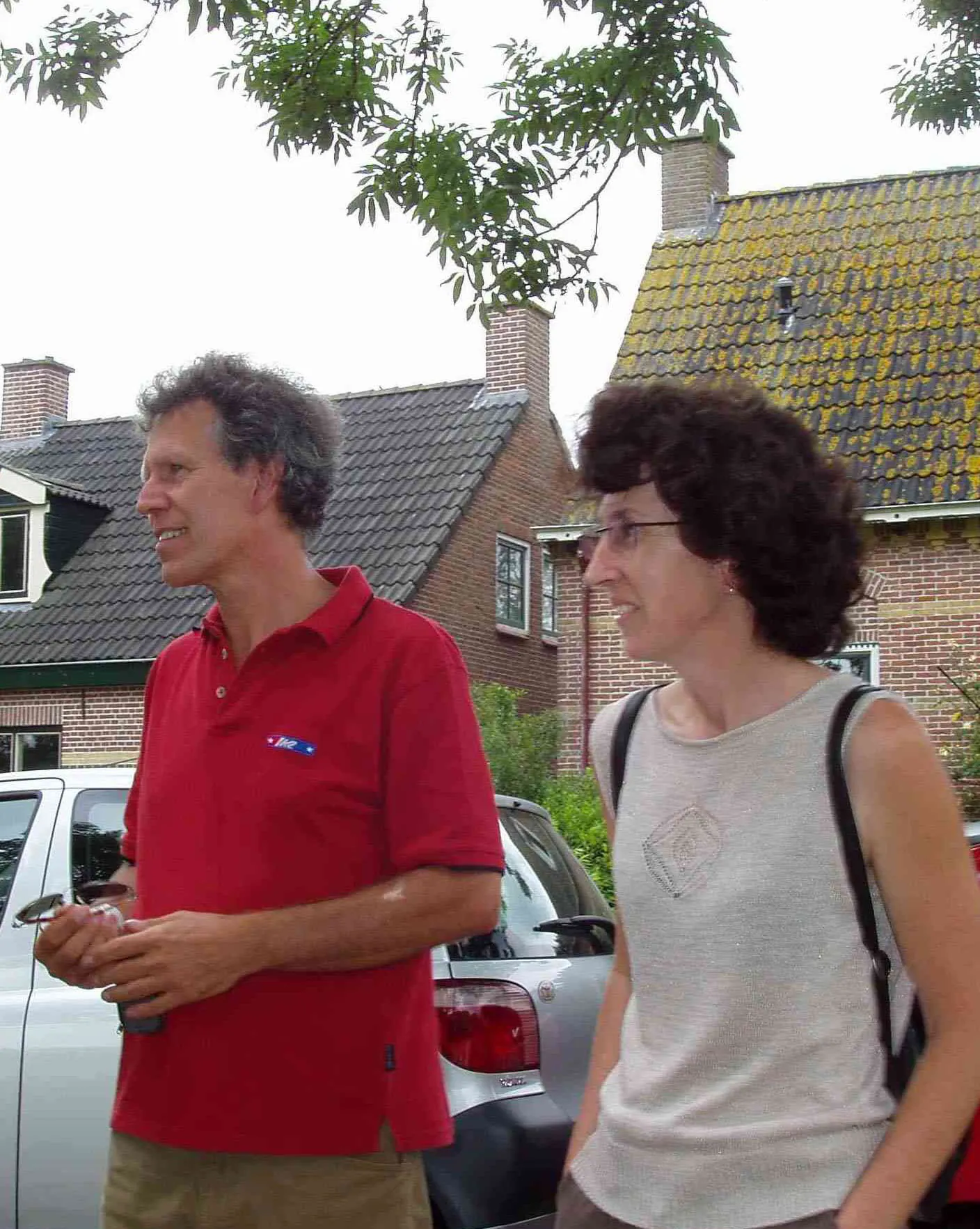
From many descriptions I knew that a small narrow street had to run from Franeker to Zweins. Since Franeker isn't too large, we found the little road fairly quickly. Slowly and attentively we drove the few kilometres to Zweins, and once there we first went to the Kingmatille with its little tea houses right on the Van Harinxmakanaal. The Van Harinxmakanaal runs from Leeuwarden via Zweins and Franeker to Harlingen, where it flows into the Wadden Sea. It must also be very beautiful to sail the canal by boat sometime. We took a break on the bank of the canal.
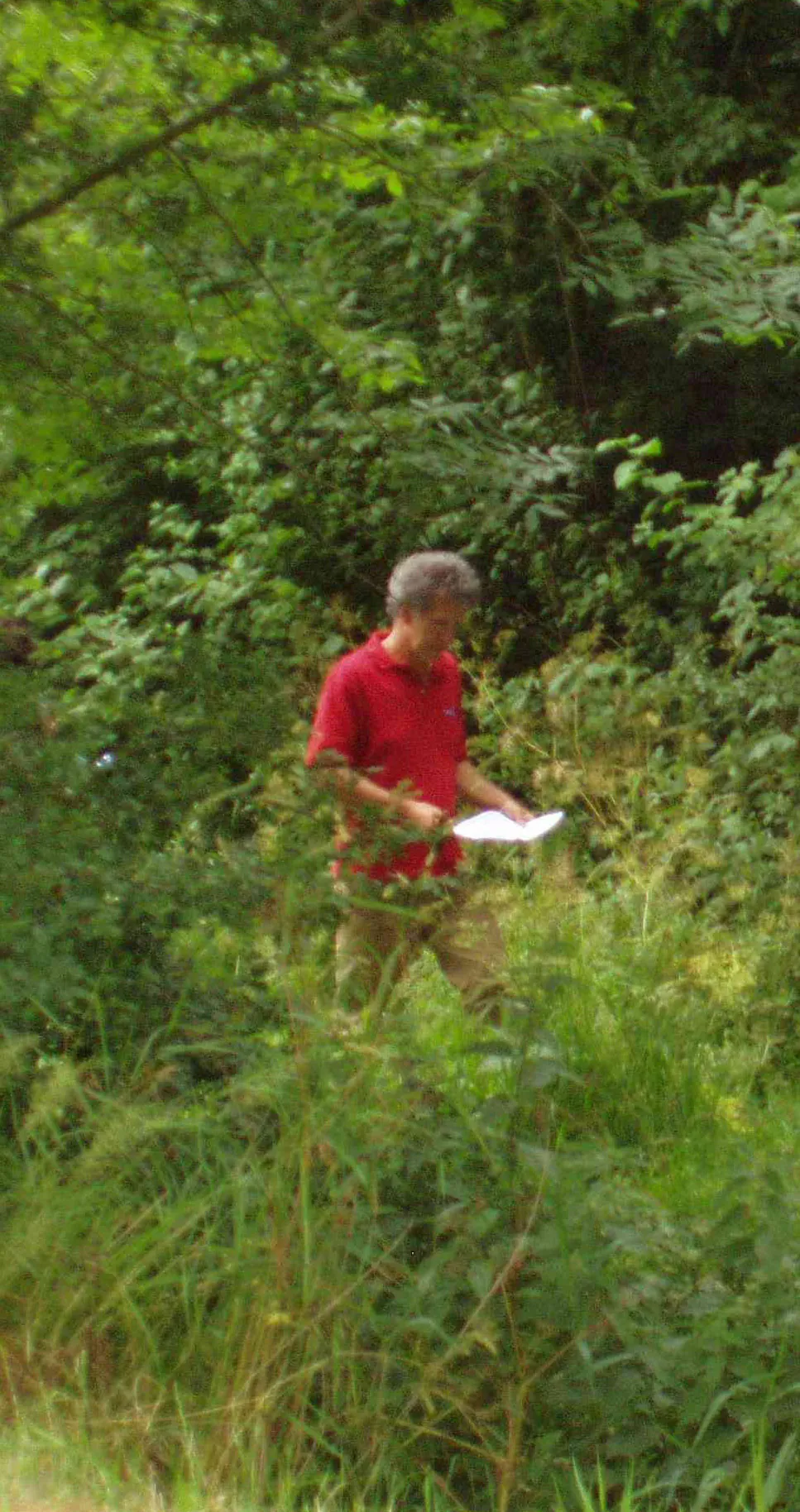
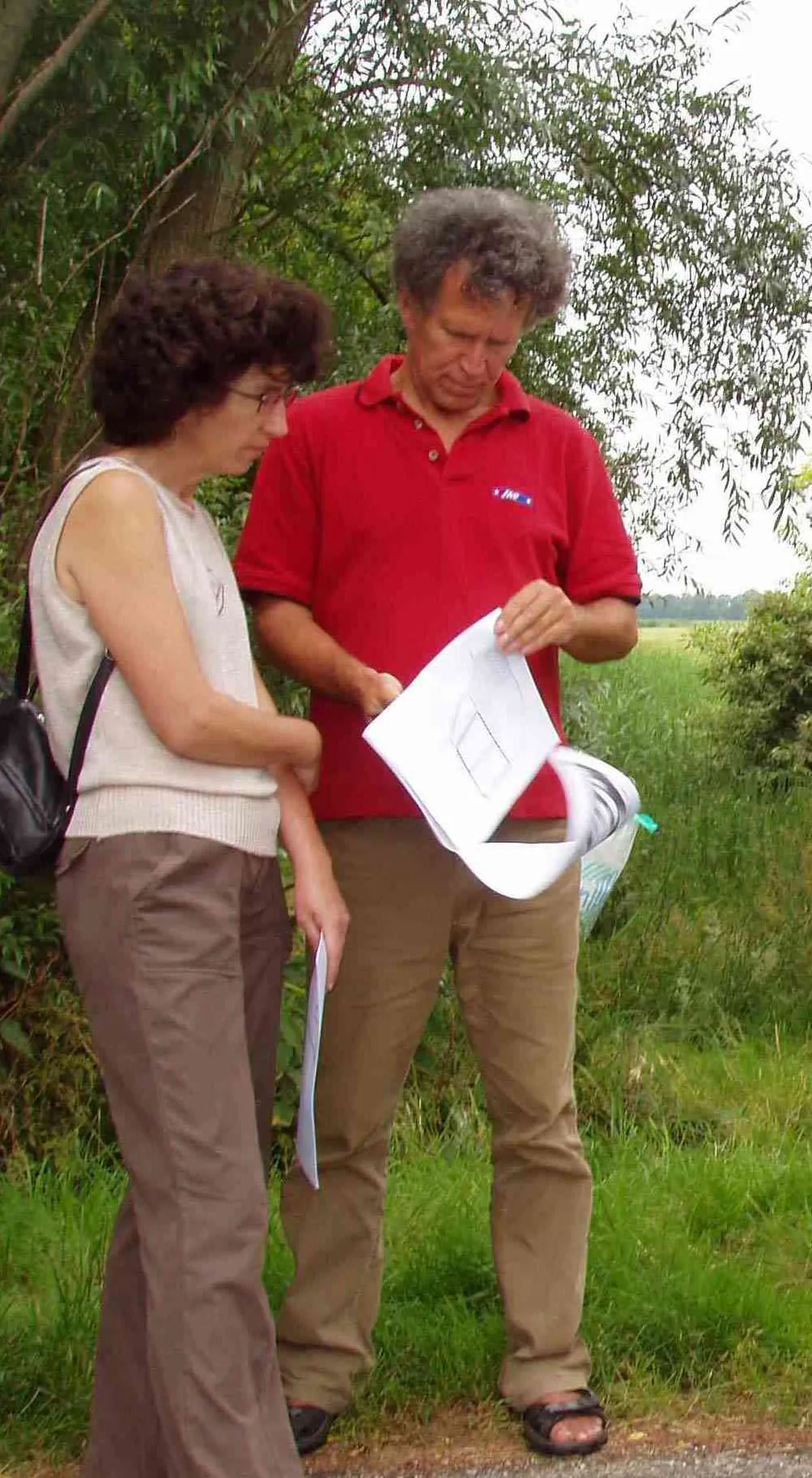
Satisfied and rested, we drove to the spot where Kingma State had stood until 1864. Nowadays sheep graze in the clearings in the woods. We were lucky that just at that moment an elderly man was leaving the sheep pasture. Politely and kindly I asked whether I might enter the current nature reserve. The elderly man was very friendly and said it was fine. Camera in hand, my son and I walked over the "sacred" ground of Kingma State. Unfortunately there isn't much left to see.
After this experience we drove to the Reginakerk, which stood just a few metres further on. The church was closed, and we had to fetch the key from the verger in the village, who came along with us. Feeling a little tense, we went into the church. The verger told us various things about the church and about the organ, which is to be restored in 2003. Our daughter, who plays the piano well, was even allowed to play the organ for a moment. The verger also told us that all Kingmas have access to the church, because the Kingmas were a blessing to the village in the 16th century. The church is well worth seeing, with the Kingma gravestones on the floor, the small solitary coat of arms, and the two lords' pews. Also very interesting is the gravestone on the north wall, made for the wife of Ignatius van Kingma. Finally we signed the guestbook and received an original stamp of the Reginakerk. Unfortunately we missed the morning service, held that very Sunday morning.
Via the Van Harinxmakanaal we drove to Dronrijp and discovered there a signpost that also pointed to the Kingmatille. Following it, we ended up, via a narrow street, in a dead-end alley directly opposite the Kingmatille. From here we had a beautiful view of the whole street layout of the Kingmatille, with the village of Zweins situated behind it.
On the way back to our holiday resort "It Wijd" we drove through many villages where my grandparents and their ancestors were born, lived and died. The places Huins, Lions, Baard, Jorwerd, Oosterwierum, as well as Oosterlittens and Winsum, all lie close together and all have the same village appearance with their houses and churches. In the villages the roads to the church were paved with shells, and by chance we also came across an intact whelk (kinkhoorn in Dutch). We found this discovery especially delightful, because the whelk appears in the Kingma coat of arms.
The holiday in Friesland suited us very well. The people there are very friendly, and fortunately the weather was also very nice. All in all, I can recommend a trip to Friesland to everyone, and I know for certain that I will personally go to Friesland again sometime.
Translation: Daniels
Kingma Kronkels: Stateless

Joost Kingma
We are still stateless.
And by that I don't mean the statelessness in which the displaced people who have to report to Rita Verdonk find themselves. No, I'm talking about the fact that we still have to do without a rebuilt Kingma State. Fortunately, for some weeks now it has looked as though our statelessness's days are numbered. The Stichting Herstel Kingma State has in fact purchased just under eight hectares of land situated around the home plot on which the state (a Frisian manor house with its land) stood until about a century and a half ago. Including that home plot of just over two hectares, which we will be able to obtain from Staatsbosbeheer (the Dutch state forestry service) on a leasehold, we will soon have around ten hectares available for the redevelopment of our ancestral seat.
Another positive development is that the municipality of Franekeradeel has invited us to present our vision for the rebuilding to the municipal council before long. An invitation we are of course eagerly seizing with both hands. Especially when you know that stateless people were not always equally welcome in that very same Franeker.
After all, impoverished travelers who came to the city gates seeking aid and shelter were once encouraged, with a sort of 'get-lost bonus', to leave again as quickly as possible. Among them, in 1646 — the first year for which records of this were kept — were, among others, 'een arme frou uyt Ierlant, 5 Polacken met een kint, een Hoogduytsche student en een Ongerse edelman'.
Despite our statelessness, we are nevertheless welcome in Franeker after all. That has put us in a cheerful state of mind. Should this news even put you 'in a state' and make you want to spend the night in a state right away, then I can recommend the fine brochure about all the states around Leeuwarden by the Stichting Staten en Stinzen.
Source: Fryslân, staat en macht (Hilversum, 1999), pp. 154–155. See the website www.statenstinzen.nl.
Colophon
'De Kinkhoorn' is a periodical publication of the Kingma State foundation.
The periodical is sent to donors of the foundation.
You can become a donor by transferring an amount of at least 12 Euros annually to account number 55.00.97.538 at ABN AMRO bank in Arnhem, in the name of the Treasurer of the Kingma State Foundation.
Circulation: 150 copies.
Published at least twice a year.
Kingma State Foundation
Secretariat:
Sterrenboslaan 20, 3972 GD Driebergen
phone: 0343 521212
fax: 0343 517689
e-mail: info@joostkingma.nl
website: www.kingmastate.nl
Board
Chairman: C.S.J. Kingma, Emmen
Secretary: J.H. Kingma, Driebergen
Treasurer: J.M. Kingma, Arnhem
Board member: Tj. Kingma, Zwolle
Design and production
Drukkerij Bakker Baarn
This publication is registered with the Koninklijke Bibliotheek under ISSN: 1569-8645
For full or partial reproduction of the content of articles from De Kinkhoorn, please credit the source.