
IV De Kinkhoorn
De Kinkhoorn 9 — April 2004
Volume 5, number 1
This issue as pdf (Dutch) · Read the Dutch original · the printed original · the German translation by Ralf J. Kingma
Foreword
Once again we can look back on a successful and well-attended donors' gathering in Zweins. After the welcome and the customary slides recapping the past year's events, the report on the archaeological research carried out on the grounds of the *state* (the Frisian manor house and its estate) was given not by the archaeologist, who was unexpectedly unable to attend due to family circumstances, but by our secretary. Afterwards we left the village hall to be given a fascinating account of the church building and the items it contains by Sytse ten Hoeve, in the church of Zweins itself. The fact that this took place in the church gave the talk a special cachet. Afterwards we returned to the village hall for a convivial chat.
This issue of De Kinkhoorn also contains a report on the archaeological research, and this time we turn our attention to Ignatius's uncle, Saeckle's brother, Jan, whose gravestone lies in the church of Tytsjerk. Furthermore, among others, we also feature Kingmas whose descendants live very far away indeed.
In Kinkhoorn 7 I wrote an article about the little church of Boer and the pulpit donated by Ignatius. The content of that article was largely based on information I had received from the Stichting Alde Fryske Tsjerken, which in turn was partly drawn from an article published in a newspaper. This suggested that the artist Cees Launspach, who uses the little church as his studio, would no longer want to do so after a restoration, because of the "cleane" atmosphere that would then result. After the Stichting Alde Fryske Tsjerken had also reprinted my article in their own periodical "Keppelstok", I was surprised to receive a phone call from Cees Launspach, who told me that this was not what he had meant. After a restoration he would no longer be able to carry out some of his work, which produces a lot of dust, and he would have to take visitors into account. But, he said, that did not mean he no longer wanted to work there. I then promised him, to his satisfaction, that I would correct this in a future issue of Kinkhoorn. Consider it done.
Kees Kingma
Results of the archaeological survey
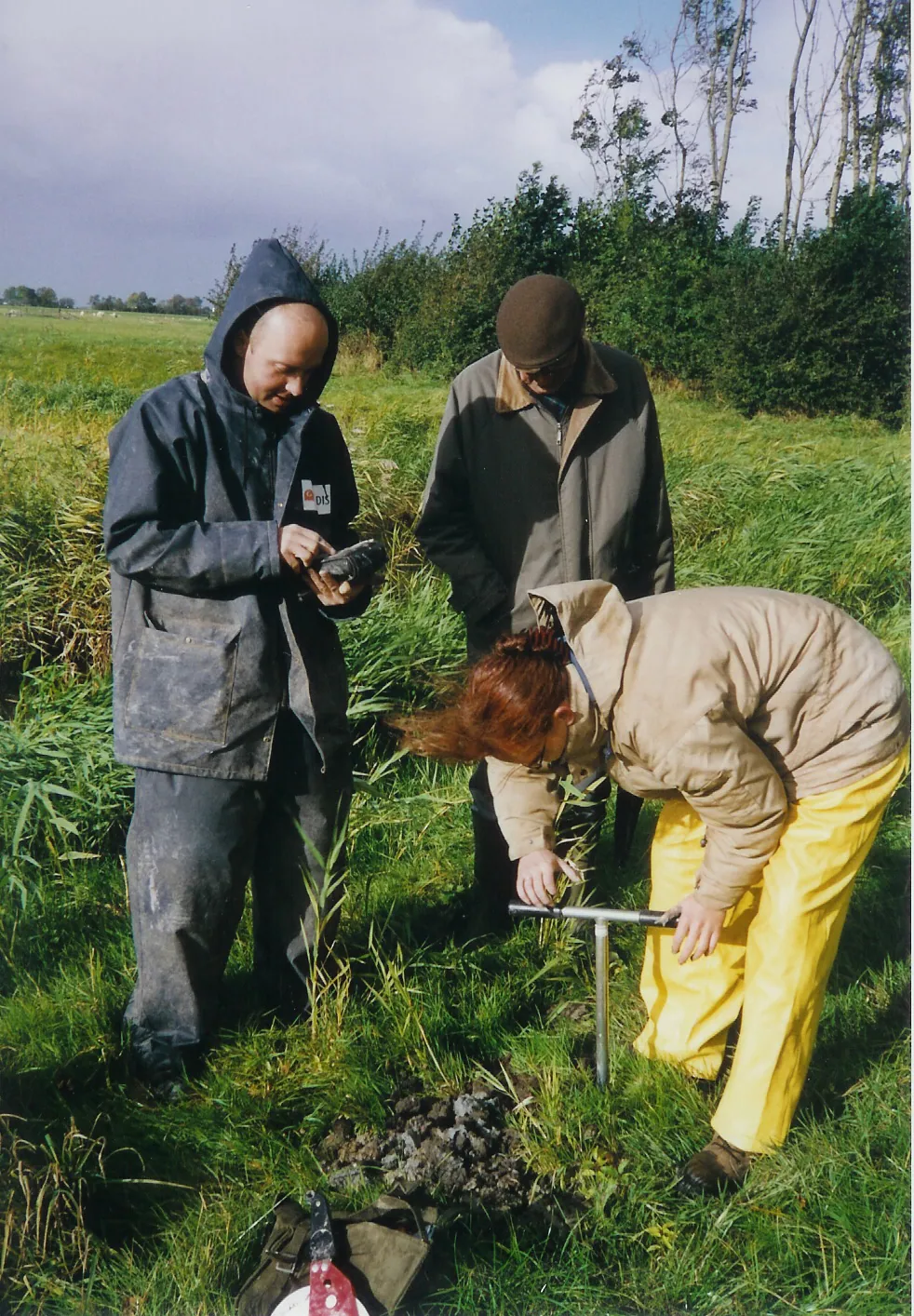
Contours of the state and moat are visible, but no clear foundations
Summary
In October 2003, Arcadis, commissioned by Stichting Kingma State, carried out an exploratory archaeological survey on the grounds of the former Kingma State.
It is known that the State was sold for demolition in 1864 and that the underlying *terp* was subsequently excavated to extract the fertile *terp* soil.
The aim of this survey was to gain a picture of any remaining traces of habitation in the soil. This was done both out of strictly historical interest and with a view to a possible restoration of the State.
A borehole survey was chosen, as this method allows a relatively quick and cost-efficient exploration that gives a sufficiently reliable answer to the research questions.
It can be concluded that the contours of the buildings and moats, as known from old drawings and maps of the State, can be traced in the terrain, but that no clear foundations were found. The boreholes did, however, reveal rubble remains at spots where buildings once stood, and phosphate residues indicating the presence of a *terpmantel* (the surviving outer soil layer of a terp).
Below is a summary of the survey results, based on the report by Arcadis 1.
Historical situation
The survey area lies within the area of Westergo, which was diked in during the 11th century.
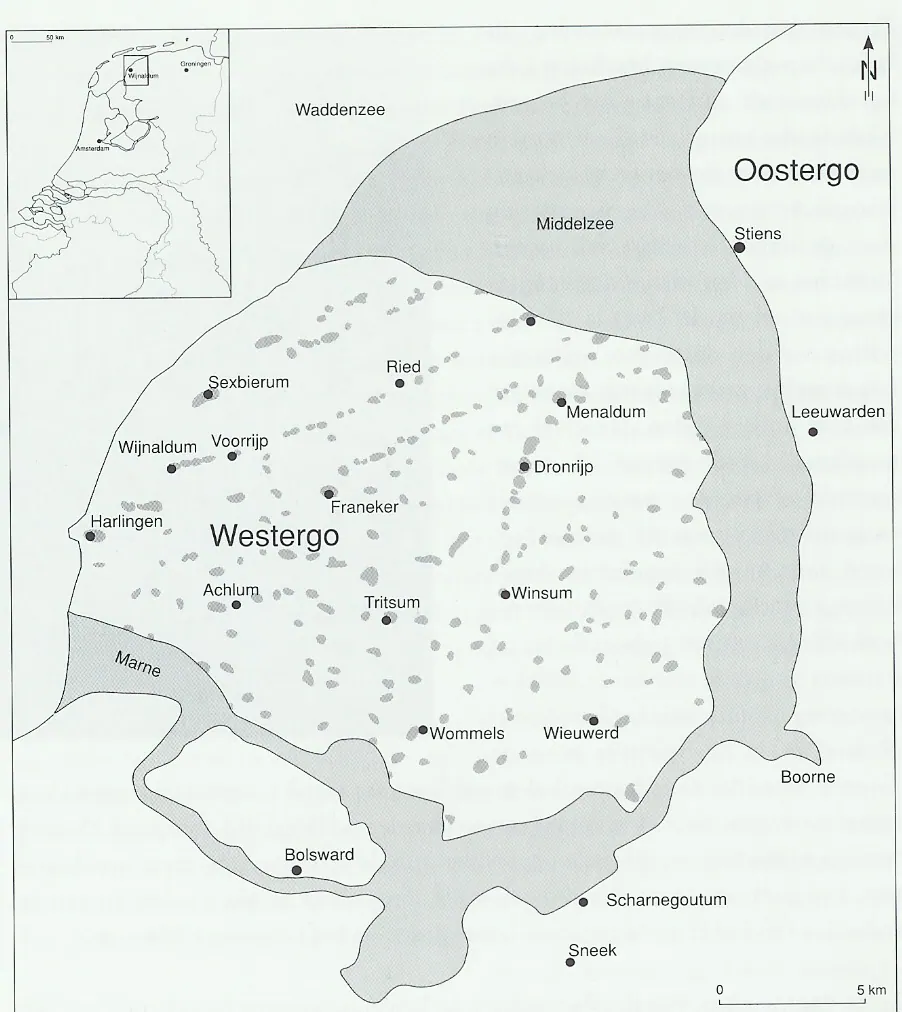
Kingma State lies about 4 km east of Franeker, on a *terp* dating from before this diking. The moated State itself is of a later date. The origin of the State goes back to the early 16th century, but it can only be called a *state* (a Frisian manor house with land) after a renovation around 1600.
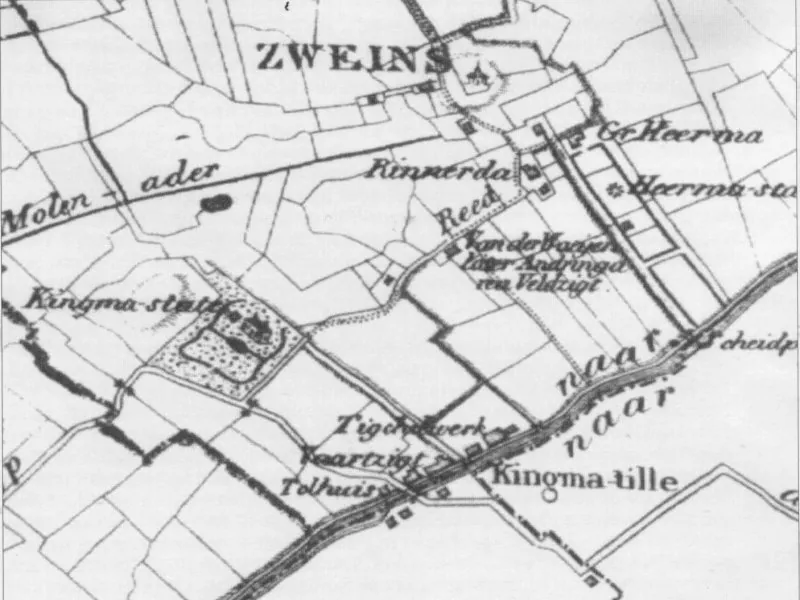
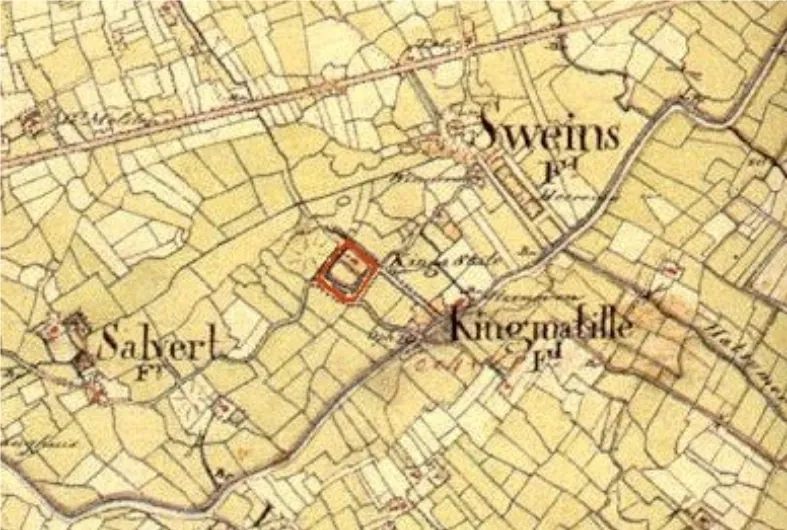
In the historical atlas from the mid-19th century 3 shown above, the State can be seen with its moats and buildings. The surrounding land is in use as farmland.
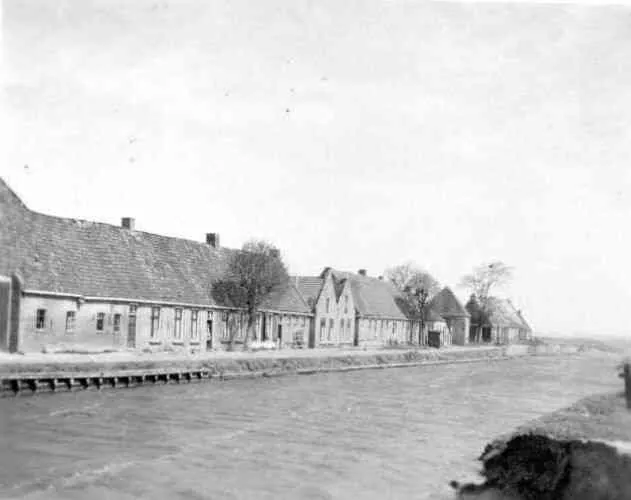
Kingma State lies in an open pastureland landscape that was dominated by the old *trekvaart* (tow-barge canal) to Leeuwarden, or by the Harlingervaart. This also served as the access route to the State. The avenue with its *opvaart* (approach waterway) ran in a straight line north-westward from the *trekvaart* to the State.
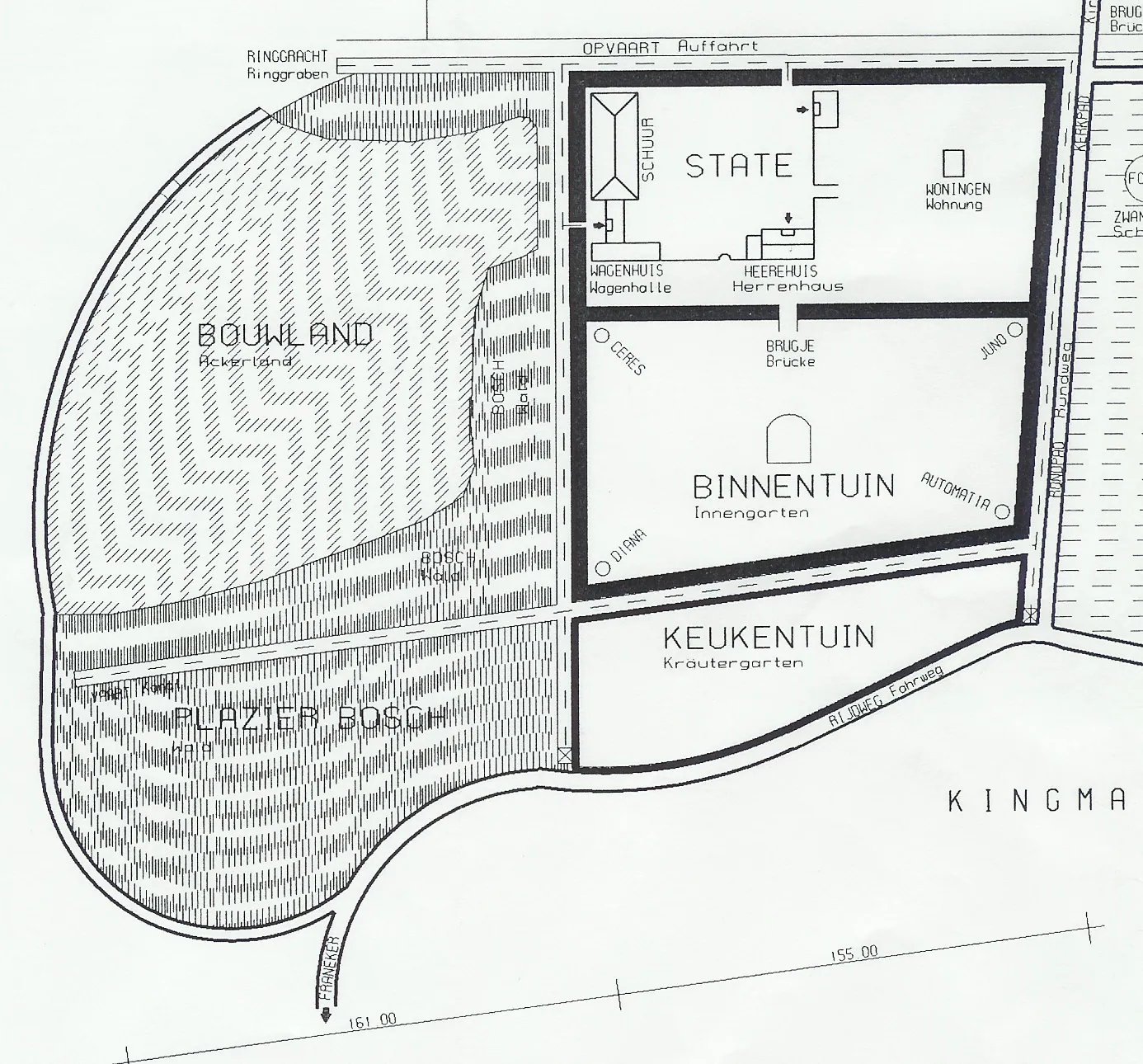
In a recently made drawing, the layout of the State's grounds — with the position of buildings, moats, and garden and landscape design — has been reconstructed as accurately as possible, using historical maps and material from the State's archive.
This reconstruction is partly based on a schematic drawing of the estate, for which it is not clear whether it is a design or a description of a situation that was actually carried out.
Field survey
After the demolition of the State (after 1864), the site was excavated as part of the extraction of *terp* soil, common practice in the 19th century, used to fertilize poor soils elsewhere in the country.
About 25 years ago, the central part of the site, namely the area within the former moat, was allocated to Staatsbosbeheer, which planted it with woodland.
Because of this now-mature planting, and the low-lying position resulting from the excavation, the site is not easily accessible.
This was also a determining factor in the choice of boreholes as an exploratory technique.
The research questions were:
- Are there still (remains of) traceable foundations of the old State?
- Can the contours of the moat still be determined?
- Are there still remains of the *terpmantel* present?
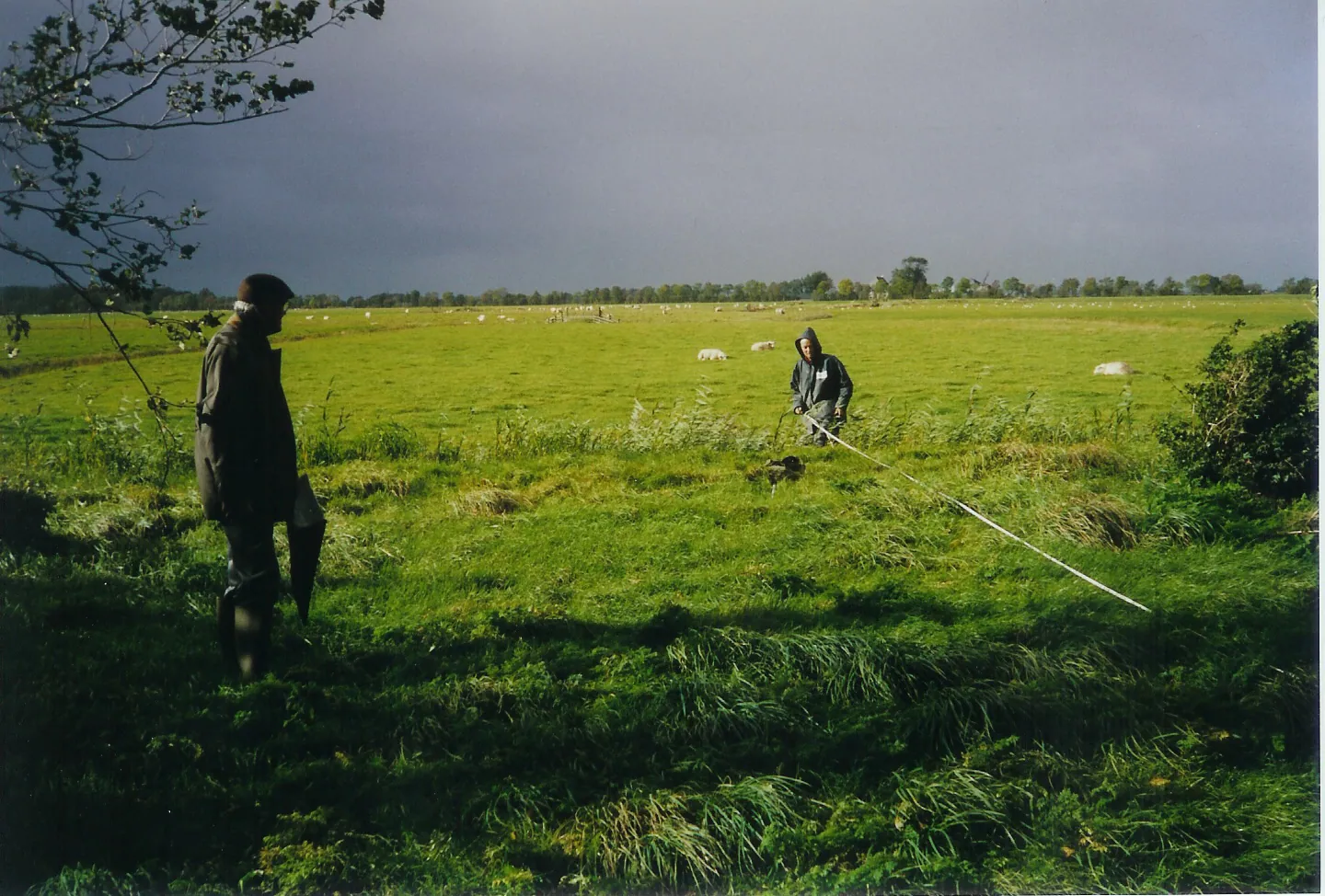
The survey was carried out on 7 and 8 October 2003 by means of soil borings, ranging in depth from 125 to 225 cm, using a so-called Edelman auger.
Because this was an evaluative survey, the search was carried out in a targeted way based on indications from the available map material. A total of 42 boreholes were made in 6 clusters:
- Barn and coach house
- Swan Island
- Moat and house
- Elevation
- Bridge (?)
- Dwelling
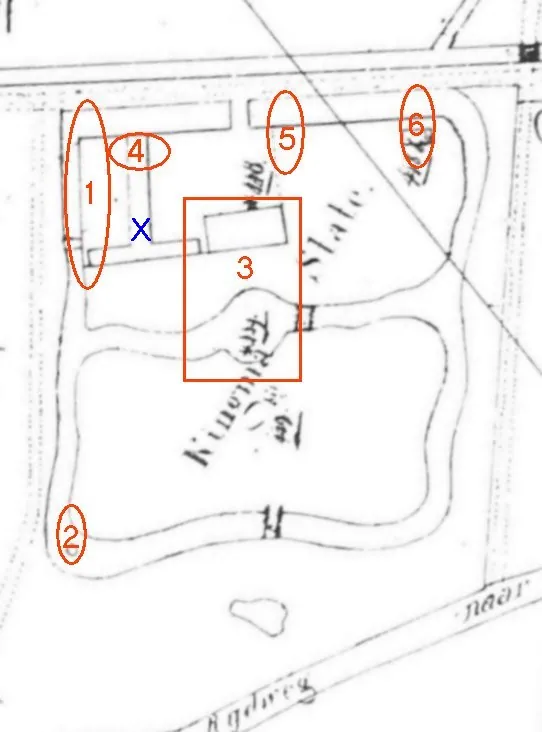
In summary, it can be said that the contours of the old Kingma State have been traced. The boreholes in the various clusters confirm the position of the buildings and moats shown on the map at that location.
'Datable' archaeological indicators were found in the borehole cores. These consist of rubble — mainly red, but also some orange and yellow brick fragments, as well as cement — and in addition some pottery fragments were found. The material dates from the Early Modern period. The brick fragments cannot be dated more precisely. The glazed sherd from cluster 1 can be dated to the period from the 17th to the 18th century. The stoneware sherd from the same cluster cannot be dated more precisely than the period 1500 to the early 20th century. The remaining archaeological indicators (phosphate residues, charcoal) cannot be dated.
Given the phosphate residues found in almost all the boreholes, and the weakly humic layers lying above the parent material on which the *terp* was built, part of the *terpmantel* is still present. This layer is on average 50 cm thick, at most 100 cm, and forms the base of the *terp*.
Joost Kingma
Note: The archaeological survey could be carried out thanks to the generous financial support of a large number of donors and a financial donation from the Kingma Stichting.
1 Aanvullende archeologische inventarisatie Kingma State. Arcadis, januari 2004
2 Van Middelzee tot Bildt; Landaanwinning in Fryslân in de Middeleeuwen en de
vroegmoderne tijd. Mijndert Schroor, ROB, 2000
3 grote Historische Atlas van Nederland, 1:50:000, deel 2, Noord-Nederland,
1851-1855
Extremes (2)
Following an article in De Kinkhoorn no. 2 by Joost Kingma about the Kingmas in Australia, and a conversation with Carlos Kingma Gervola from Punta Arenas in Chile, my curiosity was piqued about the origins of this Kingma family and how these Kingmas had ever ended up in the southernmost part of South America, the Chilean part of Patagonia.
Punta Arenas is located on the Strait of Magellan, which, until the Panama Canal opened in 1914, formed the main shipping route from Europe to the west coast of South America and the United States.
The Chilean government colonized the area in 1843 and developed a penal colony there. In 1852 the governor of the time imported 300 sheep from the Falkland Islands. Sheep farming later became one of the area's main sources of wealth, and the wool was sometimes called white gold. In 1867 the then president of Chile declared Punta Arenas a free port, a status the city still holds today. Immigration was also promoted, and with the rise of steam shipping Punta Arenas became an important strategic port town. Until the Panama Canal opened in 1914, Punta Arenas experienced strong economic growth, partly as a result of the 1885 discovery of gold in Tierra del Fuego (the Land of Fire) and the wave of emigration this set in motion. By then a number of large enterprises had developed in sheep farming, wool, and slaughterhouses.
Punta Arenas is now a city of some 110,000 inhabitants, where tourism, livestock farming, timber, and oil and gas extraction form important sources of income. Punta Arenas is also the main supply port for the Antarctic region. In winter, in July, the average temperature in Punta Arenas is 2.1º Celsius; in summer, in January (southern hemisphere), the average temperature is 11.4º Celsius. The Punta Arenas region is also known as ¨La tierra más austral del mundo¨, or in other words, ¨the most southerly region in the world¨.
The foregoing gives a picture of the area where the Kingmas had settled.
Back to Carlos Kingma Gervola.
The use of a double surname is customary in Spain and much of South America. The addition of Gervola to the name Kingma means that the first surname of Carlos's mother was Gervola.
Through Joost Kingma I obtained an email address in Punta Arenas so I could contact Carlos in Spanish. He responded enthusiastically and, together with his sister, wanted to become a donor to the Stichting Kingma State. Naturally he was very interested in his roots in Friesland. From Carlos I received information from the population register of Punta Arenas with details of his grandparents. In the handwritten documents the names had been somewhat garbled: Bauke had become Bonke, and Antje Lodewegen had become Anne Loodenegen. According to Carlos, Antje Lodewegen was said to have been born in Buitenpost and to have emigrated around 1900. A son of Bauke and Antje, Cornelis, who drowned in 1916, was said according to the records to have been born in Groningen.
With this information I started searching online in the records of the Rijksarchief in Friesland. Fortunately the name Bauke Kingma occurred only once, in Anjum, born in 1866. Antje Lodewegen too was quickly found, born in 1865 in Buitenpost. Given their ages, these had to be the Bauke and Antje I was looking for. With the name Cornelis (son of Bauke and Antje) the link was made to Kornelis Minnes Kingma, born in 1833 in Anjum, father of Bauke Kingma. Next I searched the peerless genealogy of the Kingmas on Ruurd de Bruijn's website, where Bauke came into view again via the descendants of Gerrit Arjens, born around 1700 in Anjum. The problem was that no record of the marriage of Bauke Kingma and Antje could be found in the records of the Rijksarchief in Friesland — the conclusion being that the family had possibly left Friesland. According to the information from Chile, a son of Bauke and Antje had been born in Groningen. I then sought access online to the Rijksarchief in Groningen, where the marriages for most municipalities have been processed. Here it turned out that Bauke and Antje had married in Grijpskerk in 1888. Bauke's father, too, had remarried there; the family had evidently moved from Anjum to Grijpskerk. For further information there was no option but to search in person at the Rijksarchief in Groningen. Here it indeed turned out that the family had moved from Anjum to Grijpskerk in 1881. Bauke and Antje were then lost from the population register again, but resurfaced in the separate register of farm laborers and maidservants. Both worked on farms in Oldehove in 1884 and 1885. Bauke and Antje probably met each other there and subsequently married in Grijpskerk in 1888. From Oldehove they then moved to the municipality of Ulrum. Since the population register of Ulrum was not arranged in alphabetical order, searching was difficult. Through an official of the municipal archive of the municipality of De Marne in Groningen, I obtained a copy from the population register of the municipality of Ulrum with the details of Bauke Kingma's family.
This showed that Bauke and Antje had left for Chile in March 1896 with four young children. The question, of course, is how a day laborer's family from Ulrum comes to emigrate to Chile, and who paid for that journey? Conditions in the countryside were very poor at the end of the 19th century because of the notorious agricultural crisis. For a day laborer it meant poverty. Among the archival records of Bauke and Antje was a certificate of indigence for paying the registration of their marriage at the registrar's office. While going through the population register of the municipality of Ulrum for the period Bauke and Antje lived there, I came across the name of a certain Brandt, captain of a steamboat. The curious thing is that in the records of the population register of Punta Arenas in Chile, at the registration of the birth of Carlos Kingma's father in 1901, a J. G. Brandt signs as the civil registrar and states that he is an acquaintance of Bauke Kingma. There may be a link here, and it's possible that people in Ulrum were aware of the discovery of gold in Tierra del Fuego and the Chilean government's promotion of emigration to Patagonia (see the earlier information about Punta Arenas).
With the information supplied by Carlos Kingma Gervola, supplemented with data from the Mormon archives, the picture of the Kingmas in Chile is fairly complete.
Antje Lodewegen died in Santiago de Chile in 1946. It is not clear what became of Bauke and two of his sons. Carlos may still be able to shed light on that. It cannot be ruled out that Bauke and two of his sons returned to the Netherlands.
This shows that one of Bauke's sons, named Bouke, has descendants in the province of Santa Cruz in Argentina. The name Kingma still occurs there today.
Research into the Kingmas takes you to remote corners of the world, each with its own history. These investigations also raise new questions and challenges.
It would be a good thing if more stories like this became known and could be added to the history of the Kingmas.
Tjeerd Kingma
tjeerd.kingma@planet.nl
A Kingma mill and Kingma schools
I regularly receive misdirected email that, judging by its content, is meant for a Kingmaschool. That mail of course always goes properly back to the sender, but after a while you do become curious about that school.
It turns out there are two schools of that name on the internet, one in Amersfoort and one in Amsterdam. What they have in common is that both schools offer special-needs education. The school in Amersfoort offers primary education for children with learning and developmental difficulties. The Kingmaschool in Amsterdam focuses on secondary special education for the same group of children.
Searching further, I found an article in my (little) archive about a certain Fokke Yntes Kingma (1813-1883), educationalist. My brother Paul was thoughtful enough to send it to me.
This Fokke, the article reveals, was a highly progressive and innovative teacher for his time. Among other things, he was the inventor of the 'Kingma-molen' (see photo), a kind of letter wheel used in a reading method he developed, which can be regarded as a forerunner of the *leesplankje* (a well-known Dutch reading-primer board) devised by Hoogeveen. Kingma's letter wheel consisted of three different discs with which all sorts of word combinations could be made. He also introduced a new form of singing instruction for primary school, the *cijfer-notenschrift* (a numeral-based system of musical notation), and developed new ideas for teaching children with learning disabilities. It is probably to the latter that he owes the fact that the schools were named after him. The schools' websites say nothing about the origin of their name. But Fokke Yntes Kingma's life story shows that he founded schools in both Amersfoort and Amsterdam. Born on 2 November 1813 in the Frisian village of Wolvega, he developed into a nationally known educationalist, versatile and driven. However, he also regularly clashed with the authorities. Not least when once again he wanted to boost his meagre teacher's income for his large family of nine children.
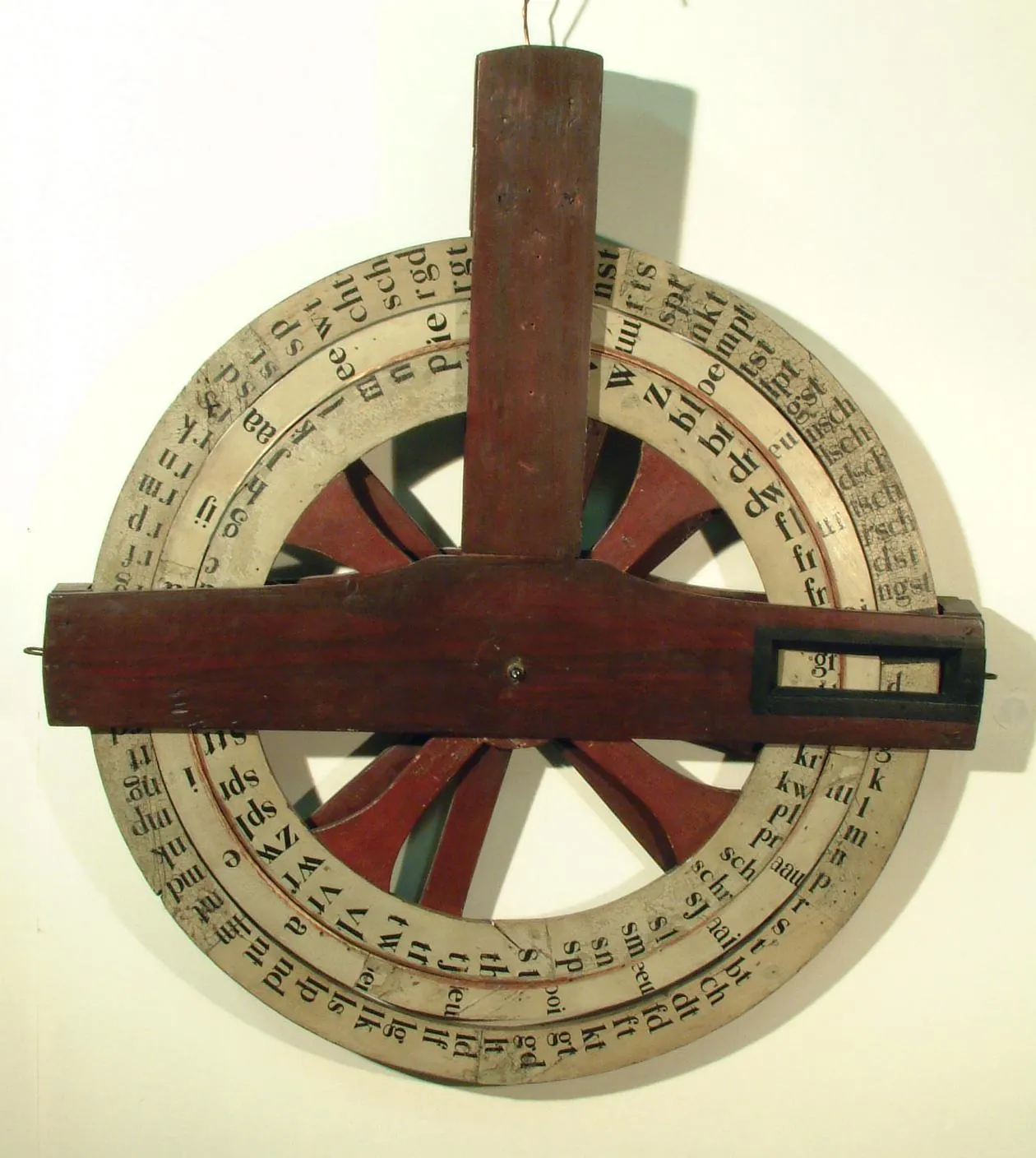
As a result, his wanderings took him successively to Elburg, Amersfoort, Oudega, Leeuwarden, Amersfoort again, Amsterdam, The Hague, Utrecht and finally Amsterdam again, where he died on 18 April 1883. A large number of innovative publications on teaching methods appeared under his name.
Joost Kingma
Source: 'Fokke Yntes Kingma (1813-1883). Pedagoog', from the series Utrechtse biografieën, Het Eemland (2). Publisher: SPOU (Stichting Publicaties Oud Utrecht).
Jan (van) Kingma, deputy of the States of Friesland
Years ago (I believe in 1958), work being carried out in the Reformed church of Tietjerk (now Tytsjerk) brought several old gravestones to light. According to newspaper reports at the time, one of them, which had unfortunately been broken crosswise, dated from 1645. It must already have been lying there when the old church was demolished in 1721 and replaced by a new one. The inscription read: “Ao 1645 de 21 Ianneur. sterf Ian va Kingma gewese Gedepeterd. Staet va Frislandt ovt 59 Iaer.” In the middle there must have been an indistinct coat of arms of the Kingmas.
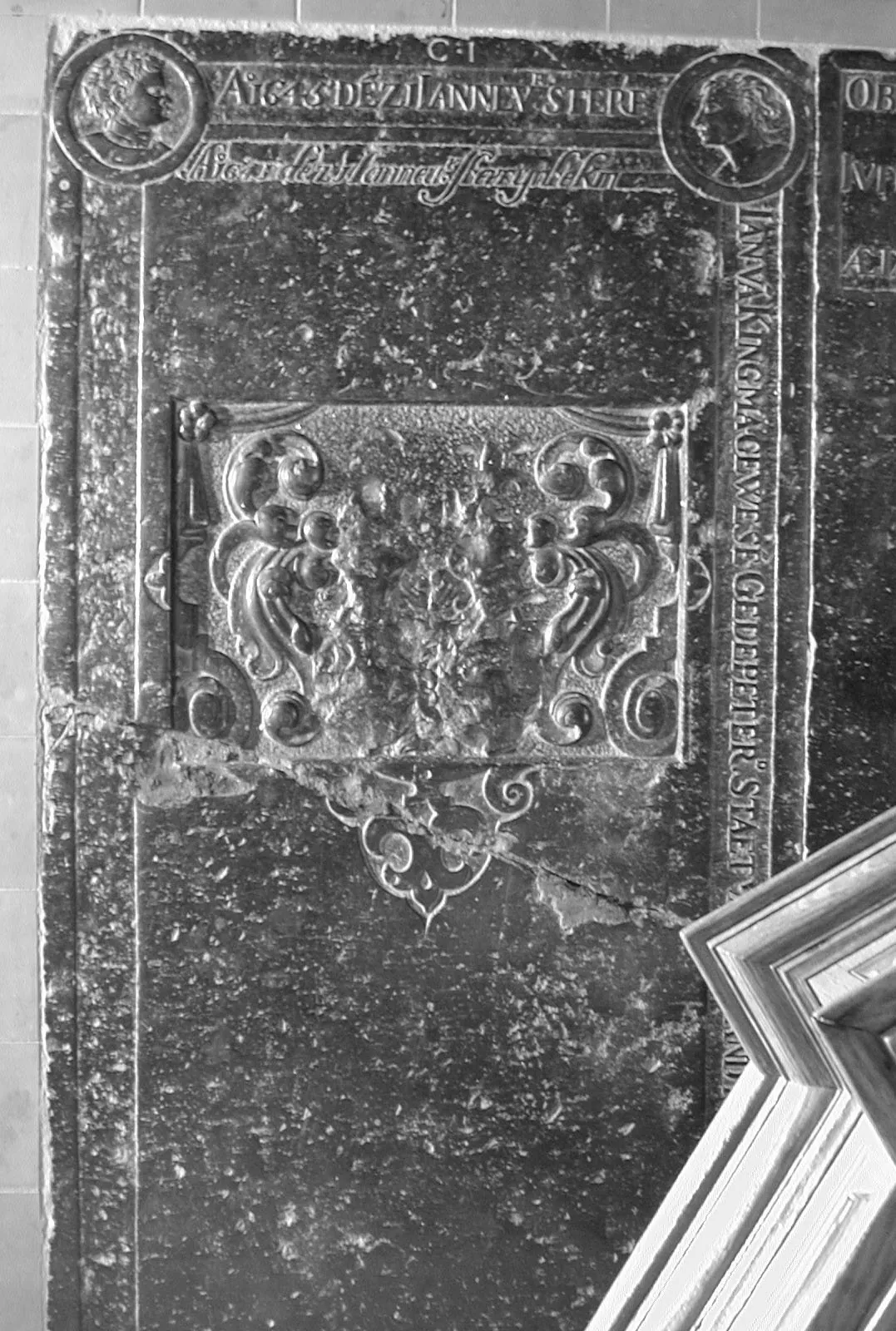
Who was this Jan van Kingma? He was Jan Intes Kingma, also called Joannes, Johannes or Johan van Kingma. He was born ±1585 in Schalsum and therefore — as shown above — died on 21 January 1645. Around 1640 he married Bauck Pieters Beyma (also mentioned once as Meyma), who must have died in Minnertsga between 1674 and 1677.
Their daughter Trijntje Jans (van) Kingma is the ancestress of the Kingmas of Makkum. One of her grandsons, Hylke Jans, took over the family name Kingma from her, more or less against his will. A bijzitter (alderman) had to have a surname according to the grietman (see pages 45 and 46 of "De Kingma-Kroniek," the history of the Kingmas of Makkum, the doctoral dissertation of Henk Nicolai).
Jan (van) Kingma was the son of Ynte Jelles Kingma. He in turn was a son of Jelle Pieterzn. Kingma, whose father Pieter Jellezn. Kingma was a son of the oldest known ancestor, Jelle Kingum (born ±1450 and died at Kingmasate in Zweins in 1538).
In 1615 Jan lived in Weidum. According to page 42 of "Weidum, dorp van staten" (drs. R. Mulder-Radetzky and B. de Vries — 1994), Jan Intes Kingma was in 1618 the first known owner of the grounds of the state Oud-Bornia. The authors do not know whether a building already stood on it at that time.
From 1 June 1627 to 20 February 1630, Jan Kingma was a deputy of the States of Friesland.
Jan Kingrna later (1633) lived in Huizum at Abbingastate; in 1638 he still lived there. In 1640 this state was still his property. At that time, however, he lived at Farnia- (or Fernia-) state in Minnertsga, which he also owned. The Prekadastrale atlas Barradeel states: 1640 - 16: Fernia - owner: Mr. Johan Kingma; occupant: Mr. Johan Kingma.
In 1645 he lived with his family in Tietjerk. The baptismal register of that parish shows that Hubrecht, daughter of Jan Kingma and Bauck Beyma, was baptized there on 6 April 1645. He must therefore have died shortly before. His widow must later have returned to Minnertsga; the membership register of that parish for 1665 records under 25 January: "Juffr. Bauckien Kinghma, wed. wln. Jan van Kingma, van nieuw tot lidmaat aangenomen."
From a publication in the Genealogysk Jierboek 2001 of the Fryske Akademy about "It Capellelien fan Minnertsgea" we learn a little more about the fortunes of this Jan/Johan Kingma. In 1637 Jan Kingma, former deputy of Friesland and resident of Huizum, bought 21 gg. of free perpetual annual rent from the sate "Fernia" in Minnertsga, inhabited by Miss Nitzen, for 546 gg. from the jonkers (a title of lesser nobility) Homme van Bootsma and Hessel van Popma.
In 1643 Reyn Haytsma and Jan Gerryts, both of Minnertsga, bought 6 pondemaat (an old Frisian unit of land area) of grassland there from Johan Kingma for 140 gg. per pondemaat. From the same Kingma, former deputy of Friesland, Reyn and Rintske bought in 1643 5 pondemaat of arable land in Minnertsga for 160 gg. 15 st. per pondemaat.
In 1678 Dirck Claessen of Ferwerd, as father of Reyn Dircks by the late Saeske Reyns Haeytsma, brought proceedings against the heirs of Johan van Kingma and those of his deceased daughter (this must of course mean: wife) Bauck van Beyma, over unpaid perpetual rents or a ground lease "uyt de plaetse Fernia comende".
It would be interesting to learn more about the life of such a 17th-century Kingma, but I am happy to leave that research to a historian.
T.J. Kingma, Burgum
About the gravestone of Jan Kingma
When I received the above text for publication in De Kinkhoorn, I promised the author of this piece that I would try to take photographs of the gravestone. Thanks to the kind cooperation of the church's keyholder, this was successful.
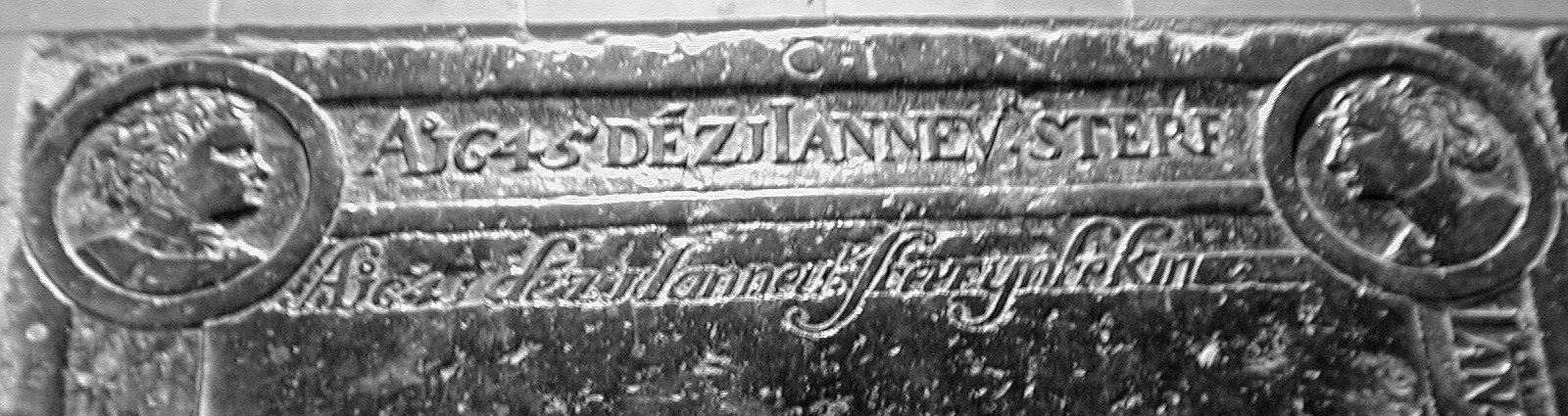
The text on the gravestone, mostly in Roman capitals, requires some explanation.1
At the top is the date of death: "A o 1645 de zj" means: Anno 1645 den 21ste. The small stroke above the E indicates that the word has been abbreviated, in this case by omitting the n.
In "Iannev R ." the I must be read as a J and the v as a u; this was very common at the time. The dot after the v indicates that the word has been abbreviated, and the small r above it must then be the last letter of the word. This results in "Janneuar," in other words January. Altogether, then, it reads here: "A nn o 1645 de n 21 ste Janneuar sterf".
Above this text, on the edge of the stone, are the initials "CI". These stand for Claes Jellesz., the master gravestone carver.
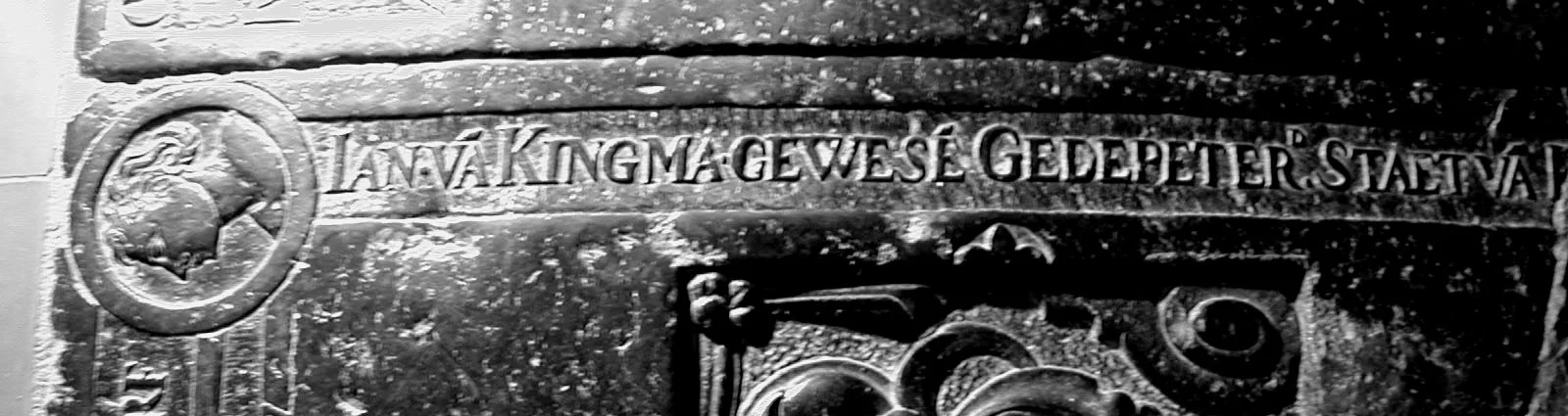
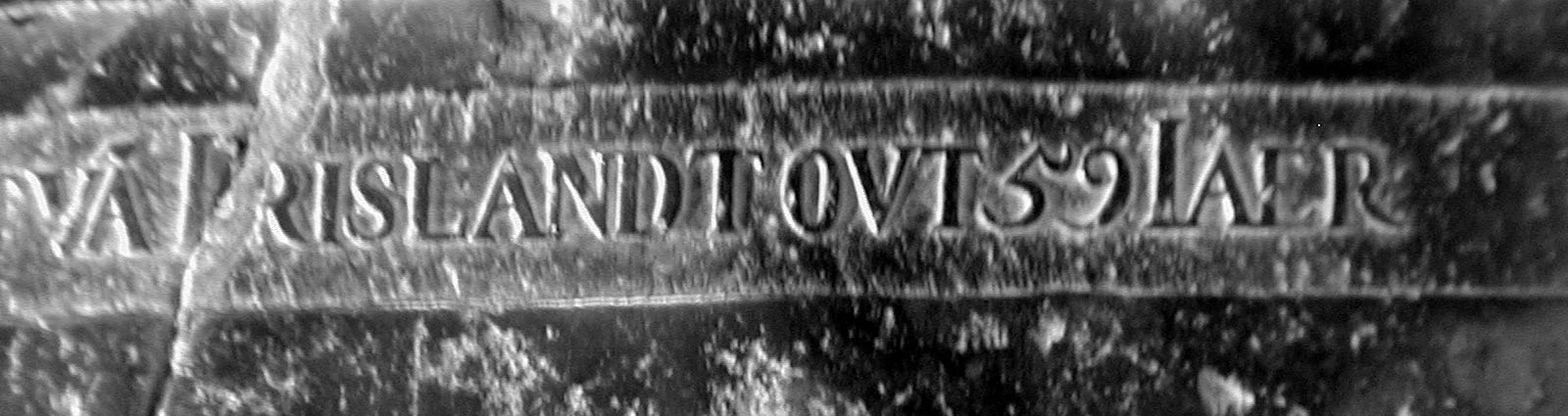
Along the right side, the text continues with "Ian va Kingma gewese Gedepeter d . Staet va Frislandt ovt 59 Iaer".
Here too, the I of Ian must be read as a J. "Van" is abbreviated twice by omitting the n, indicated by a small stroke above the a. The same applies to gewese(n), with a stroke above the e.
With "Gedepeter d ." it is somewhat curious. The dot indicates that the word has been abbreviated, and the small d above it that it must end in a d. It is not clear to me what should have stood here in full. What is certain is that "Gedeputeerde" is meant. It could also be that the d is meant as an abbreviation of der.
Also in "ovd" the v is used instead of the u.
On the corners of the gravestone are the so-called 'age heads' (leeftijdskoppen). These are usually of a man, as a child, youth, adult, and as an elderly person or skull. They depict the rise and decline of human life.
In the central field, names and dates of death are often recorded, not in Roman capitals, relating to children who died young.2 Here too there is such a record, which reads: "A o 1641 de zi Ianneu r . sterf ynte kin", in other words "A nn o 1641 de n 21 Janneu ar sterf Ynte Kin gma". This cannot be the son who was an ensign. So a later son must have been born who was given the same name. This is also recorded in the genealogy of the Kingmas that Mr. H.G. van Slooten of Leeuwarden drew up in 1952. He names four children of Jan. The first Ynte, who is buried in the same grave as his father. The second Ynte, who is recorded in a mortgage deed from 1679 as an ensign. Daughter Hybrech(je) or Sybrech(je). The latter is more likely, and she is also more often called that. And finally Trijntie, the ancestress of the Kingmas of Makkum.
Along the left side of the gravestone there is no text. This place is normally reserved for the wife. She, however, is buried elsewhere.
Of the Kingma coat of arms that is said to have been on the gravestone, unfortunately nothing remains but the decoration around it.
Kees Kingma
Literature: Zerken in Friesland 1535–1680, by Rik Vos et al. From the series “Monument van de Maand”, vol. 9, part 3a. ISBN 90 73845 27 0.
1 Before ca. 1550, Gothic minuscules were generally used.
2 See, for example, the gravestone of Saeckle Yntes Kingma in the church of Zweins.
How did Hylke Jans become a Kingma?
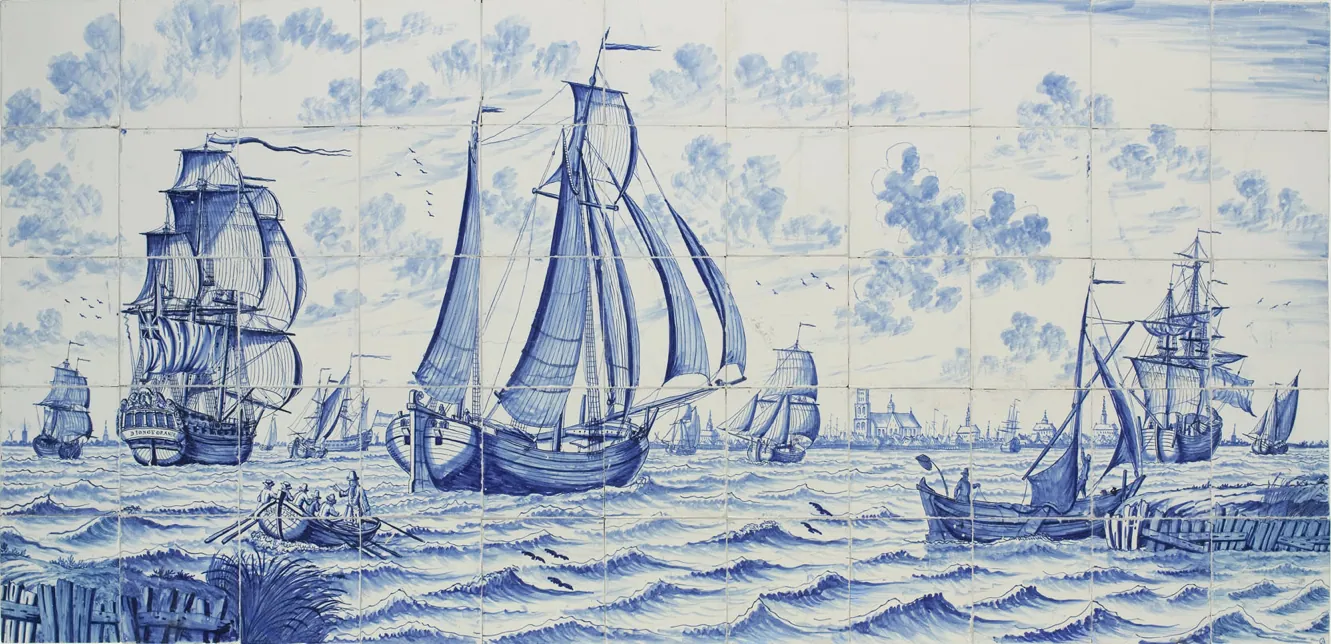
Hylke Jans was a master mariner and innovative shipbuilder; he ran a sailmaking, block- and mast-making workshop and a ropewalk, and was a ship-owner and merchant with a network stretching from Seville to Saint Petersburg. He could do all that under the name Hylke Jans. But when he was appointed co-judge on the grietenij (a Frisian administrative unit, roughly comparable to a district) board of Wonseradeel, he adopted — with slight reluctance — the name Kingma…
Your editors in conversation with (Jan) Herre Kingma, chairman of the Vereniging Familie Kingma, who is happy to dig up a few episodes from the rich family history of distant ancestor Hylke Jans and his descendants.
“People say: we Kingmas are a bit like the Buddenbrooks of the Netherlands.” The family from the Frisian village of Makkum was in business for centuries, just like the wealthy Lübeck family Buddenbrook in the novel by Thomas Mann. And just as in Buddenbrooks' subtitle – Verfall einer Familie – after nearly three hundred years the number of entrepreneurs in the Kingma family can be counted on the fingers of one hand. In the seventeenth century the Kingmas still sailed as freight carriers, but within one generation they grew wealthy. Hylke Jans Kingma (1708-1782) made a fortune in trade, shipping and shipbuilding. Hylke Jans is the founding father of the Makkum Kingmas. He was born in Makkum in 1708. In the spring of 1746 he sailed his kof ship “De Twee Gebroeders” (wrecked in 1838 on the Zuiderzee) on a voyage from Bordeaux to Saint Petersburg, where he sold a quantity of liquor, perfume, citrus fruits and colonial goods. With the profits he made from this and other merchant voyages he built, among other things, an oil mill in 1764 and a warehouse in 1767, both named “Fortuin uit Zee”.

From the middle of the 19th century onward, three main branches can be distinguished in this family, all starting in Makkum and later spreading out across Friesland and far beyond: the Sneek branch, with tile manufacturers among others, later pharmacists, physicians and notaries; the Lemerveld branch, from 1907 also growing rapidly in Brazil: initially exclusively dairy manufacturers; and the banking branch from Makkum and Bolsward, mainly oil pressers, cashiers and bankers, the last of these until the early 1980s, when Kingma's Bank was absorbed into what is now ABN AMRO.
But how did these Kingmas actually come by their (fine) name? What could have moved someone in the 18th century to adopt a family name? In an article in De Vrije Fries, Pieter Nieuwland states on this point that from the little that is known about it, one can conclude that it had much to do with status or social position.
The same was true for Hylke Jans. He and two of his three brothers adopted the name Kingma in 1771, because Hylke Jans' appointment as bijzitter (a lay assessor on the grietenij board) made it advisable to carry a surname. The grietman (the head of a grietenij) advised him to adopt the name of his maternal grandmother, Trijntje (van) Kingma. At that time the name Kingma had a distinguished ring to it, so it suited a bijzitter.
However, he was not yet enthusiastic about it. After all, he was known among his business contacts under the name Hylke Jans and feared that his firm would suffer damage from a change of name. In his business correspondence he remarks: “onze Secretaris voegt agter mijn naam dat van Kingma, dat ik anders in mijn gebruik nooit gedaan heb, maar bij deezen ook gedaan heb omdat in de Acte staat”. By this he means the deeds of proxy drawn up by the secretary of the grietenij of Wonseradeel. Elsewhere he writes that this practice dates from the start of his term as bijzitter, which had likewise been forced upon him.
But once he had accepted the name Kingma, Hylke Jans began to warm to it. He traveled to Zweins, where well-known Kingmas were laid to rest in the family grave, and copied the family coat of arms from the arms board there. In time Hylke Jans became so enthusiastic that he even tried to get hold of Kingma State. He started a lawsuit against the Beijma thoe Kingmas, because he believed he could claim the state as the eldest male heir. A case in which the judge ruled against him.
The Makkum Kingmas never lived in great style. Hylke Jans, perhaps the most successful and wealthiest of them, did not want to distinguish himself too much from the other merchants — a new façade, yes, but one that was not allowed to rise above those of others. Three generations later, at the height of the family bank's prosperity, the then head of the family, Tjeerd Herre Kingma (1838-1931), sighed: “as long as we don't become extravagant now!”. That style of sobriety has persisted through the centuries and still characterizes the family culture today, preserved in the Kingma Stichting and the Vereniging Familie Kingma.
Tijmen Brommet
Joost Kingma
Note:
Much of the family history of the Makkum Kingmas has since been published in book form, including:
- De Kingma-Kroniek, of Hoe een familiegeheugen meer dan honderdvijftig jaar intact bleef. Henk Nicolai; Thesis, RUG 1997. Published by Egbert Forsten, Groningen.
- Het leven van Tjeerd Herre Kingma, olieslager, kassier en bankier (1838-1930): ”als we nu maar niet weelderig worden”; Henk Nicolai. Kingma Stichting.
- Genealogie Familie Kingma, nazaten van Hylke Jans Kingma; T.H. Kingma, Hollandia Baarn, 1883.
Recently published: 'Dekzand, een familiegeschiedenis' by (again) Henk Nicolai, this time about the Lemelerveld branch.
Kingma Kronkels: Imitation

Joost Kingma
Imitation is not a pleasant word. Someone makes something and someone else copies it. Fake, not authentic, fake.
When it comes to buildings, the arsenal of words available to choose from in case of imitation is full of patronizing terms: neo, nostalgic, retro, replica, folly, fake, historicizing, hybrid, remake, re-creation, or just kitsch!
So it is not easy to create something, in this critical field of forces, that receives universal appreciation.
In Mantgum they are doing their best. There, before long, State Hoxwier is to see the light of day again. At a well-attended gathering of the Stichting tot Behoud van Staten en Saten, architect Syb Eldering recently explained how that works. And we listened, of course, with pricked-up ears: financing, archaeological research, architectural design, permit application, etc. — it all sounds familiar to us.
But the initiators are optimistic, and that is an understatement for the state of mind you need to have in order to fight your way through the slow porridge of critics and bureaucrats.
The rather scathing tone that Peter Karstkarel saw fit to adopt in his 2003 article in Noorderbreedte about new stinzen and states in Fryslân is, fortunately, not shared everywhere. Not in Mantgum, of course. But nor in an article by Aart de Vries (Bulletin KNOB 2002-5), in which he discusses the 'fake or neo' dilemma for a number of historical (re)constructions in considerably more nuanced terms. Realized and planned projects. Fake and fine. Including the resurrection of Kingma State.
A long-vanished building that, as De Vries puts it, 'lies waiting like a dormant time bomb for the most favorable moment of ignition.' In our case, that must lead to restoration, not imitation.