
IV De Kinkhoorn
De Kinkhoorn 21 — October 2010
Volume 11, number 1
This issue as pdf (Dutch) · Read the Dutch original
- Foreword
- Zweins and Kingma State on old maps (5, conclusion)
- How ‘eigenerfd’ were the early Kingmas of Zweins?
- Response from historian Paul Noomen
- The gravestone of Gerrolt Yntesz Kingma
- The will of Hendrick Jellesz Kingma of 14 November 1625
- Kingma in Lapland
- Swiss and Michigan Kingma’s
- Kingma Kronkels: Round
Foreword
What you are holding is, for the time being, the last issue of "De Kinkhoorn", as we announced at our last donors' meeting in November of last year. The activities of the Stichting Kingma State will now concentrate on compiling a book about Kingma State and the Kingmas up to 1700, including the research this will require. From next year we will keep you informed of our activities and progress twice a year by means of a newsletter. With this "Kinkhoorn" you will also receive a request for your annual donation in support of our activities; we would also greatly appreciate continuing to receive your annual donation in the future in support of the research and publication. In order to keep costs down as much as possible, we ask you to let us know whether you would like to receive the newsletters by e-mail, and to pass this on to our secretary Joost Kingma, e-mail: info@joostkingma.nl . Those who do not have an e-mail address can let the secretary know that they wish to receive the newsletter by post. You will find the secretary's address under Colophon at the back of the Kinkhoorn.
On Saturday 6 November we will once again be organising a donors' meeting in Zweins. We will then give you further information on the progress of the planned publication and the intended building activities on the grounds of Kingma State. We have persuaded André Kingma to give a presentation on "Eigenerfden, berechtigd allodiaal erfgoed en de naam Jelle Kinghum", prompted by a 1943 publication by Gonggrijp, "De wapens der friesche eigenerfden in verband met hun berechtigd allodiaal erfgoed".
In this "Kinkhoorn" you will find the fifth article on the old maps of Zweins and Kingma State, a report on the 2009 autumn meeting by Herre Kingma with a response to it from the speaker, Paul Noomen, a story about the search for the gravestone of Gerrolt Intesz Kingma, the will of Hendrik Jelles Kingma, and two contributions from abroad, namely an article from Lapland and a genealogical report on the "Swiss" Kingmas, and finally the last Kingma Kronkels.
I hope to meet many of you on 6 November in Zweins.
Tjeerd Kingma
Chairman
Zweins and Kingma State on old maps (5, conclusion)
In previous issues of De Kinkhoorn, a number of maps have been mentioned on which Zweins is shown. From this we can probably conclude that Zweins, at least from 1545 onward, had enough significance to be included on the first provincial map (by Jacob van Deventer) and later maps. None of these maps mentions Kingma State either, with the exception of the map of Friesland from the Atlas Major, which was the reason for this series of articles. But this Atlas was published in 1662, so after 1616, when Barthold Wicheringe was the first to introduce the practice of showing prominent houses on maps.1
After the last map discussed, by Gerard Mercator from 1585, several more maps follow up to 1622 that do not mention any states (Frisian manor houses with land). I will not discuss those further, it would not add much.

As far as I can tell, the first map of Friesland on which, among other things, Kingma State is shown appears in 1622. It is the map "Frisia Occidentalis" by Adrianus Metius and Pier Winsemius. See the detail alongside.
Here Zweins is written as "Sueins"
A prominent house, or as it was called on maps in those days, a "Nobilium aedes", is indicated with: 
Herama State in Zweins is also indicated in this way.
For this map, new surveys were carried out by Adrianus Metius and Gerardus Freitag, both professors at the university of Franeker. The map was included in "Pier Winsemius, Cronique ofte historische geschiedenisse van Vrieslant".
In the border are the coats of arms of the eleven cities and of the grietenijen (Frisian administrative districts, roughly comparable to municipalities) - of which seven were still blank, as these had not yet been established in 1622. The map was hand-coloured.

Pier Winsemius was initially a lawyer, became a historian in 1616, and was appointed professor of history and rhetoric in 1638.
After the appearance in 1622 of the map above in Winsemius's Cronique, many more maps followed until 1864 (the year the State was demolished), often showing the states. Altogether too many to discuss, so I have picked out a few. For more information I refer you to the book "Frisia Dominium" by P.J. de Rijke.
The most striking is of course the map of Friesland from the Atlas Maior of 1662, already discussed in Kinkhoorn 15 and 16. The world-famous eleven-volume masterpiece by Joan Blaeu.

Also important are the well-known maps of Bernardus Schotanus à Sterringa from 1665 and his atlas from 1718, for which he carried out new surveys. A detail is shown alongside. On these, Kingmatille and the tollhouse are also indicated, as are the other states in Zweins
In the French period (Batavian Republic, 1795-1806), new surveys for military maps were carried out under the direction of French military engineers, beginning at the national borders in connection with defence. Later, cadastral data was also recorded.
When the Netherlands became a kingdom under Willem I in 1813, the surveying work came to a temporary halt, until the king decided in 1816 to resume the cadastral work.

In 1832 the Kadaster (the Dutch land registry) was introduced in the Netherlands, except in Limburg. In the same year the Kadastrale atlas van Nederland was published. These maps are based on the so-called minuutplannen (the original large-scale cadastral survey maps). These are maps on which all parcels of land, water, paths and roads, buildings and yards are drawn to scale.
A few years ago these maps, for Friesland, were republished by the Fryske Akademy. The accompanying detail of the area around Kingma State is taken from this reissue: volume 4, Franekeradeel and Franeker.

In the period 1849-1859 the "Nieuwe Atlas van Friesland" was published by Wopke Eekhoff. This atlas contains maps of the thirty grietenijen or municipalities, with the eleven cities located within them and their territory, as well as the islands of Ameland and Schiermonnikoog. The maps were drawn from the "Kadastrale Plans en latere Topographische opmetingen", as the title page states.
The maps have a scale of 1:25,000 and are in "Atlas-plano formaat in het koper gegraveerd op last der Proviciale Staten".

Finally, probably the last map on which Kingma State is still shown.
It is once again a Topografische Militaire Kaart (Topographic Military Map, abbreviated TMK).
The State is found on map sheet TMK 5, labelled Harlingen and published in 1862, so two years before the demolition of the State.

1 P.H. Wijk, Groninga Dominium, p. 117.
How ‘eigenerfd’ were the early Kingmas of Zweins?
Herre Kingma
It is a quarter to two when I drive into Zweins on the first Saturday of November. A grey day, with here and there a brief ray of sunshine over land that lies flat and unyielding at this time of year. The land here was not always flat, for this region is called it terpelân, after the row of terpen (artificial dwelling mounds raised above flood level), thrown up from 150 BC onward, which were largely levelled to the ground at the end of the nineteenth century. The fertile terp soil was carted away and now lies like a film over the Frisian farmland, containing within it the minuscule archaeological remains of early medieval Friesland. The visible remains, insofar as they were noticed and secured in time, ended up in museums, antiquarian collections, and in attics and private collections. In this way the terp Kingum too was processed into terp soil, and shortly afterward the neighbouring Kingma State was demolished and sold off in parts. Of the history of Zweins as a village with a few sizeable states, little now remains beyond a handful of houses along the Van Harinxmakanaal, called Kingmatille, and a small group of houses opposite the Regina church, built in the eighteenth century on the remains of its medieval predecessor. In that church a few Kingmas still lie buried, among them Ynte Jelles and his wife Trijntje van Sanstra, from whom our branch of the Kingmas of Makkum descends via their granddaughter Trijntje Jans, the grandmother after whom Hylke Jans named himself Kingma in 1771. From this couple also descends the last resident of Kingma State, their grandson Ynte (Ignatius van) Saecklesz Kingma, the well-known cavalry colonel, who still fought, with a regiment of horsemen bearing his name, against the invading French at Lobith in 1672.
On his death, the country estate passed via the van Ghemmenich family to the van Beijma family (later ~ thoe Kingma). In our archive at Tresoar — to be distinguished from the Kingma State archive also held there — are documents showing that Hylke Jans and his brothers wanted to claim this inheritance. The fideicommis (a form of entail under which an estate had to pass undivided to a designated heir, typically the eldest male descendant) resting on Kingma state stipulated that it should go to the eldest male descendant, and the Kingmas of Makkum believed this gave them a claim to the state as well. These fideicommis estates played a major role in the histories of noble families in particular. By establishing a fideicommis one could ensure that the ancestral seat, or a particular part of the estate, could not be alienated or inherited by a married daughter, and so pass into the hands of a family by marriage. That, at any rate, is not what the fideicommis that Ignatius established over the inheritance of Kingma State managed to achieve with respect to the Kingma family.
The meeting is opened by chairman Tjeerd Kingma — that sounds familiar to us, even though he is at best twentieth-degree family, or more distant. Tjeerd tells us that plans have been made to compile a book about Kingma State and its inhabitants. Joost Kingma then explains — he too is a board member of Stichting Kingmastate, but also of Stichting Herstel Kingma State — how they intend to rebuild the state in a contemporary form, albeit with a fitting historical allure. Support for this building initiative was at the time also requested from us, that is, from Kingma Stichting, but so far we have not joined the initiative. The considerable investment required, but also doubts about whether the past should be reconstructed in this way, have kept us from participating. Nevertheless, attractive, well-substantiated plans are ready, and candidates are already being sought who would later like to actually take up residence on the new Kingma state. Anyone interested can visit www.kingmastate.nl.
Very interesting, after the break, was the lecture by Paul Noomen on the late-medieval stinzen (fortified stone houses) and states and their inhabitants in Friesland, zooming in somewhat on the question of what role the Kingmas played at the time. For the former I refer to his recently published, important booki. Here I will go into what Noomen observed about the position of the Kingmas in late-fifteenth- and sixteenth-century society in Zweins and its surroundings. The Kingmas are recorded as freeholders, but had they been so since time immemorial, or did they actively acquire that status at some point? Were the Kingmas, in the fifteenth century, when we first encounter the Kingums, already freehold owners of what was then still the sate (Frisian farmstead) Kingma, or did they lease the property from by far the largest and most powerful landowner in and around Franeker, the Sjaerda family, related to the Heremas, the family that was at that time the leading hoofdeling (Frisian chieftain-noble) lineage in Zweins? The archives say the following about this in 1511/1514, as quoted by Paul Noomenii:
Peter Kenghum geft dit jaer toe huyer:
- Aan Gerrelt Herrem heerscip [ gehuwd met Lutke Siaerda] 9 fl;
- Ende zyn faer [ Jelle Kinghen] ende moer: 16 fl.
- Ende Johannes [comen Petersz], vicarius [op het altaar van St Crispinus en Crispianus] in Franeker: 14 fl;
- Ende heer Sybren, vicarsi in Peyns: 24 st.;
- Ende de patroon in Sweyns: 6 st.;
- Ende om ’t ander jaer sal degeen daer op ’t goet woont [voor Swob Syaerde ende Gerrolt toe saemen een hyncxt voeden.
This amounts to Pieter Kingum paying about 40 florins (fl., the currency of the period) in rent, of which 9 to Gerrolt Herema and Lutke Sjaerda, 16 fl. to his father Jelle Kingum, 14 florins to Johannes, son of the merchant Peter and parish priest in Franeker, for the benefit of the vicarage of St Crispinus (what we would nowadays call the St Crispinusleen), and two small amounts in stuivers. In addition, every other year he keeps a stallion in stable for the Herema family. Noomen regards this last item as a kind of servitude owed by the Kingmas to the Sjaerdas/Heremas.
In 1529 Pieter to Kemgum declares the following (before the court):
Pieter to Kemgum wonachtig tot Sweyns voer hem ende syn broeders ende susters segt dat hem hoort de jacht soe verre als het lant stereckt van der sate geheeten Te Kemgum; zijn teycken is: beyde syn voeten buyten ende binnen gesplit. Allegert possessie vyfftich jaeren ende hefft geen brieven.
Gherolt Herema voer hem ende voer die van Siardema opposiert hem daertegens ende protesteert van syn gerechticheyt [so ét binnen ’s dycx is in Franckerdeel].
Pieter thoe Kingum declares on behalf of his sisters and brothers that the hunting rights belong to him as far as the land of the sate Thoe Kingum extends. His (hunting?) mark is: both feet split, outside and inside ??. Finally he states that he (his family) has held possession of this for fifty years. He can, however, produce no letters or written documents from which those hunting rights would appear. The Heremas dispute that right (to the swan hunt), which was an attribute of 'seigneurial' (read: noble) status. That went too far for the Heremas, for it belonged to them alone in Zweins.
Noomen concludes that Herema was the leading family in Zweins, that is, supplied the village hoofdelingen in the fifteenth century, and that the Kingums/Kingmas were then still largely tenants of the Sjaerdas and later also the Heremas. In the course of the sixteenth century this changes: the entire sate eventually becomes the property of the Kingma family. The sate then also undergoes an upgrade, that is, from then on it is referred to as a state. We also see this transition from tenant to freeholder taking place in the career of Pieter Jelles (thoe) Kingum, mentioned in the quotation above. In 1552, four years before his death, he is a gevolmachtigde ten landsdage (a delegate to the provincial diet, i.e. a member of the provincial States). That was a position entirely reserved for freeholders and nobles. He must therefore have held it there as a freeholder, as did a line of his descendants, among them our ancestor Jan Yntesz (van) Kingma.
The state grows in the seventeenth century to a size of about 200 ha, while during that period many other Kingma family members also acquired substantial landholdings besides. That immediately raises the question of how — if there was originally little or no land from their own or inherited possessions — the Kingmas could nonetheless build up such extensive landholdings in a relatively short time. Was that luck, good farming and enterprise, or simply the making of good marriages? For the latter, though, it was necessary that you yourself also brought in the required land, and — not to forget — background. Such good marriages certainly occurred, such as twice with a daughter from the Fogelsangh family, likewise described as freeholders. This family did, admittedly, also consist in part of tenants, but special ones. They leased large former monastery estates, and such so-called kloostermeiers (tenants of former monastic estates) enjoyed high standing, and not infrequently they too were delegates to the provincial diet.
A number of Kingmas today, some descending directly in the male line from the Kingmas of Zweins, have until now assumed that, on the basis of the rent payments made, the early Kingmas were three-quarters owners in 1511, and thus would at the very least also have been de facto freeholder farmers on land that was largely their own. This is because it is assumed that the parish priest Johannes Pieters, mentioned in the sources alongside Jelle Kingum, was a brother of this Jelle. Noomen, however, considers this hypothesis not very likely. This parish priest Johannes, mentioned in the archive fragment above, could very well have been the administrator of, for instance, a vicarage or fief founded by the Sjaerdas. I would think that the rent paid to the priest could also relate to a remnant of old monastery estates. The sources available so far are too limited to give a definitive answer on this. What does stand out is that the early Kingmas, judging by their 'seigneurial' claim to the swan hunt, were concerned with their status at an early stage. Noble status could not be proven, but in the course of the sixteenth century they may, according to Noomen, indeed be regarded as freeholders. When Ignatius, the last Kingma scion living at Kingma state, dies in 1700, he has clearly distanced himself socially from his cousins, who, as Herman van Slooten put it in 1952iii, 'lived on in the farming class,' or, as in the case of our branch of the family, as skippers and shipwrights in Makkum. Ignatius, by contrast, moved as a senior military officer in the entourage of the Frisian stadtholders, and, as an expression of his aristocratic lifestyle, donated, for instance, a new pulpit to the Maria Church in Boer, prominently bearing his initials IVK. Karstkarel says, in a speech at the completion of the church's restoration in 2008iv: 'It will [have been] a pleasure for a Kingma so fond of representation and decorum to see us sitting here around his gift.'
Status and ordinariness are still competing for precedence in many traditional families, the Kingmas not excepted. Were the earliest Kingmas freeholders, hunting for recognition of their supposed seigneurial rights, or simply tenants who, being enterprising as they were, quickly climbed the social ladder of sixteenth-century class society? The latter, at any rate, fits well with what followed in Makkum, where a second renaissance took place, from skippers and carpenters to energetic, prosperous entrepreneurs who, as homines novi, took their place in the governance of village, grietenij (Frisian administrative district), and province.
i P.N. Noomen, de stinzen in middeleeuws Friesland en hun bewoners, Fryske Akademy & Uitgeverij Verloren BV, Hilversum, 2009.
ii P.N. Noomen, handout accompanying the lecture at the donors' meeting of Stichting Kingma State, Zweins, 7 November 2009.
iii H. G. van Slooten, 'De reders`en koopmansfamilie Kingma te Makkum' in: Jierboekje fan it Genealogisk Wurkforban, 30-52, 1952.
iv P. Karstkarel, speech at the completion of the restoration of the Maria Church in Boer, 15 March 2008.
Response from historian Paul Noomen
Herre Kingma
I sent my article, which was published in March 2010 in the Kingma Kroniek, the magazine of the Makkumer Kingmas, also to the historian Paul Noomen, on whose lecture in Zweins last autumn I largely based my article. He replied as follows:
"Dear Herre Kingma,
A nice response to my talk in Zweins. I have one point of criticism, concerning the following passage in your article:
It is namely assumed that the priest Johannes Pieters, mentioned in the sources alongside Jelle Kingum, was a brother of this Jelle. Noomen, however, does not consider that hypothesis very likely. This priest Johannes, mentioned in the archival fragment above, could very well have been the administrator of, for instance, a vicarage or fief founded by the Sjaerdas. I would think that the rent paid to the priest could also concern a remnant of old monastic property. The sources so far are too limited to give a definitive answer on this.
Johannes Petri, according to the register van den aanbreng (register of holdings, 1511/1514) and the beneficiaalboek (benefice register, p. 256, dating from 1543), was not a priest in Franeker, but a priest-prebendary of the Crispinus and Crispinianus benefice in the church there. This is not a hypothesis, but can be regarded as established by combining both sources; the same goes for the fact that the perpetual rent, or "huurpenningen," in question was not the private property of Johannes Petri, but prebendal property. That it might be a remnant of old monastic property is unfounded. Since the 10th century, the various ecclesiastical institutions (bishop, chapters, parish churches, monasteries) have been financially separate from one another; the same applied in the late Middle Ages to the various funds and prebends within a single institution. Thus the church estate, the rectory, the vicarage and the various prebends within one parish church were just as many entirely separate funds, both in terms of history and of administration and expenditure. From the registration of 1511/1514 and 1543 we know all these funds and their landholdings and income precisely. The rent of 14 floreen (a Frisian land-tax unit) from Kingum, as stated, clearly belongs to the Crispijn & Crispinianus prebend. This prebend has no financial connection to any monastery. We likewise know the monastic property in Friesland precisely (1511/1514, former monastic property 1619, see also the "kloostergoed" layer in HisGis). The monasteries in Friesland were not dissolved until 1580; before that, monastic property could not be alienated. That monastic property, prior to 1511, should have been used to endow a prebend in an urban parish church would therefore be highly exceptional.
My thanks for sending your reflections on the afternoon in Zweins,
kind regards, Paul Noomen"
Paul Noomen's response is a historically technical correction of the "jump to conclusions" I apparently made in my article about the origin of the properties of which the priest Johannes Petri was prebendary (beneficiary), and for which Jelle paid rent. It was nothing more than an attempt on my part to make it plausible that Johannes Petri could indeed have been a brother of Jelle Kingum, as the chairman of the Stichting Kingma State assumed.
It is established that Jelle Kingum held the largest share — albeit only forty percent, not a majority — in the ownership of Kingma State. However, nothing has emerged to indicate any position of consequence as a landowner in Zweins and its surroundings. That only comes about in the course of the sixteenth century, when his son Pieter Jelles thoe Kingum becomes an authorized representative to the Landsdag in his position as eigenerfde (a freeholder owing no feudal obligation) from Westergo. Herman van Slooten mentions, in his book on 100 years of Kingma's Bank,i a ruling from 1597 (recesboek, court record book, of Franekeradeel) against the son and grandson of the aforementioned Pieter Jelles, the gentlemen Jelle Pieters and Pieter Jelles (thoe) Kingum, for illegal use of weapons. Freely translated, their account comes down to the claim that their ancestors had lived at Kingma sate (Frisian farmstead) for a hundred years, indeed longer than living memory, and that they alone held the fishing rights in Kingmatille and the zijlroede (sluice-toll right) there.
Founding churches or carrying out other major public works they left entirely to their noble contemporaries. It goes no further than a pulpit for the church in Boer in 1665, provided by Ynte Saecklesz (Ignatius van) Kingma, who served there as church warden, the last Kingma at Kingma State. Sytse ten Hoeve sent me a draft articleii about this little church, in which, in passing, he also portrays the figure of Ignatius van Kingma. He was, admittedly, a high-ranking military officer in the service of the States, but also, now and then, a bit of a rake, who was, for instance, reprimanded by the church council for drunkenness. Moreover, he was once suspended for a year from his military post in connection with unlawfully holding an ecclesiastical office while serving as a military man. During his student days in Utrecht he abandoned a lady of good standing along with his illegitimate son, who was bought off for more than 3,000 guilders, a fortune in those days. That he made the news because, in the mid-17th century, riding in the retinue of Johann Maurits van Nassau, "the Brazilian," he fell through a bridge in Franeker — an incident the Nassau prince survived by the narrowest of margins — was already known to us. Ignatius, the last eigenerfde at Kingma state, was not only the best-known Kingma of his time, but was also a bit notorious for his far-from-respectable lifestyle.
i H.G. van Slooten, Kingma, lid van de familie, geschiedenis van Kingma's Bank N.V. 1869-1969, Baarn 1969.
ii Sytse ten Hoeve, het kerkpoortje van Boer en de Franeker steenhouwer Philippus Nicasius. Publication in preparation.
The gravestone of Gerrolt Yntesz Kingma
Gerrit Kingma, son of Andries Kingma / Foekje Hooghiem, born in 1917 in Dokkum, began in the '70s collecting information about "his" Kingma family. Visited the old family members still living and gradually supplemented his information with theirs. Well, as everyone begins the search for their ancestors. After his retirement, during his family visits to Friesland, he spent many a day in Leeuwarden at the Rijksarchief. He also regularly visited the Rijksarchief in Den Haag. In Leeuwarden he got to know the archivist who was still working there at the time. This archivist had researched the archives of various old families / freeholders who had not yet been (genealogically) mapped out and might have died out, and had gathered the necessary information. The Kingmas had, starting from Jelle Kingum (1450), already been partly worked out to about the 7th generation, with Ignatius as the last Kingma at Kingma-State.
Now it became even more fun.
The old Kingmas naturally became a challenge — was there a link? Even more hours were spent researching baptismal registers and dusty tomes, but now extended with visits to little villages and ancient churches in Friesland where the old Kingmas might somehow have left a footprint. The ever-growing amount of data was put into a database.
We visited Zweins and "Kingma State". In the teahouse of the State lived
temporarily a teacher from Leeuwarden, researcher and archaeologist. He put us on the trail of Oosterwierum, and wandering through the villages we found the tower dating from ca.
1200. The door was locked, and after asking around here and there we got the key from the sexton of the Reformed church. Nothing was to be found in the churchyard, but the oldest gravestones lay in the tower, and after removing a pile of stones from one of the gravestones and rinsing off the mud with a small bucket of water and a little brush, we found this gravestone with the alliance coat of arms of Gerrolt Yntesz. Kingma, married in 1583 to Tyanck Ryurdtsdochter Atsma and died 21-11-1595, born in Oosterwierum. What a surprise! I couldn't get the bottom part of the stone in the photo.
In the end we got very far with our search, but we couldn't manage the missing link (with Johannes Kingma 1658-1704) — we kept getting stuck. In 1996 we met Ype Brouwer at the archive in Leeuwarden, genealogist and correspondent at the Rijksarchief. He still saw possibilities. So he got to work for us. In October 1996 came word that he had untangled the knot and had indeed been able to demonstrate the link in the male line.

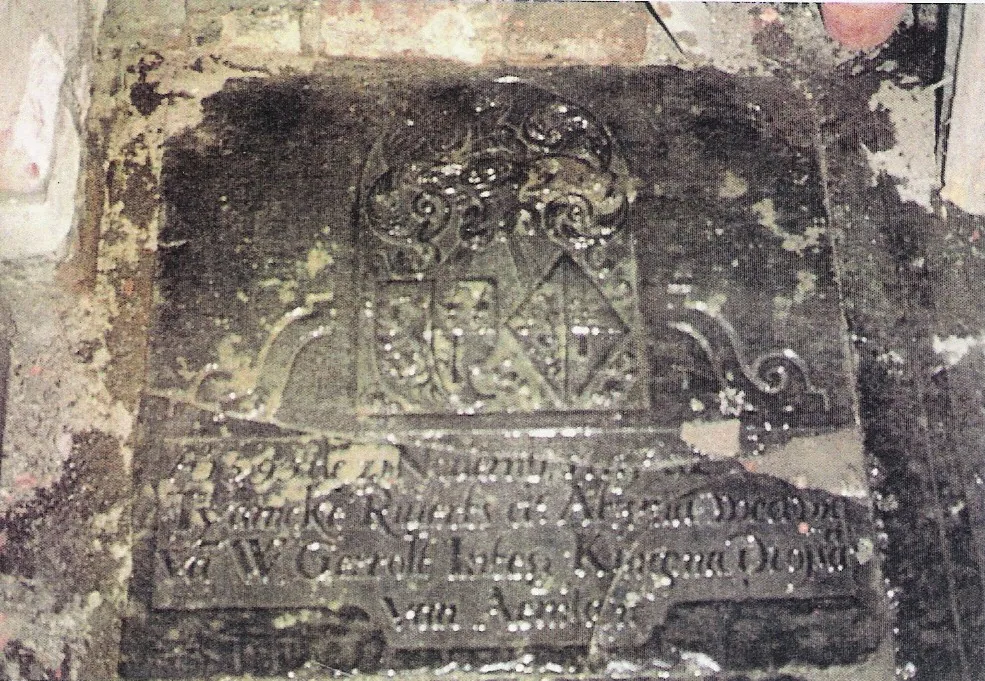
In 2000 Gerrit passed away and unfortunately was no longer able to attend the first gathering of the Kingmas in Zweins. He would have found it wonderful. In 2001 we exchanged the information with Wieb, Frans and Ruud de Bruijn. This was then processed into Ruud's fine genealogy.
However, there is still much left to find out, so besides Kingma State there is still plenty of enjoyable detective work ahead in the future.

On the high terp of Easterwierrum only the tower of the former Sint Nicolaaskerk still stands. The terp has been dug away and over the years the village has shifted westward. The church was demolished in 1903. Demolition of the tower in 1911 was prevented at the last moment. This tower originally had a saddle roof, which was replaced by the current spire in the 18th century. In the churchyard lie a few gravestones from the old church, including those of the Vogelsang family. On one of them one of the four heads symbolizing the ages of man is still visible, the skull.
This tower on the partly dug-away terp with churchyard used to be the heart of the village of Oosterwierum. The current village center lies a little further on. This happened in the nineteenth century because of the more favorable location relative to the waterways, which were economically very important at the time.
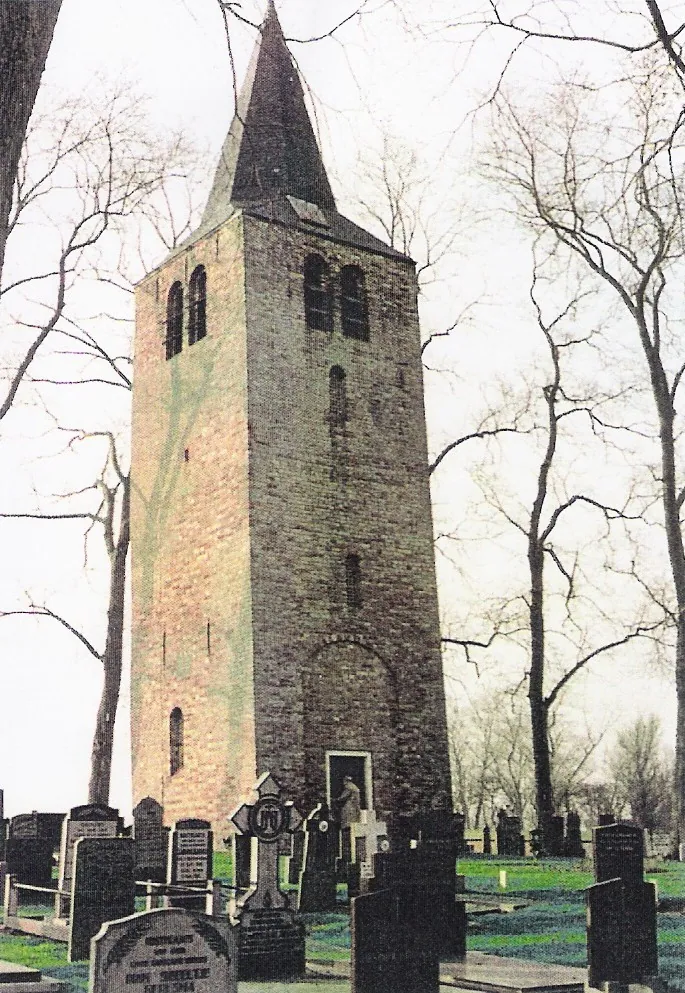

The photo shows my father in the entrance of the tower (with a broom in his hand) looking at the gravestone from which he has just removed the rubble and swept away the sand.
Jopie Kingma-Markus and André Kingma
December 2009
The will of Hendrick Jellesz Kingma of 14 November 1625

The beginning (see above) reads:
Ick Hendrick Kingma nu tegenwoirdich kranck te bedde
leggende behartigend den sekerheit des doods end en onse-
kerheit van d en iure vandien hebbe voir mij genomen dispositie
van mijn goedhe te mene sulks doende mits eerstens inden
eerhe Godt Alm achtig . mijn zeele ende he t lichae m den aerde
bestel l ende tot de salige ver rijsenis met allen gelovigen
ende begerende mijn legersteed in den kercke van den
dorpe Peins te hebben, instituere ick tot universeel erf-
genae m Rienck Kingma mijn zoon:
After this he appoints Saeckle Intes Kingma as Curator and asks the Court of Friesland to authorize him as such.
Son Rienck, a law student in Franeker, must therefore still have been a minor at that time.
He further nominates the grietman (the head of a Frisian grietenij, roughly comparable to a district magistrate), Jr. Duco van Jongema, as Honorary Curator.
Later, in an addition to the already signed will, he releases the grietman from this task again because, owing to his “wegens hoge en publieke dienste” — that is to say, his many and important duties — he does not wish to burden him with it. In his place he appoints Claes Foppes Burger en Coopman.
After that the will is signed again, this time without the signature of Claes Foppes.
After the initial appointment of the grietman as Honorary Curator, it is stipulated that the inheritance goes entirely to his son and that no part of it may go to his “vrienden” on his mother's side, but that what is inherited must remain within his family. Hendrick further stipulates that it must be understood that there can be no question of encumbering Rienck with a “fideicommisse”. Rienck is to have free disposal over it.
After this the will is signed by Hendrick and seven others, among them the signature of Ids Pyters Coopman, possibly the notary. His signature is missing after the addition.
Below is a photograph of the signature of Hendrick Jellesz Kingma. From the extremely poor handwriting it may perhaps be inferred that Hendrick was very seriously ill, unless he simply had poor handwriting to begin with.

The addition to the will is in a different hand and was added on 7 March 1626.
Unfortunately this will gives no insight into what was inherited. We know that the state (a Frisian manor house with land) had already been sold by Hendrick to Saeckle in 1611.
What else Hendrick owned besides this therefore remains unknown here.
Transcription and text: Kees Kingma
Kingma in Lapland
16 August 2010
Here at last I am sending you the little map of the place called Kingma in Lapland, which appears on the 1668 map of Wardhus. Also enclosed is a fragment of a family tree of a certain Kingma Moss. I don't have the original map, we saw this map on a TV programme and saw that Kingma was on it. My husband, Henk, went to visit the university in Tromsø and we got some little maps there of the situation today added to it. We were supposed to ask at a municipality in Sweden.
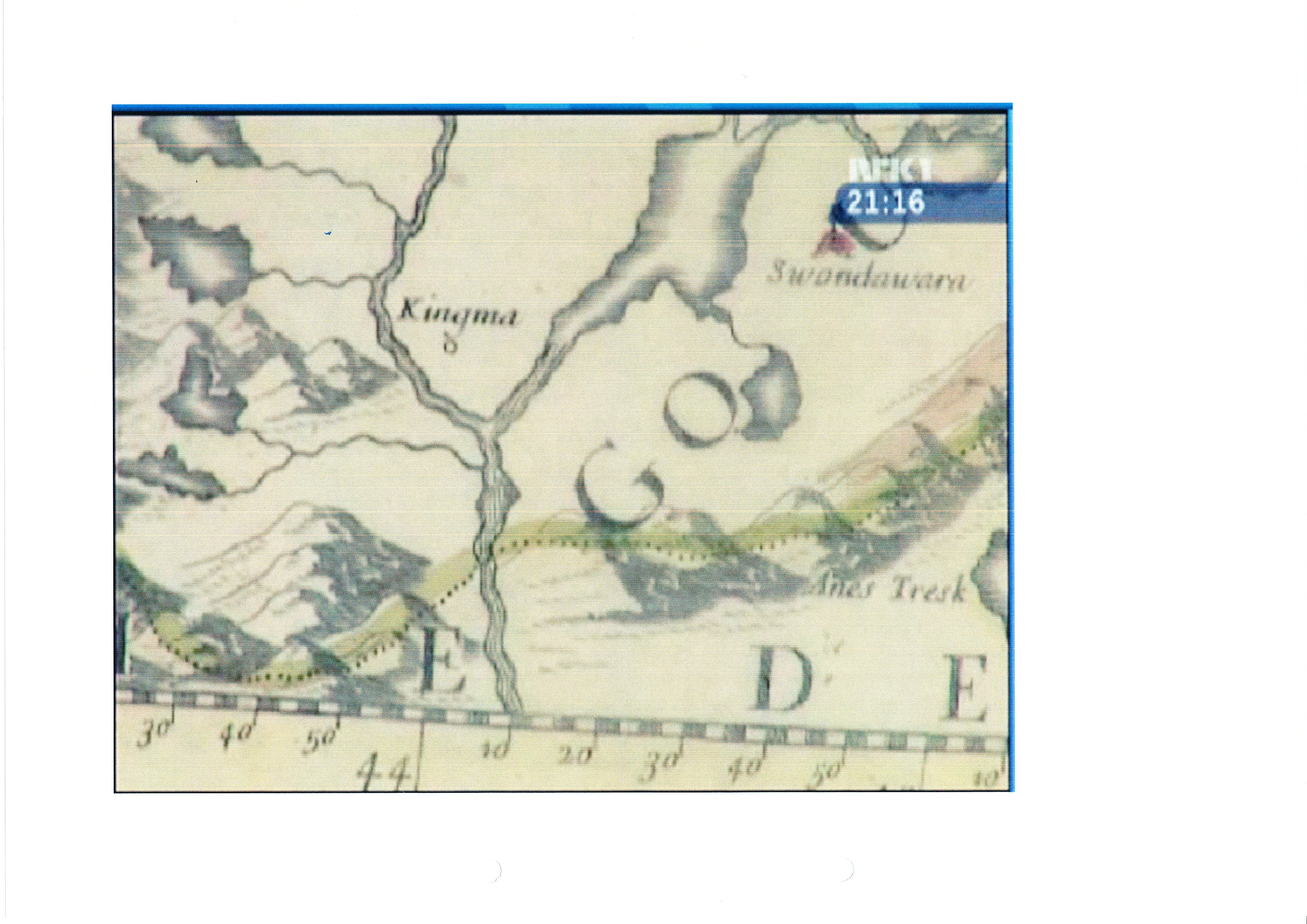
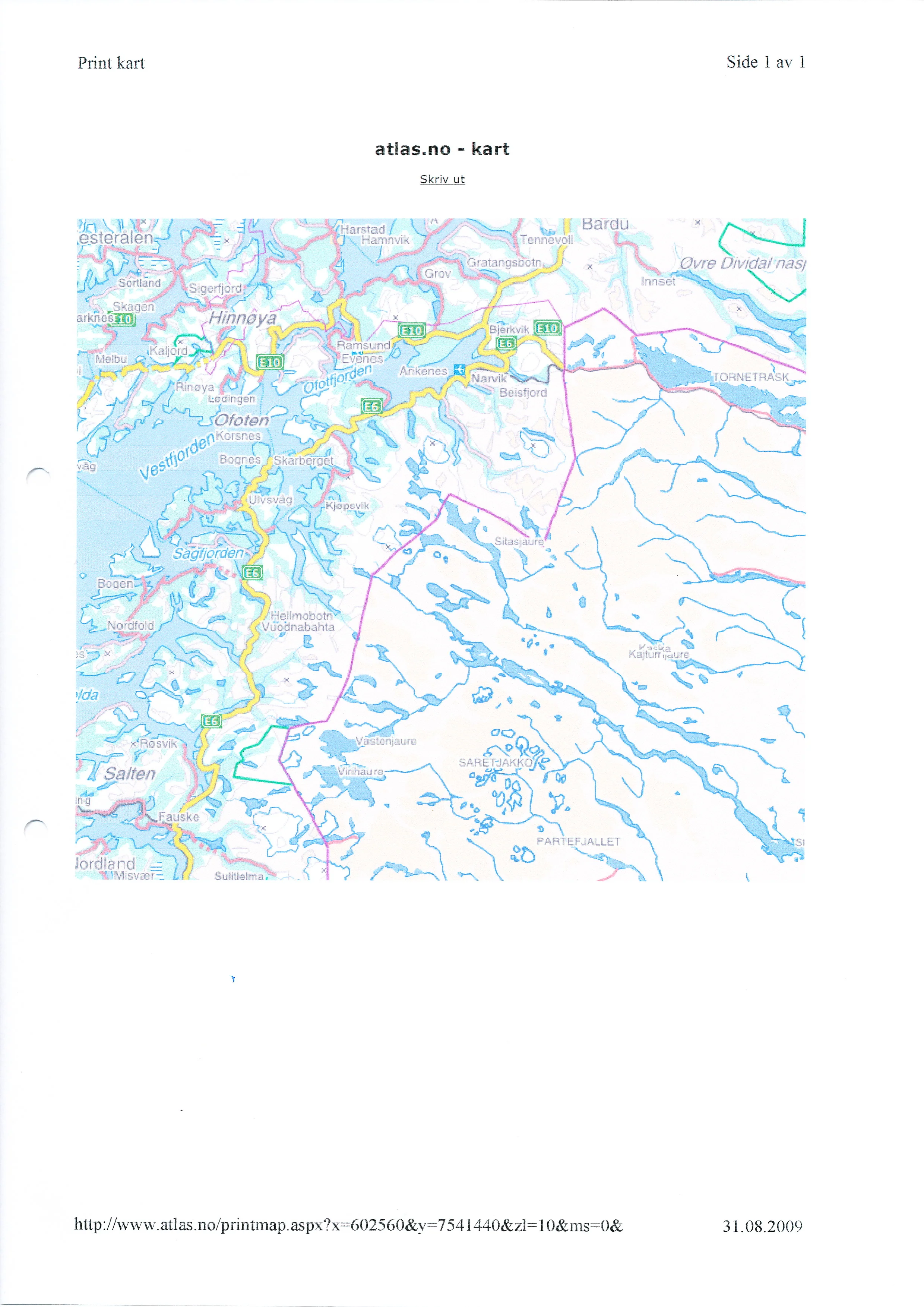
We never got that far. Now I have an evening free, so I scanned the little maps and am sending them along with this.
This e-mail is meant for and sent to you in connection with the history of the Kingmas. How could that name have ended up there?
Was there a person named Kingma there as a mapmaker, who named a beautiful spot Kingma?
Or did a Kingma live there? That, too, with the person Kingma Moss in mind, who might be descended from that Kingma, or take the name from the place Kingma. Because surnames here are often taken from the place where they lived. Or a Kingma who was shipwrecked and went to live there??
Here I am sending an enlargement of the map with the place called Kingma.
And some adjoining little maps. So this is on the map of Gouvernement de Wardhus in Lapland
I'll tell you later how we ended up in N. in 1972, I don't have time for it now. But I am the Kingma, and I already sent you all the rest of the family tree of my branch once, but it was never added in. That part has already been worked out and is in the Kalma family tree. I can send it again if you'd like it added.
> You also wrote about part of a family tree of a certain Kingma Moss.
> I haven't received that yet.
> Or is that your own family tree you are referring to?
No, that's a person we came across on the internet. I don't know or know anything about this person, but mysterious that that name then turned up in northern Norway. Here's the attachment
> That Kingma — could that also be a first name? Neither father nor mother is actually named Kingma.
No, it's not a first name here, but whether it's been used as one?
And then.... why??????
The thing here is simply that the name of the husband and of the wife can both form the surname, for both m. and f.
Or does the mother have something to do with Kingma after all, since she's called jørgensdatter(jørgensdochter) — could Jørgen, her father, have something to do with Kingma??? All just guesses
If you look at the letters of Gouvernement, you'll see that on the 1668 map it lies by the letters GO of Gouvernement.
Where exactly it lies on today's map?? It's somewhere on those little maps, see the enlargement. It's on the Swedish side, so that's where it needs to be searched for. Detective work!
Ger
Gerritje Klaaske Demmink-Kingma
Fana (Norway)
Swiss and Michigan Kingma’s
The story of my research into the Kingma family tree
One well-known Kingma family tree was compiled by Kingma families who recorded their research on the www.kingmastate.nl website. I first came to know of this data some 10 years ago, but was never sure where on this tree our lineage was situated. Some 5 years ago, during a visit to Friesland on the occasion of the KingmaDag, I was told of research that had been done by the lineage that produced Kingmas who married into the de Bruijn family. A massive amount of genealogical information can be found on the website of Ruud de Bruijn.
I am endebted to the work of the de Bruijns because, after careful search of the many pages of names and histories they compiled, I suddenly discovered my own Grandfather, Gerben Kingma. Many individuals of interest to the Michigan and Swiss Kingmas are taken from that website, discovered by working backward from my Grandfather.
The "Michigan and Swiss Kingma" line goes back to Jetske Jelles Kingma, daughter of Jelle Pieters, the third and fourth generation on the family tree published by the Kingma State.
The listing that follows on the next four pages shows the generational sequence, with all siblings, between the first known Kingma (Jelle Kingum), and the parents of Grandfather Gerben Kingma. Our grandfather then falls off the screen of the de Bruijn website, along with most of his siblings, since they emigrated and the records in the Netherlands ceased to provide information. The oldest of our grandfather's siblings, Willemtje, born 12 Nov 1863, married Geert Geerts on 14 May 1887, and they had 4 children born while still living in the Weststellingwerf district.
The Michigan (USA) and Swiss Kingmas have always understood that Grandfather Gerben Kingma was born in Oldeholtpade 08 September 1868. The genealogy records compiled by Kingma descendants on the De Bruijn website (http://home.tiscali.nl/rdebruijn/KGM01/01.htm) record his birthplace as Weststellingwerf and his birthdate as 09 September 1868. I have tried to reconcile these records and, if I have correctly understood what I have seen in certain documents, I believe this is the explanation: Weststellingwerf is a village, which is now closely linked to the town of Wolvega, some 3 km. from the village of Oldeholtpade. Weststellingwerf also appears to be the name of the district, and the latest of the Kingma family births in Holland that are of interest to us have apparently been registered in the district of Weststellingwerf.
Gerben Kingma's first wife was Adriana Antonia van Haselen of Amersfoort – they married in 1893. They lived then in Zwolle, where their four children were born: Jeltje Adriana, Adriana Antonia and Jan (who lived less than one year). They then moved to Hasselt, where this first wife died in 1899 at the age of 29. She was buried in the graveyard in Hasselt, where her tombstone stands to this day.
Gerben Kingma then married Johanna Antonetta Logtenberg in Hasselt in 1900. Their first two children were born in Hasselt: Jan Gerben (my father) and Frederika. The next 5 children were born in Amersfoort: Jan Willem, Willemina, Gerarda, Gerben (who only survived one month) and Gerben. Soon after the birth of the last of these five children (Gerben was born March 1909), the family emigrated to the United States, and there one more child was born – Johanna.
The fruits of these efforts are shared most happily with all of you. This is accompanied by two different renderings of the family trees as I developed them.
Stuart John Kingma
Rolle, Switzerland
March 2010
(This article is an excerpt from the genealogical report of Stuart John Kingma. The complete report with family tree (6 pages) is available from our chairman Tjeerd Kingma.)
Kingma Kronkels: Round
Joost Kingma
When the kronkels come full circle, the end is in sight.
But at the same time there is also a new beginning.
After 10 years of kronkelen, you hopefully haven't lost your way. We don't think we have, and we don't yet suffer from memory loss either — at least, not noticeably more than when this series of columns started.
The looming memory loss we were referring to in the very first installment, namely that of the quiet disappearance of Frisian cultural heritage, such as terpen (artificial dwelling mounds raised above flood level) and other testimonies of the past, has driven us all these years. Twenty-one issues of De Kinkhoorn are the result. With a wealth of new or reorganized information about our shared family 'roots'. About our ancestors and their splendid state.
It has even led to the initiative to rebuild our state in a contemporary form. That initiative is progressing. Slowly, but steadily.
A slowly growing tree grows strong. So too the new 'Buitengoed Kingma State'. The Stichting Herstel is working hard to have the zoning plan, building plan and layout plan ready by next spring, so that they can present the plans to you in 2011.
Besides an end to De Kinkhoorn in this form, there is also a new beginning. As our chairman writes, we have made a start on the plans and work that should lead to a beautiful book about Kingma State and the Kingmas up to 1700. Who knows, the book and the rebuilding might be finished at the same time. And then we could prepare a feast for you with roast swans and swan pie, just as our ancestors regularly enjoyed in the 16th and 17th centuries.
A royal dish, worthy of freeholding Kingmas.
Not heavy on the stomach as is claimed, but round on the tongue.
I wish you a delicious continuation with the newsletter, which from now on we will send round either digitally or by post.