IV De Kinkhoorn
De Kinkhoorn 16 — October 2007
Volume 8, number 2
This issue as pdf (Dutch) · Read the Dutch original · the printed original
Foreword
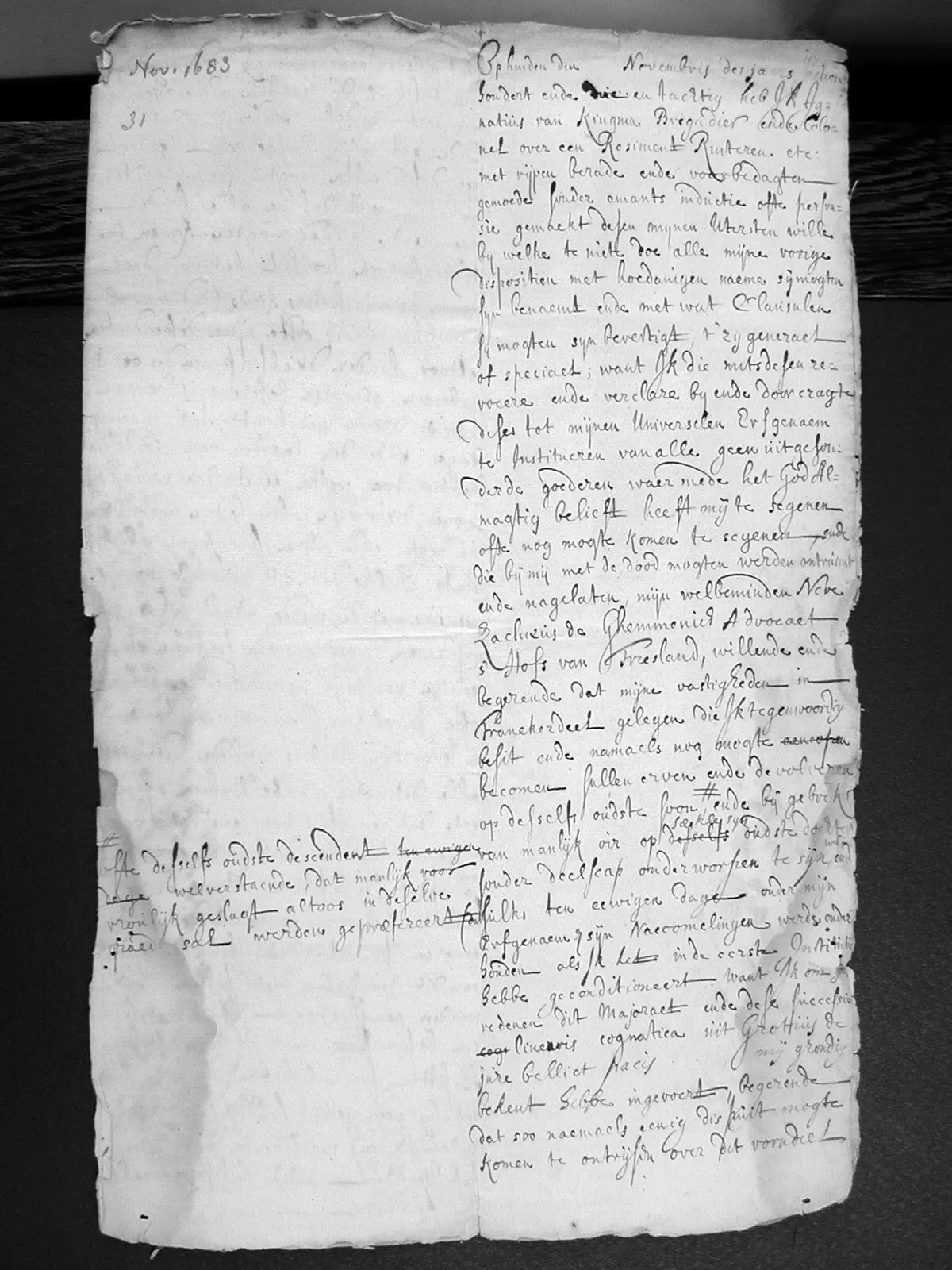
In this Kinkhoorn I return to the oldest known will of Ignatius, that of 1683. It is not complete; there are only three pages. Where the rest has gone, and whether there ever was more, remains unclear. This gives rise to speculation. But the three pages nonetheless contain a few noteworthy details. I will mention here only the appearance of the child Jacob van Ghemmenich as heir under certain circumstances. And Ignatius's reference to a work by Hugo de Groot (Grotius), which he, being a high-ranking military officer, obviously knew, but which seems irrelevant in connection with a will.
While putting together the previous Kinkhoorn, a gap arose due to the unexpected falling-through of copy. To fill it, I then started earlier than planned on my plan for a series of articles about Zweins and Kingma State in old maps. The resulting haste meant that the account of the State's appearance in the Atlas Maior could not be made complete. That is why I return to it in this Kinkhoorn.
In connection with the series of articles on old maps and Kingma State, I have started a database in which I collect all the maps on which Zweins or Kingma State appear, so that I get a good overview. In doing so, I am also including the still-puzzling mention of "Kingma" on the Wadden Sea coast.
Meanwhile, work is underway on a descendant list (parenteel) of the four oldest known generations of Kingmas. In it, starting from Jelle Kingum, all sons, daughters, grandsons, granddaughters, and so on are listed. So the female line is followed here as well.
Whether I will manage to publish some of it already in this Kinkhoorn, I do not yet know at the moment of writing this.
Kees Kingma
Chairman
The name Kingma: a response
On page 15 of Kinkhoorn no. 15 the name Kingma is explained. Herman van Slooten had already offered an explanation of his own at an earlier point. He wrote about it in the commemorative book for the 100th anniversary of Kingma's Bank in 1969: "Kingma, member of the family". In the introduction he gives an account of the origin of the name Kingma/Kinghum. In that connection he mentions the name Kinge, a Frisian first name and pet form of Rinse, which is in turn related to "regin", counsel, and is a one-stem shortening of it, according to H.v.S. It could still be the case, however, that the choice of the conch shell as a heraldic device is itself connected to the name Kingma/Kingum, which would be older than the coat of arms. I myself have sometimes thought that the shape of the terp Kingum could also have been an explanation, for instance a terp with a somewhat terraced, layered profile. Incidentally, the horn also appears in the coat of arms of Het Bildt, but there with ears of corn sticking out of it, the horn of plenty (www.jabikspaad.nl). A more exotic explanation, or perhaps a rich fantasy, is to draw a connection with the stronghold of Kinheim in Kennemerland, the place where Radboud is said to have had his seat. Radboud was a Frisian king around the beginning of the eighth century. Under his rule Friesland reached its greatest extent, stretching from the Zwin in Zeeland to the Weser.
Also addressed in Kinkhoorn 15 is the registration of the Kingma Makkum family line in Nederland's Patriciaat (N.P.), also known as the blue booklet. Back in the late 1980s the family had already been admitted upon request, but it was never actually published. Despite our excellent documentation, it is an incredible amount of work, already published earlier by H. van Slooten in the Jierboekje fan het Genealogysk Wurkforban in 1952, further in the genealogy published by the Kingma Stichting in 1983 with Uitgeverij Hollandia, and in our 1989 archive inventory by Mr. D.P. de Vries. N.P., incidentally, is far from including everything you submit and consider important yourself. For instance, the entire branch of Gerben Jans, younger brother of Hylke Jans and mayor of Workum, was left out, presumably because it died out apart from one German branch known to us, now living in Berlin. All sorts of not particularly distinguishing, but actually rather nice, occupations are omitted. The emphasis lies on positions in public administration. Incidentally, according to the editorial rule of N.P., only descent in the male line is followed. Looking back from Hylke Jans, we then do not end up in Zweins but in Gaast, a village near Makkum, where — compared with the seventeenth-century Kingmas on the maternal side — the somewhat less distinguished ancestors of Hylke Jans, also skippers, come from in the male line. That is thus different from the peerage book, the red booklet, where the family name and title are followed, even when these — at least in the distant past — were continued through the female line. But such families then usually still owned the estate that bore the name, and that makes the difference. Perhaps this is also a reason for Hylke Jans and his kin to call into question the possession — lost even before their time — of Kingma State, which by then was already Beijma property.
J. Herre Kingma, chairman of the Vereniging Familie Kingma in Makkum
Zweins and Kingma State on old maps (2): the Atlas Maior

In the previous issue of De Kinkhoorn I began, rather hastily, a series of articles on the appearance of Zweins and Kingma State on old maps. I am therefore supplementing the first article now, after further study. To begin with, I want to return to the statement that the “Atlas Maior” was published (only) in Latin. In fact the atlas was also published in French in 12 volumes, in Dutch in 9 volumes, in Spanish in 10 volumes, and in German in 9 volumes. The Latin edition of the atlas consisted of 11 volumes. The atlas was divided into parts, and these in turn into books. But this division has nothing to do with the division into volumes, which relates purely to size. The copy in Tresoar has eleven volumes and must therefore be the Latin edition. Not surprising for a gift to a university where Latin was then an important and widely used international language. The atlas was donated in January 1711 by Stadtholder Johan Willem Friso, who studied there in 1700 and 1701 as the stadtholder-to-be. A special cabinet was made for it, see the accompanying photo. In some images of this cabinet, a 12th volume can still be seen on the top shelf. That is the celestial atlas of Andreas Cellarius (published by J. Janssonius, Amsterdam 1661), which also belonged to the gift. Sadly, Johan Willem Friso drowned in the Hollands Diep in the year of the donation, to the grief of the academic senate. This last fact is also recorded on the upper section of the atlas cabinet, along with the title of the atlas, the name of the donor, and his coat of arms. His widow, Maria Louise van Hessen-Kassel (Marijke Meu), then took over the leadership for 20 years.
The price of such an atlas, hand-coloured, was ƒ430 for the Latin edition. An uncoloured version was ƒ100 cheaper. That made the atlas the most expensive book of the 17th century. A present-day equivalent would come to €20,000. Its market value is inestimable.
The map of Friesland in Joan Blaeu's “Atlas Maior” is labelled “Frisia occidentalis” (Western Friesland). The map was, however, not made by Joan Blaeu but originates from his father Willem Jansz, who called himself Blaeuw after 1621 and Blaeu from 1635 onward. He is said to have bought the copper printing plate of the engraving from Jodocus Hondius in 1630; Hondius had made it in 1629 for the Mercator-Hondius atlas, but it had been used to issue separate engravings.1 Willem replaced the name Hondius with his own — a common practice at the time. In the cartouche (a decorated frame around a text) at the bottom left of the map, the caption reads Amstelodami Guiljem. Blaeuw excudit (published in Amsterdam by Willem Blaeuw). The cartouche also gives the names Adriano Metio et Gerardo Freitag, and below that, Auctoribus (Authors). These men provided a short text in Dutch, French and English concerning the inhabitants of the land or region shown on the map.
These texts read as follows:
‘Heel Vrieslandt, soo wel ’t gene wy nu beschreven hebben, als oock Groeninger-landt, is seer volckrijck, en de inwoonders sijn van oude tijden wonderlijck strijdbaer, straf, en altijdt dappere voorstanders van hare vryheyt geweest. Begeven haer nu ter tijdt veel tot den koophandel en zeevaert, waer toe sy een groote menighte schepen uytreeden; sijn behalven dien groote visschers, daer sy mede veel geldts verdienen. Dit volck heeft een geweldigen afkeer en grouwel van overspel en allerhande onkuysheydt.
“All Frisians use the same language. Though this clearly draws heavily on German, it is nonetheless sufficiently dissimilar from the language of their neighbors that it must be judged a language in its own right – for it cannot be understood by non-natives. However, it has such affinity with English that no other language is as close. This is powerful proof that the Frisians originally came from England. Their names also differ entirely from those of other nations, so that they can tell from a person’s name whether he is a native or a naturalized Frisian.”
The French text is identical in content to the English text, or vice versa.
The scale of the map is not indicated by a ratio of map to terrain, e.g. 1:100,000. That does not work, because in those days maps used thumbs as the unit of length, while distances on the ground were given in miles, and the two have no relation to one another. Many different miles existed, but the one most commonly used was the German mile, which at a length of 7.4 km was the same size as the Dutch mile. A scale bar was used to indicate how great a distance of one or more miles was on the map. Sometimes two scale bars were used, as on the map of Friesland, with German miles of 7.4 km and French miles of 5.5 km.
The orientation of the map did not always have north at the top. For economical use of the paper, the image was often rotated, to the left or right, sometimes by as much as 90 degrees. A compass rose then indicates where north lies, as on the map of Friesland. Waterways are mostly shown on this map, but few roads. The lakes appear rather small.
Zweins, written here as “Sueins”, is marked with the image of a small church. Kingma State and Herama State are marked with the image of a 'noble house'. The road from Franeker to Leeuwarden crosses the tow canal at Kingma State. The towpath along the tow canal is shown as well.

1 P.J. de Rijke, “Hoogetepunten van de Friese cartografie”.
Genealogy of the Kingmas up to c. 1700 (1)
In the genealogy set out below, the various generations are indicated with Roman numerals. The data are drawn from various sources: genealogies by Ruud de Bruijn, Taede Kingma and D.D. Ozinga. Comments and additions are welcome, to build as complete a picture as possible of the early Kingmas (tj.kingma@planet.nl).
I.1 Jelle KINGUM, freeholder, born circa 1450 in Zweins, died 1514-1538, on the Kingma Sate in Zweins. In 1413 the sate is already referred to as Kinghum. Married to N.N. Died before 1538; recorded as spouses on the Kingma sate in 1511 and 1514. From this marriage:
| 1. | Pieter Jelles KINGUM (see II.1). |
| 2. | Pybe JELLESZ (see II.3). |
| 3. | Jelle JELLESZ, died before 1555. Married to Houck AERNCKDR, possibly recorded as spouses in 1546; they have no descendants. |
| 4. | Jelle Kinghemsdr KINGGEMA, born in Sweins. Jelle Kinghemsdr is the owner of land under Dongum in 1514 #reg.nr.476#, which was land of her father, Jelle Kinggema. Married to Crispiaen? |
II.1 Pieter Jelles KINGUM, born ±1480 in Zweins, on the Kingma-Sate, died circa 1556 in Zweins. Freeholder on the Kingma sate, authorized deputy for Franekeradeel (1552). In 1511 and 1514 he was not yet the owner but a tenant of about 80 p.m. (short for *pondemaat*, an old Frisian unit of land area) of land, for a total of 40 florins and a few stuivers (currencies in use before the euro), son of Jelle KINGUM (see I.1) and N.N. Married circa 1510 to Nel JANSDR, recorded as spouses in 1551. From this marriage:
| 1. | Jelle Pieters KINGUM (see III.1). |
| 2. | Ynte Pietersz KINGUM (see III.4). |
| 3. | Claes Pietersz KINGUM (see III.6). |
| 4. | Hendrick Pietersz KINGUM (see III.8). |
N.B. In 1588 a certain Tyal Pieters Kingma is named as the mother of the children of Wybe Tyaerds; it is not clear where she fits into the genealogy.
II.3 Pybe JELLESZ, born 1480, died 1538, son of Jelle KINGUM (see I.1) and N.N. Married to Yesck? Died 1538; recorded as spouses in 1538. From this marriage:
| 1. | Jan PYBESZ, died after 1555 |
| 2. | IJsbrant PYBESZ, died after 1555 |
| 3. | Jelle PYBESZ, died after 1561 |
| 4. | Saecke PYBESDR, died before 1561. |
III.1 Jelle Pieters KINGUM, born circa 1530 in Zweins, died 1603-1605, buried in Dronrijp, freeholder in Zweins on the Kingma sate, holds land in Schalsum (1572) and Dronrijp (1600), son of Pieter Jelles KINGUM (see II.1) and Nel JANSDR. Married (1) on 16-03-1551 in Oosterlittens to Hylck Gerritdr FOGELSANGH, born circa 1535, died 20-06-1570 in Zweins, buried in Dronrijp, daughter of Gerrits Dyercks FOGELSANGH, husbandman at Oosterwyerum on Hoochhijem, and Tyaemck Syeckes ATSMA. Married (2) to Yda MEYNTESDR, died before 1597. From the first marriage:
| 1. | Pieter Jelles KINGMA (see IV.1). |
| 2. | Inte Jellesz KINGMA (see IV.3). |
| 3. | Dirck Jellesz KINGMA (see IV.5). |
| 4. | Hendrick Jellesz KINGMA (see IV.7). |
| 5. | Jetske Jellesdr KINGMA (see IV.10). |
III.4 Ynte Pietersz KINGUM, died 1555 in Dronrijp, lived at "op te Fennen" near Dronrijp (1543), son of Pieter Jelles KINGUM (see II.1) and Nel JANSDR. Married to Tryn SANDSTRA KINGEMA. (Also referred to as Sjouw CLAESDR.) From this marriage:
1. |
Siuw Yntesdr KINGMA, born 1548 in Dronrijp, died 04-01-1606 in Dronrijp. Married to Folkert Gerrijtsz FOGELSANGH, born 1540 in Oosterwierum, died 14-08-1582 in Dronrijp, son of Gerrits Dyercks FOGELSANGH, husbandman at Oosterwyerum on Hoochhijem, and Tyaemck Syeckes ATSMA. |
|||
| 2. | Gerrolt YNTESZ (see IV.13). |
|||
| 3. | Hendrick YNTESZ, married to Rinck EPES TOLSUM; they sell two and a half *pondenmate* in Tolsum-sate in 1593. |
|||
| 4. | Sybolt YNTESZ (see IV.14) |
|||
III.6 Claes Pietersz KINGUM, died before 1592 in Dronrijp, son of Pieter Jelles KINGUM (see II.1) and Nel JANSDR. Married to Taedts RUYRDTSDR, died 1571; recorded as spouses in Dronrijp in 1564 and 1571, lived on the Poppinga-sate in Dronrijp. From this marriage:
| 1. | Ruyrdt Claesz KINGMA (see IV.16). |
| 2. | Inte Claesz KINGMA (see IV.17). |
| 3. | Jelle Claesz KINGMA. (see IV.18) |
| 4. | Anna Claesz KINGMA. Married to Foppe PHILIPPUSZ. |
| 5. | Trijn Claesdr KINGMA. Married to Elingh PIERSZ. |
III.8 Hendrick Pietersz KINGUM, son of Pieter Jelles KINGUM (see II.1) and Nel JANSDR. Married to Jouck DOUWES
From this marriage:
| 1. | Mary HENDRICKSDR, recorded as spouses in Marssum, 1590. Married to Hoijte HERESZ; recorded as spouses in Marssum, 1590. |
| 2. | Trijn HENDRICKSDR. Married to Eecke JURIANS; recorded as spouses in 1592. |
| 3. | Pietrick HENDRICKSDR. Married to Thomas JANSZ; recorded as spouses in 1592. |
| 4. | Nel Hendricksdr KINGMA. Married to Egbert HAYESZ; recorded as spouses in 1592. |
IV.1 Pieter Jelles KINGMA, freeholder on the Kingma sate, member of the *Gedeputeerde Staten* (the Provincial Executive Council of Friesland) (1601, 1604), born circa 1552 in Zweins, died circa 1610 on Kingma State in Zweins, #Source: "Heringa's uit Djongjum" by JW Heringa, p. 70, and GA Friesland no. 0046, procuratieboek 22.9.1600#, son of Jelle Pieters KINGUM (see III.1) and Hylck Gerritdr FOGELSANGH. Married circa 1587 to Aelcke HERE JELDERTSDR, born circa 1562, died before 1611 in Zweins. From this marriage:
| 1. | Elske KINGMA, born circa 1588, #widow in 1635#. Married 11-1611 to Ebele JARICHSZ, farmer in Raard, Hallum, Holwerd and Genum, born 14-06-1588 in Nes |
| 2. | Hero Pietersz KINGMA (see V.3). |
| 3. | Neltie Pietersdr KINGMA (see V.7). |
| 4. | Johannes Pietersz KINGMA (see V.8). |
| 5. | Gadtske Pietersdr KINGMA, died 06-1653. Married 1631-1636 to Johannes VOMELIUS, minister in Firdgum (1627-1628) and in Minnertsga (1628-1653), died 12-1653. |
| 6. | Hylck Pietersdr KINGMA, born in Zweins, died after 1636 (widow in Bolsward, 1636). Married circa 1610 to Pieter Ryurdtsz BANTERT; the couple were innkeepers in St Annaparochie and Bolsward (at 'de Doele') in 1625 and 1627. |
IV.3 Inte Jellesz KINGMA, born 1556 in Zweins, died 18-08-1590 in Schalsum, son of Jelle Pieters KINGUM (see III.1) and Hylck Gerritdr FOGELSANGH. In 1588 a farmer in Schalsum on the Hinxterterpstra-sate. Married to Trijntie Saeckles SANSTRA, born 1562, died 06-05-1623 in Zweins, daughter of Saekle and N.N. From this marriage:
| 1. | Saeckle Intesz (see V.14). |
| 2. | Jan Intesz (see V.16). |
IV.5 Dirck Jellesz KINGMA, died before 1618, son of Jelle Pieters KINGUM (see III.1) and Hylck Gerritdr FOGELSANGH. Married to Fedtke Pybesdr WYARDA, died after 1618 (recorded as a widow in Rauwerd, 1613). He was a farmer on the Zyaerda-State at Lombersbuyren, near Dronrijp, churchwarden in Dronrijp (1597) and Weidum (1602, 1606). From this marriage:
| 1. | Jelle Dircksz, innocent, died after 1635. |
| 2. | Trijntje Dircksdr (see V.20). |
| 3. | Hylck Dircksz. Banns published on 18-05-1618 in Rauwerderhem with Bocke AGGESZ. |
| 4. | Gerrit Dircksz (see V.23). |
| 5. | Dirckien Dircksdr, died between 1635 and 1639. |
| 6. | Inte Dircks. |
IV.7 Hendrick Jellesz KINGMA, died after 1626, son of Jelle Pieters KINGUM (see III.1) and Hylck Gerritdr FOGELSANGH. Married to N.N. RIENKSDR, citizen of Franeker (22.11.1603), makes her will on 24.11.1625, in Peins 1611/1624, still living in 1626. From this marriage:
| 1. | Rienck Hendricksz, died 1635, law student in Franeker 1631, Leiden 1634. |
IV.10 Jetske Jellesdr KINGMA, died ±1617 in Wommels, daughter of Jelle Pieters KINGUM (see III.1) and Hylck Gerritdr FOGELSANGH. Married to Broer GOSSESZ, farmer in Wommels, 1605, died 1635 in Wommels; recorded as spouses in Wommels. From this marriage:
| 1. | Inte Broersz KINGMA (see V.28). |
| 2. | Ulbe Broersz SIPPENS (see V.30). |
| 3. | Nelcke BROERSDR, born in Wommels, died 1666. Married to Frans SAECKESZ. |
IV.13 Gerrolt YNTESZ, *drost* (a regional administrative official, roughly a bailiff or governor) and secretary of Ameland (1591), son of Ynte Pietersz KINGUM (see III.4) and Tryn SANDSTRA KINGEMA. (?) Married to Tyam Ruyrdtdr ATSMA, daughter of Ruyrdt Sickesz ATSMA and Meyns Sytsedr ADAMA; recorded as spouses in 1583 and 1591. From this marriage:
| 1. | Into Gerroltsz KINGMA, law student in Franeker, 15.6.1587, *drost* and secretary of Ameland, died 22-08-1595, buried in Oosterwierum. |
| 2. | Sixtus Gerrolsz KINGMA, died after 1588. |
IV.14 Sybolt YNTESZ, son of Ynte Pietersz KINGHUM (see III.4) and Tryn SANDSTRA KINGEMA. (?) Married to N.N.
From this marriage:
- Inte Sybolts KINGMA, worker on the country's fortification works and land user,
died between 1639 and 1640 in Oosterlittens.
IV.16 Ryurdt Claesz KINGMA, residing in Oosterwierum, son of Claes Pietersz KINGUM (see III.6) and Teadts RUYRDTSDR., died between 1612 and 1614 in Franeker.
Married to Kinsck HOYTEDR. A married couple in Minnertsga, 1590; he is mentioned in Oosterwierum in 1608.
From this marriage:
- Sybren Ruyrdts KINGMA
- Peter Ruyrdts Kingma
IV.17 Inte Claesz KINGMA, died 15-12-1603 in Achlum, assistant judge of Franekeradeel in Achlum, freeholder at "Stickenberster-sate", son of Claes Pietersz KINGUM (see III.6) and Taedts RUYRDTSDR. Married (1) 1597 to Syucke Rijverdtsdr BANTS. Married (2) to Ulb Gerlofsdr RISPENS. From the second marriage:
| 1. | Pyter Intesz KINGMA (see V.36). |
| 2. | Dye Intesz KINGMA, born 1582 in Achlum. Married on 28-02-1608 in Leeuwarden to Saeck DIRKSDR, born in Oosterwierum; a married couple in Jouwerd, 1618. |
| 3. | Claes Intesz KINGMA (see V.40). |
| 4. | Gerleff Intesz KINGMA, born 1587 in Achlum, died 1608. |
| 5. | Sybren Intesz KINGMA, born 1590 in Achlum. |
| 6. | Ruyrdt Intesz KINGMA (see V.44). |
| 7. | Wlbe Intesz KINGMA, born in Achlum; farmer in Dongjum 1640, Arum 1655. Married to N.N. Taeckledr GRADA. |
| 8. | Antie Intesdr KINGMA, born in Achlum. Married to Idske Minnesz HILLEMA, beer merchant in Leeuwarden, citizen there in 1635; a married couple in Leeuwarden, 1636, 1637. |
IV.18 Jelle Claesz KINGMA, died 6 April 1612 in Oosterend, son of Claes Pietersz KINGUM (see III.6) and Teadts RUYRDTSDR. In 1605 in Oosterend on Jellema-sate.
Married (1) to Tryn TAECKES, daughter of Taecke ATSES.
Married (2) after 1605 to Hack JENCKES
From the first marriage:
- Taedts Jelles KINGMA, born around 1593. She was married to Douwe ANDRIES, merchant, residing in Dongjum.
- Jisck Jelles KINGMA, born around 1596.
(Layout note: spread across 2 pages in the centre of the issue!)
The Will of Ignatius van Kingma from 1683
This 1683 will is a precursor to the earlier-discussed major will of 1696 and the supplementary will of 1698. It begins with the date on which the will was made: .. Novembris des jaers sestien hondert ende drie en tachtig. Here the day itself is not filled in, but space has been left for it.
Ignattius then declares that he, Brigadier ende Colonel over een Regiment Ruiteren etcetera met rijpen berade ende voorbedagten gemoede sonder iemants inductie 1 ofte perfuasie 2 gemaekt desen mijne utersten wille bij welke te niete doe alle mijne vorige dispositien met hoedanigen naeme sij mogten sijn benaemt ende met wat clausulen 3 sij mogten sijn bevestigt, het zij generael of speciael. This could mean that there had been an earlier will or codicil. But it may also have been a standard formulation to rule out all unforeseen possibilities.
It then continues as follows: want ik die mitsdesen revocere 4 ende verclare bij ende door cragte deses tot mijn Universelen Erfgenaem te institueren 5 van alle geen uitgesonderde goederen waermede het God Almagtig belieft heeft mij te segenen oft nog mogte komen te segenen ende die bij mij met de dood mogten werden ontruimt ende nagelaten, mijn welbeminden Neve Zacheus de Ghemmenich Advocaat des Hofs van Friesland, willende ende begerende dat mijn vastigheden 6 in Franekerdeel gelegen die ik tegenwoordig besit ende namaels nog mogte becomen sullen erven ende devolveren 7 op desselfs oudste soon ...... enz.
The ongoing line of succession is then arranged for every conceivable situation. In doing so, in case of disputes, he refers as follows to a work by Hugo de Groot: Want ik om geredenen dit majorraet 8 ende dese successio linearis cognatica 9 uit Grotius de jure belli et pacis 10 mij grondig bekent hebbe ingevoert begerende dat soo naemaels eenig dispuit mogte komen te ontrijsen over dit vorndeel 11 dat alsdan daar na mag worden geregt want ook al de gevallen aldaer gementioneert in desen houde voor geinsereert 12.
Ignatius further stipulates that if his heir leaves no successor at all, het vorndeel sal komen op mijn susters kindskind Jacob van Ghemmenich ofte sijne descendenten.
This Jacob is a son of Paulus van Ghemmenich, the brother of Zacheus. This grandson Jacob died unmarried.
Then follow several provisions for the protection and preservation of the inheritance. But the possessor may indeed support himself from it honestly and in a dignified manner, though he may not burden the inheritance with debts.
The heir is further instructed that within three months of learning of Ignatius's death, desen (het testament) in het fideicommissaire registratieboek des Hofs van Friesland met een pertinent inventaris van de bewaerde vastigheden doe aentekenen, maer ook het selve in het hyptheecqboek 13 van Frankerdeel met het gedagte inventaris document registreren.
Then follows the further instruction to de besitters des vorndeels om elke twintig jaar de inventarisopgave ten overstaan van de Commissaris van het Gerecht van Franekerdeel met de namen der alsdan tegenwoordige bruikers ende naestlegers 14 der beswaerde vastigheden te vernieuwen.
To Jacob van Ghemmenich a sum of tienduizend caroligulden van twintig stuivers het stuk is then bequeathed, van welke penningen mijn erfgenaem de administratie zal behouden tot het kind zal getrout zijn of de volle ouderdom van vijf ende twintig jaeren hebben bereikt, ondertussen jaerlijks tot profijte van het kind uitkerende drie ten hondert 15 welke penningen tot het kinds profijt ook sullen oplopen sonder dat deselfs vader daer af iets sal mogen genieten ofte profiteren.
Finally comes: Ende sal het mede in mijn erfgenaems willekeur zijn,
Here the will breaks off abruptly. The question now is: was the will never finished, or has the continuation been lost?
Further inquiry with Tresoar about the latter possibility yielded nothing. In favor of it is that the will breaks off at a comma in a sentence almost at the bottom of a page. That it went missing at some point over the past three centuries remains a real possibility.
There is, however, also something to be said for the first possibility. It could be an unfinished draft. This is supported by the fact that space was left for the day in the date on the first line, but it was never filled in. The sheets of paper are folded lengthwise and written on the right-hand half. The left-hand half was used several times to note insertions into the text.
What further stands out is that in this will Ignatius calls himself Brigadier and Colonel, whereas in the later wills he is referred to as Old Brigadier. In 1683, at age 62, he was apparently still in active service (it is known that his regiment was disbanded in 1688). That he was unexpectedly called up while drafting this will, only picking up the thread again much later, is a real possibility.
We will probably never know how it really was.
1 inductie, aanrading invoering, invoeging, indrang, ( P racticyns W oordenboekje).
2 perfuasie, vroedmaken, aanrading, overreeding, (P.W.).
3 clausulen, slot, besluit, grondreedenen, byvoegsel, (P.W.).
4 revoseren, wederroepen, herroepen, (P.W.).
5 institueeren, inzetten, onderwyzen, instellen, (P.W.).
6 vastigheid, onroerend goed,(S.J. F ockema A ndreae: w oordenlijst bestuurs- en rechtstermen).
7 devolveeren, afkoomen, afwentelen, afrollen, (P.W.).
8 majoraet, onverdeeld familiegoed dat op het oudste familielid moet overgaan, (van Dale).
9 successio linearis cognatica, cognatus means blood relative; apparently what is meant here is: succession according to blood relationship in the direct line.
10 de jure belli ac pacis, "On the Law of War and Peace," the famous book that Hugo de Groot wrote in 1625 while living in exile in Paris after his escape from Loevestein Castle. Although this work is about the law of nations, it possibly also contained a few things about inheritance law and succession.
11 vorndeel, voordeel (voordeelsgoederen), inzonderheid fideicommis, (F.A.w.).
12 insereeren, inzetten, invoegen, inlyven, tusschenvoegen, (P.W.).
13 hypotheecqboek, these books served as public registers in which anyone could have a search made into the debts ("registrations") of someone else, (from: Friezen gezocht, p. 119).
14 naestlegers, neighbors on the adjoining parcels. In this way the location of a parcel was determined in the absence of a land registry.
15 drie ten hondert, this will be three percent of the tienduizend caroligulden.
Announcement of a book about Birdaard
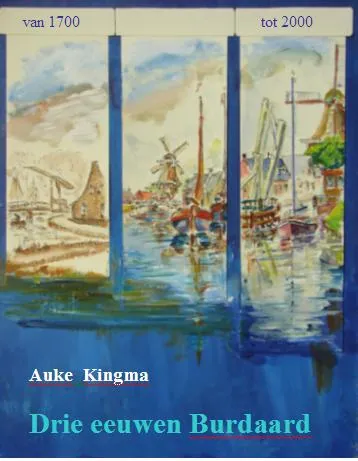
"Three Centuries of Burdaard" will be published at the end of 2007, the result of more than 10 years of research. The book was written by Auke Kingma, the cover was made by Joop Bouma. This book is partly a book for reading and partly a reference work. The origin and development of the village is described from ca. 1700 to 2000. All homeowners and principal residents over that period are included. The book will run to about 500 pages, describing 3455 people, with an index.
The price of the book depends on the number of subscriptions. With the help of sponsors, the price is expected to come to no more than 25.00 euros, excluding any shipping costs. Many people outside Burdaard may also be interested in their birth house or the history of the village and its inhabitants. Since it contains many Kingmas, with an overview of the different "kinds", it would be interesting for a number of Kingmas to subscribe. Orders can be placed at http://www.aldburdaard.nl/hetboek.htm.
Iebeltje Kingma: When She Spoke, She Did So in Rhyme
Some Kingmas are truly quite 'remarkeable'.
Under the title 'Paradijsvogels of zorgmijders?' [Birds of Paradise or Care Avoiders?], the following story appeared in Medisch Contact (no. 43, 28 October 2005, NieuwsReflex column, page 1701).
At the time we came across it in the Kingma Kroniek of the Vereniging familie Kingma, and did not want to withhold it from you.
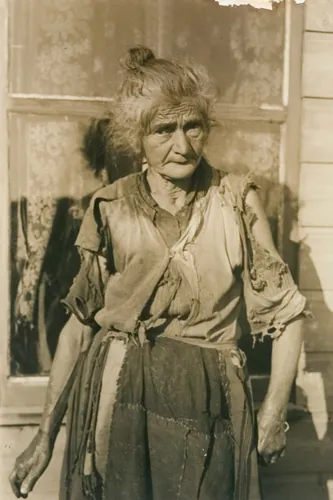
In 2005, visitors to the Het Dolhuys museum in Haarlem could learn, through photo reportages in the illustrated press, how the general public in the years 1925–1970 viewed eccentric recluses. One of them was Iebeltje Kingma from Bovenknijpe (Friesland), seen here in a photo from 1925. Together with her four white cats she lived in a small shed next to her old houseboat, which lay beached and was crammed full of junk and clothes. She ate from a pot of rice that she cooked once every few weeks and dressed herself in rags, even though she had plenty of clothes. And, remarkably: whenever she spoke, she did so in rhyme. Image: SFA
Kingma Kronkels: Birdsong

Joost Kingma
This spring I visited Fogelsangh State for the first time. A beautifully restored country estate, which immediately gave me the feeling that we should simply take it as an example for the rebuilding of our own castle. Especially that raised ground floor (bel-étage) with the basement gives the house a pride all its own, through its elevated position. And that light yellow colour, of course — gorgeous. With a vintage car parked outside that seemed to have been gleaming there for a century already.
I had just taken my photos when the happy bridal couple to whom the car belonged came out of the garden to get back into their vehicle. Later I spoke with the architect, Broor Adema, who had derived a great deal of pleasure from the restoration.
Now, we Kingmas had something of a connection with those Fogelsanghs. As we can read in the Kingma genealogy, Jelle Pieters Kingum, born around 1530 in Zweins and died sometime between 1603 and 1605, freeholder in Zweins at the Kingma sate (a Frisian farmstead held in freehold, with no fully corresponding English term), married Hylck Gerritdr Fogelsangh on 16 March 1551 in Oosterlittens. Together they had 4 sons and a daughter.
In early September the province of Friesland organised an information afternoon for municipal administrators, policymakers and initiators about new country estates that the regional plan allows as special forms of rural living. We too, of course, listened in with curiosity to see whether we might perhaps be in the running as well. I can assure you: it doesn't look bad at all. We have enough land, we don't want too many houses, and we are creating new greenery and grandeur in the countryside. Hope springs eternal, then. To my great joy, the province has now put Fogelsangh State, in all its glory, on the front of the brochure. Nothing can go wrong now between that state (a Frisian manor with land), us, and the province. By the way, it was a very interesting afternoon, with 'open space' discussions and many different views. We, too, of course made ourselves heard. After all, every little bird sings as it is beaked.
Colophon
'De Kinkhoorn' is a periodical published by the Stichting Kingma State.
The periodical is sent to donors of the foundation.
You can become a donor by transferring at least 15 euros annually to account number 55.00.97.538 at ABN AMRO bank in Arnhem, in the name of the Treasurer of Stichting Kingma State.
Print run: 150 copies.
Published at least twice a year.
Stichting Kingma State
Secretariat:
Sterrenboslaan 20, 3972 GD Driebergen
tel: 0343 521212
fax: 0343 517689
e-mail: info@joostkingma.nl
website: www.kingmastate.nl
Board
Chairman: C.S.J. Kingma, Emmen
Secretary: J.H. Kingma, Driebergen
Treasurer: J.M. Kingma, Arnhem
Board member: Tj. Kingma, Zwolle
Design and production
Drukkerij Bakker Baarn
This publication is registered with the Koninklijke Bibliotheek under ISSN: 1569-8645
When reproducing the content of articles from De Kinkhoorn, in whole or in part, please credit the source.